Catholic devotions for 14th August
Scroll down for today's
Saint of the Day/ Feast
Reading of the Martyrology
Dedication of the Month
Dedication of the Day
Rosary
Five Wounds Rosary in Latin
Seven Sorrows Rosary in English
Latin Monastic Office
Reading of the Rule of Saint Benedict
Celebration of Mass
Reading from the School of Jesus Crucified

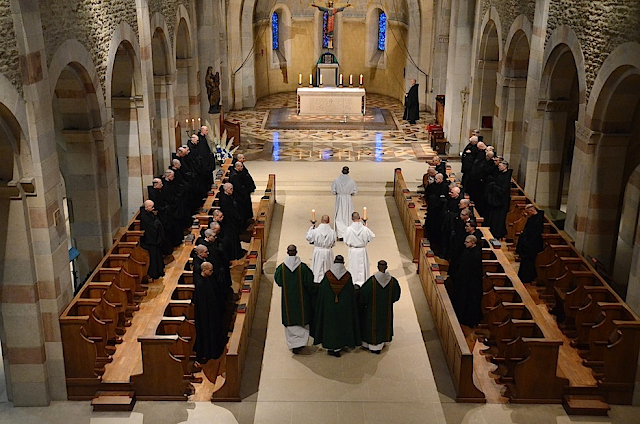
Feast of Blessed Eberhard, First Abbot of Einsiedln (immediately over the hermitage which gives the Abbey the name. On the right St Benedict.
From their website
Over the course of its almost 1,100-year history, our monastery has repeatedly produced saints: from the first three abbots, who lived and worked in the 10th century, to Brother Meinrad Eugster (1848-1925), whose beatification process is currently underway. A 17th-century painting depicts the family tree of the holy monks of Einsiedeln, who are celebrated together every year on August 3rd on the "Feast of All Holy Monks of Einsiedeln." The well-known and unknown saints of our monastery are presented under the heading "Einsiedeln Saints" on the day of their passing, and are intended to motivate us to follow our own path in following Jesus.
On the eve of the Assumption of Mary, we at Einsiedeln Monastery remember one of the most significant figures for us. After Saint Meinrad (+861, feast day on January 21st) and Blessed Bishop Benno (+940, memorial day on August 3rd), Blessed Eberhard is the third saint to whom the monastery, village, and district of Einsiedeln owe their existence. Blessed Eberhard was the first abbot of the Benedictine monastery at the site of Meinrad's cell, and he brought the first "secular" inhabitants from Alsace to the Einsiedeln high valley to assist the monks in reclaiming the densely wooded area. Abbot Eberhard is considered and venerated as the true founder of our monastery.
Eberhard was born around 890 and probably came from Swabian nobility. He served as provost (head of the cathedral chapter) at Strasbourg Cathedral, where Blessed Benno also served as a canon before his retreat into the "Dark Forest" in 906. After Benno's blinding and his resulting forced resignation as Bishop of Metz, Eberhard accompanied his blinded relative to Meinrad's Cell in 924, where they expanded the existing hermit settlement into a Benedictine monastery, and where Eberhard became the first abbey leader. For this reason, the year 934 is considered the founding date of the Benedictine Abbey of Our Lady in Einsiedeln.
During Eberhard's tenure, important foundations were laid that continue to have an impact today: Bishop Ulrich of Augsburg brought a relic of Saint Maurice here in 940. In 947, the monastery's land holdings were confirmed by King Otto I and expanded with donations; the monastery was granted free election of abbots and imperial immediacy. In 948, the first monastery church was completed and consecrated to the Mother of God, Mary and Maurice, by Bishop Conrad of Constance (the present Baroque monastery church also has these patron saints). Bishop Conrad also brought a significant particle of the Holy Cross from Jerusalem. Furthermore, the "Angel Consecration Legend" is also associated with the tenure of Blessed Abbot Eberhard, according to which Jesus Christ himself, accompanied by angels and saints, consecrated the chapel in honor of his mother, Mary, on the night of September 14, 948.
Eberhard died on August 14, 958 and was buried in the Holy Chapel. He was soon venerated as a saint at Einsiedeln Abbey. The high esteem in which Eberhard was held is demonstrated by the fact that King Otto I, in a document from 961, referred to the monastery as "Eberhardszell" instead of "Meinradszell." Eberhard's remains were exhumed in 1465, but have been lost since the French invasion of 1798.
Abbot Eberhard was a man who could let go of the old and begin and consolidate the new. He was someone who didn't do things by halves, but rather did everything "with all his heart, with all his soul, and with all his strength" (cf. Deuteronomy 6:5 and Luke 10:27; incidentally, also the motto of the Einsiedeln Abbey School!). To achieve his goals, he utilized his extensive relationships with the nobility and the higher clergy. But he was more than just a skilled networker! He was a courageous visionary, a spiritual father to his monks, a champion of true renewal in the Church, and a man who led by his own good example.
Blessed Eberhard encourages us to live our dreams, to share them with others through our own efforts, and with God's help, to make this world a habitable place.
Blessed Eberhard, pray for us!
The Reading from the Martyrology
The blood of Christians is the seed of the Church
Tertullian, Apologeticum, 50
This Day, the Fourteenth Day of August
The vigil of the Assumption of the Blessed Virgin Mary.
At Rome, the birthday of the blessed priest Eusebius, who for the defense of the Catholic faith was shut up in a room of his own house by the Arian emperor Constantius, where constantly persevering in prayer for seven months, he rested in peace. His body was removed by the priests Gregory and Orosius, and buried in the cemetery of Callistus, on the Appian road.
In Dalmatia, St. Ursicius, a martyr, who was beheaded for Christ, after suffering various torments, under the emperor Maximian, and the governor Aristides.
In Africa, St. Demetrius, martyr.
At Apamea, in Syria, St. Marcellus, bishop and martyr, who was killed by the exasperated Gentiles, for having pulled down a temple of Jupiter.
At Todi, St. Callistus, bishop and martyr.
In the island of Aegina, St. Athanasia, widow, celebrated for monastical observance, and the gift of miracles.
And elsewhere in divers places, many other holy martyrs, confessors, and holy virgins.
Omnes sancti Mártyres, oráte pro nobis.
("All ye Holy Martyrs, pray for us", from the Litaniae Sanctorum, the Litany of the Saints)
August is the Month of the Immaculate Heart of Mary

Composed by Saint John Henry Cardinal Newman, shortly after his reception into the One, True Fold of the Redeemer
Thursday is the Day dedicated to the Blessed Sacrament
The Pope at Corpus Christi
And at the wonderful Abbey of Heiligenkreuz
The Joyful Mysteries of the Rosary are prayed on Thursday
"I would like to remind you that the Rosary is a biblical prayer, all filled with the Holy Scriptures." It is a prayer from the heart, in which the repetition of the Ave Maria directs the thought and affection towards Christ, and thus is made a confident prayer to Him and our Mother. It is a prayer that helps to meditate on the Word of God and assimilate the Eucharistic Communion, on the model of Mary who kept in her heart everything Jesus did and said and even His Presence. " Pope Benedict XVI
The Rosary in Latin
Chaplet of the Five Holy Wounds of Christ in Latin
Chaplet of the Seven Sorrows of Our Lady in English
Latin Monastic Office for today from Le Barroux in France Texts also provided
The Reading of the Rule of Saint Benedict for August 14
LX DE SACERDOTIBUS QUI FORTE VOLUERINT IN MONASTERIO HABITARE
1 Si quis de ordine sacerdotum in monasterio se suscipi rogaverit, non quidem citius ei assentiatur.
2 Tamen, si omnino persteterit in hac supplicatione, sciat se omnem regulae disciplinam servaturum,
3 nec aliquid ei relaxabitur, ut sit sicut scriptum est: Amice, ad quod venisti? 4 Concedatur ei tamen post abbatem stare et benedicere aut missas tenere, si tamen iusserit ei abbas;
5 sin alias, ullatenus aliqua praesumat, sciens se disciplinae regulari subditum, et magis humilitatis exempla omnibus det.
6 Et si forte ordinationis aut alicuius rei causa fuerit in monasterio,
7 illum locum attendat quando ingressus est in monasterio, non illum qui ei pro reverentia sacerdotii concessus est.
8 Clericorum autem si quis eodem desiderio monasterio sociari voluerit, loco mediocri collocentur;
9 et ipsi tamen si promittunt de observatione regulae vel propria stabilitate.
CHAPTER 60: PRIESTS WHO WISH TO LIVE IN THE MONASTERY
1 If anyone ordained to the priesthood asks to be received into the monastery, assent should not be granted him too quickly.
2 But if he definitively persists in this request, he must know that he will have to keep all the discipline of the Rule
3 and that nothing will be relaxed in his favor, for it is written: Friend, for what have you come (Matt 26:50)?
4 Nevertheless, it is permitted him to stand in the next place after the abbot, to give the blessing, and to celebrate Mass if the abbot tells him to do so:
5 without this he is not to presume anything whatever, knowing that he is subject to the discipline of the Rule and that he should moreover give an example of humility to all.
6 And if there arises a question of an appointment or of other matters in the monastery,
7 he is to regard as his place that which corresponds to his time of entry in the monastery, and not that which was conceded him out of reverence for the priesthood.
8 With regard to clerics, if one of them has a similar desire and wishes membership in the monastery, he is to be placed in a middle rank;
9 and this only if they promise observance of the Rule and stability.
Today's Celebration of the Mass
Also today

Feast of Blessed Juliana Puricelli, here crowned by Our Lady in the presence of Saint Ambrose
Jesus is presented before Herod

Jesus XPI Passio sit semper in cordibus nostris
May the Passion of Jesus Christ be always in our hearts

"The Cross is our trophy against the demons, our sword against sin, and the sword Christ used to pierce the serpent. The Cross is the Father's will, the glory of the Only-Begotten, the joy of the Spirit, the pride of the angels, the guarantee of the Church." -St. John Chrysostom






.jpeg)

Comments