Catholic devotions for 13th August
Scroll down for today's
Saint of the Day/ Feast
Reading of the Martyrology
Dedication of the Month
Dedication of the Day
Rosary
Five Wounds Rosary in Latin
Seven Sorrows Rosary in English
Latin Monastic Office
Reading of the Rule of Saint Benedict
Celebration of Mass
Reading from the School of Jesus Crucified


Feast of Saint John Berchmans
John Berchmans (1599-1621) personifies the ideal that ordinary deeds done extraordinarily well lead to great holiness. He died very young, only five years after entering the novitiate, but his great desire to be a priest inspired him to live religious life fully. He was born to a very religious family in Diest, Belgium, and started studies that would lead to the priesthood early in his life. He lived in the rectory of Notre Dame parish while he studied, but after three years his father told him he would have to leave school and learn a practical trade to help his family's poor finances. The pastor of the Diest Béguinage offered to pay for Berchmans' education in return for his service as a servant; in 1612 the young man took the same arrangement in Mechlin at the household of Canon Froymont. In Mechlin, though, Berchmans met the Jesuits and decided to join them rather than become a diocesan priest. His father was disappointed because a diocesan priest could contribute to the family while a Jesuit could not, but he gave his son permission to pursue his goal.
Berchmans entered the Jesuits in 1616 and performed all the novice duties with joy and exacting fidelity. He also sought to control himself through penances. A few months after he entered the Jesuits, his mother died; then his father gave up his shoemaking shop and entered the diocesan seminary. He was ordained a priest in April 1618. Later that year, on Sept. 25, John pronounced the three vows of religious life and went to Antwerp to study philosophy. After only three weeks he was informed that he would move to Rome for studies. Before he could return to Mechlin to say goodbye to his father, the latter died suddenly.
The young Jesuit arrived in Rome on Dec. 31 and joined the community at the Roman College, where he was as faithful to his studies and religious life as he had been in the novitiate. He excelled in his studies and at the end of his third year he was selected to defend the entire course of philosophy in a public disputation. His health had suffered from the effort he had put into studying for his final exam, and he became steadily weaker as he prepared for the public disputation, held on July 8. He hoped to rest when it was over, but he was also selected to represent the Roman College at another disputation to be held in August at the Greek College. The two events took too much out of his weakened condition.
On Aug. 7 he suffered an attack of dysentery, and then a fever set in. When the superior saw how pale and weak Berchmans was, he sent him to the infirmary. The young Jesuit grew more ill day by day as his lungs became inflamed and he grew weaker and weaker. He spoke of Paradise as if he would soon be there when other scholastics came to visit. The brother infirmarian suggested that he should receive Communion the next day, even though it was not a Sunday. The Jesuit community came in procession bringing Viaticum to the their dying brother. He asked for his crucifix, rosary and rule book and received a steady stream of visitors, including Father General. He spent his final night in prayer and died on August 13 in the morning.
Semen est sanguis Christianorum
The blood of Christians is the seed of the Church
Tertullian, Apologeticum, 50
The Reading from the Martyrology
This Day, the Thirteenth Day of August
At Rome, blessed Hippolytus, martyr, who gloriously confessed the faith, under the emperor Valerian. After enduring other torments, he was tied by the feet to the necks of wild horses, and being cruelly dragged through briars and brambles, and having all his body lacerated, he yielded up his spirit. On the same day, suffered also blessed Concordia, his nurse, who being scourged in his presence with leaded whips, went to our Lord; and nineteen others of his house, who were beheaded beyond the Tiburtine gate, and buried with him in the Veran field.
At Imola, the birthday of St. Cassian, martyr. As he refused to worship idols, the persecutor called the boys whom the saint taught and who hated him, giving them leave to kill him. The torment suffered by the martyr was the more grievous, as the hand which inflicted it, by reason of its weakness, rendered death more tardy.
At Todi, St. Cassian, bishop and martyr, under the emperor Diocletian.
At Burgos, in Spain, the Saints Centolla and Helena, martyrs.
At Constantinople, St. Maximus, a monk, distinguished for learning and for zeal for Catholic truth. Combating valiantly the Monothelites, he had his hands and tongue torn from him by the heretical emperor Constans, and was banished to Chersonesus, where he breathed his last. At this time, two of his disciples, both called Anastasius, and many others endured diverse torments and the hardships of exile.
In Germany, St. Wigbert, priest and confessor.
At Rome, St. John Berchinans, a scholastic of the Society of Jesus, illustrious for his innocence and for his fidelity to the rules of the religious life. He was canonized by Leo XIII.
At Poitiers, St. Radegundes, queen, whose life was renowned for miracles and virtues.
Omnes sancti Mártyres, oráte pro nobis.
("All ye Holy Martyrs, pray for us", from the Litaniae Sanctorum, the Litany of the Saints)
August is the Month of the Immaculate Heart of Mary

Composed by Saint John Henry Cardinal Newman, shortly after his reception into the One, True Fold of the Redeemer
Wednesday is the Day dedicated to Saint Joseph
On Wednesdays, many Catholics make a special devotion to St. Joseph by going to Mass on the first Wednesdays of nine consecutive months and offering their Communions in his honor and for the salvation of the dying.
Source
The Glorious Mysteries of the Rosary are prayed on Wednesday
"I would like to remind you that the Rosary is a biblical prayer, all filled with the Holy Scriptures." It is a prayer from the heart, in which the repetition of the Ave Maria directs the thought and affection towards Christ, and thus is made a confident prayer to Him and our Mother. It is a prayer that helps to meditate on the Word of God and assimilate the Eucharistic Communion, on the model of Mary who kept in her heart everything Jesus did and said and even His Presence. " Pope Benedict XVI
The Rosary in Latin
Chaplet of the Five Holy Wounds of Christ in Latin
Chaplet of the Seven Sorrows of Our Lady in English
Latin Monastic Office for today from Le Barroux in France Texts also provided
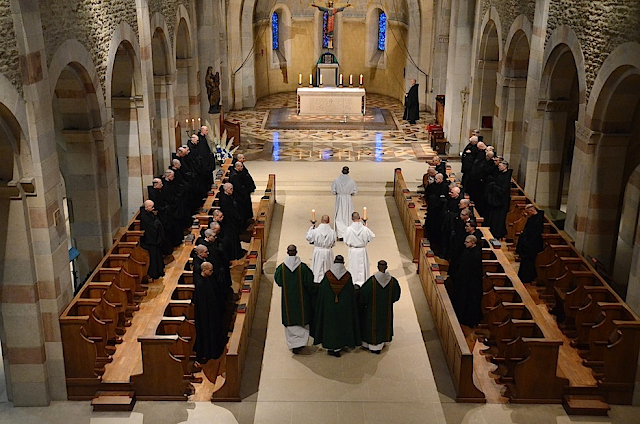
The Reading of the Rule of Saint Benedict for August 13
LIX DE FILIIS NOBILIUM AUT PAUPERUM QUI OFFERUNTUR
1 Si quis forte de nobilibus offerit filium suum Deo in monasterio, si ipse puer minor aetate est, parentes eius faciant petitionem quam supra diximus
2 et cum oblatione ipsam petitionem et manum pueri involvant in palla altaris, et sic eum offerant.
3 De rebus autem suis, aut in praesenti petitione promittant sub iureiurando quia numquam per se, numquam per suffectam personam nec quolibet modo ei aliquando aliquid dant aut tribuunt occasionem habendi;
4 vel certe si hoc facere noluerint et aliquid offerre volunt in eleemosynam monasterio pro mercede sua,
5 faciant ex rebus quas dare volunt monasterio donationem, reservato sibi, si ita voluerint, usufructu.
6 Atque ita omnia obstruantur ut nulla suspicio remaneat puero per quam deceptus perire possit ‑‑ quod absit ‑‑ quod experimento didicimus.
7 Similiter autem et pauperiores faciant.
8 Qui vero ex toto nihil habent, simpliciter petitionem faciant et cum oblatione offerant filium suum coram testibus.
CHAPTER 59: SONS OF THE NOBILITY OR THE POOR WHO ARE OFFERED
1 If a member of the nobility offers his son to God in the monastery and if the child is of tender years, his parents are to make the petition of which we spoke above;
2 and, together with the offerings, they are to wrap that petition and the hand of the child in the altar-cloth, and so offer him.
3 With regard to his property in the same petition they are to promise under oath that they will never, either directly, through an intermediary, or in any other way give him anything or the means of having anything:
4 or else, if they are unwilling to do this and wish to give something as an benefaction to the monastery to win their reward,
5 they are to make a donation to the monastery of the property they wish to give, reserving to themselves, if they so wish the revenues.
6 And thus let every way be blocked, so that no sort of expectation will remain by which the child might be deceived and perish (may it never happen!), which experience has taught us may happen.
7 Those who are poorer are to do the same.
8 But those who have nothing whatever are to simply make the petition and offer their son along with the offerings before witnesses.
Today's Celebration of the Mass
<
Also today

Feast of Saint Radegunde

Jesus before the tribunal of Pilate

May the Passion of Jesus Christ be always in our hearts

"The Cross is our trophy against the demons, our sword against sin, and the sword Christ used to pierce the serpent. The Cross is the Father's will, the glory of the Only-Begotten, the joy of the Spirit, the pride of the angels, the guarantee of the Church." -St. John Chrysostom








.jpeg)

Comments