Catholic devotions for 25th July
Scroll down for today's:
Saint of the Day/ Feast
Reading of the Martyrology
Dedication of the Month
Dedication of the Day
Rosary
Five Wounds Rosary in Latin
Seven Sorrows Rosary in English
Latin Monastic Office
Reading of the Rule of Saint Benedict
Celebration of Mass
Reading from the School of Jesus Crucified

Feast of Saint James the Greater
St. James was the son of Zebedee, a Galilean fisherman, and Salome, a pious woman who tended after Christ. He and his younger brother, St. John (Feast Day: December 27), were called as disciples just after Simon Peter and Andrew were called, and Peter, James and John are often mentioned together in Scripture, having been witness to the raising of Jairus's daughter, the Transfiguration, and Christ's Agony in the garden of Gethsemani.
James and his brother must have been zealous and of a passionate nature as they came to be called "Boanerges" ("Sons of Thunder") -- a nickname given to them by Jesus Himself. After Our Lord's Ascension, tradition says that St. James's zeal for evangelizing took him to Marmarica in North Africa and, possibly, parts of Spain for a time -- where St. Paul had wanted to travel (Romans 15:24) -- whereafter he returned to Judea for his martyrdom.
In A.D. 44, Herod Agrippa I, the grandson of Herod the Great who tried to have Baby Jesus killed, set out to do the will of the Jews by dealing harshly with local Christians. St. James was accused, and Herod then "killed James, the brother of John, with the sword." (Acts 12:1-2). Church Historian, Eusebius, tells us that St. James's accuser followed James to martyrdom when he converted after hearing the Saint's confession to Herod. At the place where James was said to have been martyred by beheading, a chapel was built; you can find it near the sanctuary of Jerusalem's Cathedral of Saint James, in the Armenian Quarter.
Here tradition picks up again by telling us that James's relics were translated to Spain (of course, legends grew surrounding the event, one strange and lovely one in particular apparently meant to explain why the cockleshell is St. James's emblem. It is said that when the Saint's relics were being conveyed by ship from Jerusalem and approached the coast of Portugal, a man happened to be riding his horse on the beach. The horse disobediently plunged into the sea, with its rider, making for the boat. They sank, of course, but then rose again, covered with scallop shells, and hence the cockleshell became the symbol of our hero). The relics were entombed and rather forgotten after years of Roman persecution, Vandal and Visigoth invasions, and Muslim attacks -- forgotten, that is, until an early 9th century hermit named Pelayo discovered the tomb -- some say after seeing a star marking the place -- in an area that became known as Compostela, which means "Field of Stars." The King built a cathedral to mark the location (Pelayo's Bishop, Theodomor of Iria, is also buried there, refusing to be buried in his See out of his desire to be near the Saint).
The faithful began to make pilgrimages to the site -- so much so that Compostela became the third greatest place of pilgrimage, just after Jerusalem and Rome -- and still make the pilgrimage today. After making one of the many routes, known as "the Camino de Santiago," pilgrims attach cockleshells or their facsimile to their hats or clothes as "pilgrim badges," signs that they'd venerated the holy relics. Any year in which St. James's Day falls on a Sunday is called a Holy Year, and a plenary indulgence may be gained by making the pilgrimage (his Feast falls on a Sunday every 6, 5, 6, and 11 years). To gain the indulgence, one must fulfill the usual conditions of plenary indulgences, must the pilgrimage for spiritual purposes and must have made the last 63 miles (100 km) on foot or on horse, or the last 125 miles (200 km) on bicycle.
At the time of the Muslim ("Moorish") invasions mentioned above, a particular battle took place that was to seal St. James ever more closely to Spain, where he is known as "San Tiago." At the Battle of Clavijo in A.D. 841, the Christians had lost and were in retreat when King Ramirez of Leon had a dream in which the Apostle assured him of victory. He relayed his vision to his men, and the next morning he had his trumpeters sound the call to battle. There, on the field, the men saw St. James on a horse decorated with cockleshells, waving a banner. He led the Christians on to a clear victory, and ever since, the Spanish battle-cry has been "Santiago!" and St. James has been known as "Matamoros" -- "Moor-slayer."
St. James is Patron of the Spanish people, equestrians, blacksmiths, tanners, and veterinarians. He is usually depicted in art with his symbols -- the cockleshell, pilgrim hat, sword, Sacred Scripture -- or on Horeseback, usually trampling a Moor.
Note that July 25 is also the Feast Day of St. Christopher, one of the Fourteen Holy Helpers whom we honor together on August 8.
Semen est sanguis Christianorum
The blood of Christians is the seed of the Church
Tertullian, Apologeticum, 50
The Reading from the Martyrology
This Day, the Twenty-Fifth Day of July
St. James the Apostle, brother of the blessed evangelist John, who was beheaded by Herod Agrippa about the feast of Easter. His sacred bones were on this day carried from Jerusalem to Spain, and placed in the remote province of Galicia, where they are devoutly honored by the far-famed piety of the inhabitants, and the frequent concourse of Christians, who visit them through piety and in fulfillment of their vows.
In Lycia, in the time of Decius, St. Christopher, martyr. Being scourged with iron rods, cast into the flames, from which he was saved by the power of Christ, and finally transfixed with arrows and beheaded, he completed his martyrdom.
At Barcelona, in Spain, during the persecution of Diocletian and under the governor Dacian, the birthday of the holy martyr Cucuphas. After overcoming many torments, he was struck with the sword, and thus went triumphantly to Heaven.
In Palestine, St. Paul, a martyr, in the persecution of Maximian Galerius, and under the governor Firmilian. He was condemned to capital punishment, but having obtained a short respite to pray, he besought God with all his heart, first for his own countrymen, then for the Jews and the Gentiles, that they might embrace the true faith, next for the multitude of the spectators, and finally for the judge who had condemned him and the executioner that was to strike him; after which he received the crown of martyrdom by being beheaded.
In the same country, St. Valentina, a virgin, who was led to an altar to offer sacrifice, but overturning it with her foot, she was cruelly tortured, and being cast into the fire with another virgin, her companion, she went to her spouse.
At Forcono, in Abruzzo, the holy martyrs Florentius and Felix, natives of Sipontum.
At Cordova, St. Theodemirus, monk and martyr.
At Treves, St. Magnericus, bishop and confessor.
And elsewhere in divers places, many other holy martyrs, confessors, and holy virgins.
Omnes sancti Mártyres, oráte pro nobis.
("All ye Holy Martyrs, pray for us", from the Litaniae Sanctorum, the Litany of the Saints)
July is the Month of the Most Precious Blood

Litaniae Pretiosissimi Sanguinis Domini Nostri Iesu Christi (Litany of the Most
Precious Blood of Our Lord Jesus Christ)
This Litany in honor of Jesus in His Most Precious Blood was drawn up by the Sacred
Congregation of Rites and promulgated by Pope John XXIII on February 24, 1960. The
devotion to Jesus in His most Precious Blood was first popularized by St. Gaspar del
Bufalo (1786-1837, feast Dec. 28) who founded the Missioners of the Most Precious
Blood. A partial indulgence is granted to the faithful who recite this litany.
Kyrie, eleison Kyrie, eleison.
Christe, eleison Christe, eleison.
Kyrie, eleison Kyrie, eleison.
Christe, audi nos Christe, audi nos.
Christe, exaudi nos. Christe, exaudi nos.
Pater de caelis, Deus, miserere nobis.
Fili, Redemptor mundi, Deus, miserere nobis.
Spiritus Sancte, Deus, miserere nobis.
Sancta Trinitas, unus Deus, miserere nobis.
Sanguis Christi, Unigeniti Patris aeterni, salva nos.
Sanguis Christi, Verbi Dei incarnati, salva nos.
Sanguis Christi, Novi et Aeterni Testamenti, salva nos.
Sanguis Christi, in agonia decurrens in terram, salva nos.
Sanguis Christi, in flagellatione profluens, salva nos.
Sanguis Christi, in coronatione spinarum emanans, salva nos.
Sanguis Christi, in Cruce effusus, salva nos.
Sanguis Christi, pretium nostrae salutis, salva nos.
Sanguis Christi, sine quo non fit remissio, salva nos.
Sanguis Christi, in Eucharistia potus et lavacrum animarum, salva nos.
Sanguis Christi, flumen misericordiae, salva nos.
Sanguis Christi, victor daemonum, salva nos.
Sanguis Christi, fortitudo martyrum, salva nos.
Sanguis Christi, virtus confessorum, salva nos.
Sanguis Christi, germinans virgines, salva nos.
Sanguis Christi, robur periclitantium, salva nos.
Sanguis Christi, levamen laborantium, salva nos.
Sanguis Christi, in fletu solatium, salva nos.
Sanguis Christi, spes poenitentium, salva nos.
Sanguis Christi, solamen morientium, salva nos.
Sanguis Christi, pax et dulcedo cordium, salva nos.
Sanguis Christi, pignus vitae aeternae, salva nos.
Sanguis Christi, animas liberans de lacu Purgatorii, salva nos.
Sanguis Christi, omni gloria et honore dignissimus, salva nos.
Agnus Dei, qui tollis peccata mundi, parce nobis, Domine.
Agnus Dei, qui tollis peccata mundi, exaudi nos, Domine.
Agnus Dei, qui tollis peccata mundi, miserere nobis, Domine.
V. redimisti nos, Domine, in sanguine tuo.
R. Et fecisti nos Deo nostro regnum.
Oremus;
Omnipotens sempiterne Deus, qui unigenitum Filium tuum mundi Redemptorem
constituisti, ac eius sanguine placari voluisti: concede, quaesumus, salutis nostrae
pretium ita venerari, atque a praesentis vitae malis eius virtute defendi in terris, ut
fructu perpetuo laetemur in caelis. Per eundem Christum Dominum nostrum. Amen.
Lord, have mercy. Lord, have mercy.
Christ, have mercy. Christ, have mercy.
Lord, have mercy. Lord, have mercy.
Christ, hear us. Christ, hear us.
Christ, graciously hear us. Christ, graciously hear us.
God the Father of Heaven, have mercy on us.
God the Son, Redeemer of the world, have mercy on us.
God, the Holy Spirit, have mercy on us.
Holy Trinity, One God, have mercy on us.
Blood of Christ, only-begotten Son of the eternal Father, save us.
Blood of Christ, Incarnate Word or God, save us.
Blood of Christ, of the New and Eternal Testament, save us.
Blood of Christ, falling upon the earth in Agony, save us.
Blood of Christ, shed profusely in the Scourging, save us.
Blood of Christ, flowing forth in the Crowning with Thorns, save us.
Blood of Christ, poured out on the Cross, save us.
Blood of Christ, price of our salvation, save us.
Blood of Christ, without which there is no forgiveness, save us.
Blood of Christ, Eucharistic drink and refreshment of souls, save us.
Blood of Christ, stream of mercy, save us.
Blood of Christ, victor over demons, save us.
Blood of Christ, courage of Martyrs, save us.
Blood of Christ, strength of Confessors, save us.
Blood of Christ, bringing forth Virgins, save us.
Blood of Christ, help of those in peril, save us.
Blood of Christ, relief of the burdened, save us.
Blood of Christ, solace in sorrow, save us.
Blood of Christ, hope of the penitent, save us.
Blood of Christ, consolation of the dying, save us.
Blood of Christ, peace and tenderness of hearts, save us.
Blood of Christ, pledge of eternal life, save us.
Blood of Christ, freeing souls from purgatory, save us.
Blood of Christ, most worthy of all glory and honor, save us.
Lamb of God, who taketh away the sins of the world, spare us, O Lord.
Lamb of God, who taketh away the sins of the world, graciously hear us, O Lord.
Lamb of God, who taketh away the sins of the world, have mercy on us, O Lord.
V. Thou hast redeemed us, O Lord, in Thy Blood.
R. And made us, for our God, a kingdom.
Let us pray;
Almighty and eternal God, Thou hast appointed Thine only-begotten Son the Redeemer
of the world and willed to be appeased by his blood. Grant, we beg of Thee, that we
may worthily adore this price of our salvation and through its power be safeguarded
from the evils of the present life so that we may rejoice in its fruits forever in heaven.
Through the same Christ our Lord. Amen.
Friday is the Day dedicated to the Christ's Passion and His Sacred Heart
Fridays are penitential days and Catholics are to keep in mind Christ's suffering and to sacrifice something for the sake of penance and discipline. The traditional way to do this is to abstain from meat. On this day also, many Catholics make what is known as the "First Fridays Devotion" in honor of the Sacred Heart. This entails going to Mass and receiving Communion in reparation to the Sacred Heart on the first Friday of the month for nine consecutive months (see Devotion to the Sacred Heart of Jesus). Another Friday practice is to kneel and pray five Paters and five Aves, especially at 3:00pm, the hour Christ died on the Cross.
The Sorrowful Mysteries of the Rosary are prayed on Friday
"I would like to remind you that the Rosary is a biblical prayer, all filled with the Holy Scriptures." It is a prayer from the heart, in which the repetition of the Ave Maria directs the thought and affection towards Christ, and thus is made a confident prayer to Him and our Mother. It is a prayer that helps to meditate on the Word of God and assimilate the Eucharistic Communion, on the model of Mary who kept in her heart everything Jesus did and said and even His Presence. " Pope Benedict XVI
The Rosary in Latin
Chaplet of the Five Holy Wounds of Christ in Latin
Chaplet of the Seven Sorrows of Our Lady in English
Latin Monastic Office for today from Le Barroux in France Texts also provided
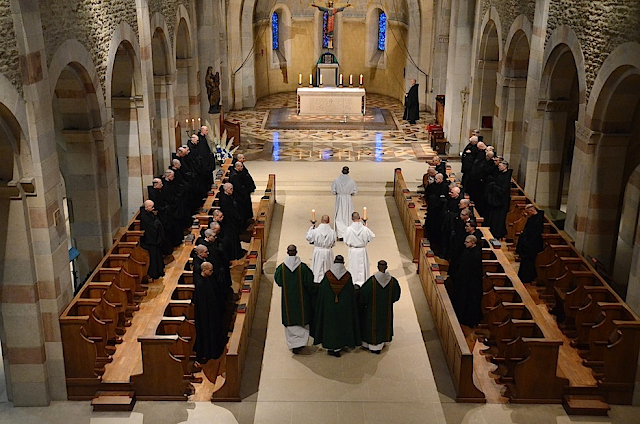
The Reading of the Rule of Saint Benedict for July 25
XLV DE HIS QUI FALLUNTUR IN ORATORIO
1 Si quis dum pronuntiat psalmum, responsorium, antiphonam vel lectionem fallitus fuerit, nisi satisfactione ibi coram omnibus humiliatus fuerit, maiori vindictae subiaceat,
2 quippe qui noluit humilitate corrigere quod neglegentia deliquit.
3 Infantes autem pro tali culpa vapulent.
CHAPTER 45: THOSE WHO MAKE MISTAKES IN THE ORATORY
1 If anyone makes a mistake while reciting a psalm, responsory, antiphon, or lesson and does not make satisfaction there before all by humbling himself, he is to be subjected to greater punishment,
2 for not correcting through humility what he did wrong through negligence.
3 Children, however, are to be whipped for such faults.
Today's Celebration of the Mass

Jesus is elevated on his Cross in the sight of all

Jesus XPI Passio sit semper in cordibus nostris
May the Passion of Jesus Christ be always in our hearts

"The Cross is our trophy against the demons, our sword against sin, and the sword Christ used to pierce the serpent. The Cross is the Father's will, the glory of the Only-Begotten, the joy of the Spirit, the pride of the angels, the guarantee of the Church." -St. John Chrysostom







.jpeg)

Comments