Catholic devotions for 7th August
Scroll down for today's
Saint of the Day/ Feast
Reading of the Martyrology
Dedication of the Month
Dedication of the Day
Rosary
Five Wounds Rosary in Latin
Seven Sorrows Rosary in English
Latin Monastic Office
Reading of the Rule of Saint Benedict
Celebration of Mass
Reading from the School of Jesus Crucified
.jpg)
Feast of Saint Cajetan
Cajetan was born in October 1480, the son of Gaspar, lord of Thiene, and Mary Porta, persons of the first rank among the nobility of the territory of Vicenza, in Veneto Region. His father died when he was two years of age. Quiet and retiring by nature,he was predisposed to piety by his mother. Cajetan studied law in Padua, receiving his degree as doctor utriusque juris (i.e., in civil and canon law) at age 24. In 1506 he worked as a diplomat for Pope Julius II, with whom he helped reconcile the Republic of Venice.But he was not ordained a priest until the year 1516. With the death of Pope Julius II in 1513, Cajetan withdrew from the papal court. Recalled to Vicenza by the death of his mother, he founded in 1522 a hospital for incurables there. By 1523, he had established a hospital in Venice, as well. His interests were as much or more devoted to spiritual healing than the physical kind, and he joined a confraternity in Rome called the "Oratory of Divine Love".He intended to form a group that would combine the spirit of monasticism with the exercises of the active ministry.
Theatines
A new congregation was canonically erected by Pope Clement VII in the year 1524. One of his four companions was Giovanni Pietro Carafa, the Bishop of Chieti, elected first superior of the order, who later became pope as Paul IV. From the name of the city of Chieti (in Latin: Theate), arose the name by which the order is known, the "Theatines".The order grew at a fairly slow pace: there were only twelve Theatines during the sack of Rome in 1527, during which Cajetan was tortured by mutinous soldiers of Charles V. The Theatines managed to escape to Venice. There Cajetan met Jerome Emiliani, whom he assisted in the establishment of his Congregation of Clerks Regular. In 1533, he founded a house in Naples. The year 1540 found him in Venice again and from there he extended his work to Verona He founded a bank to help the poor and offer an alternative to usurers (who charged high interest rates). It later became the Banco di Napoli. Cajetan died in Naples on 7 August 1547. His remains are in the church of San Paolo Maggiore in Naples;outside the church is Piazza San Gaetano, with a statue.

The Canonisation of Saint Cajetan and Saint Francis Borgia
The Reading from the Martyrology
The blood of Christians is the seed of the Church
Tertullian, Apologeticum, 50
This Day, the Seventh Day of August
At Naples, in Campania, St. Cajetan of Tiene, confessor, founder of the Theatines, who, through singular confidence in God, made his disciples practice the primitive mode of life of the Apostles. Being renowned for miracles, he was ranked among the saints by Clement X.
At Arezzo, in Tuscany, the birthday of St. Donatus, bishop and martyr, who among other miraculous deeds, made whole again by his prayers (as is related by the blessed Pope Gregory), a sacred chalice which had been broken by Pagans. Being apprehended by the imperial officer Quadratian, in the persecution of Julian the Apostate, and refusing to sacrifice to idols, he was struck with the sword, and thus consummated his martyrdom. With him suffered also the blessed monk Hilarinus, whose feast is celebrated on the 16th of July, when his body was taken to Ostia.
At Rome, the holy martyrs Peter and Julian, with eighteen others.
At Milan, St. Faustus, a soldier, who obtained the palm of martyrdom after many combats, in the time of Aurelius Commodus.
At Coino, the passion of the holy martyrs Carpophorus, Exanthus, Cassius, Severinus, Secundus and Licinius, who were beheaded for the confession of Christ.
At Nisibis, in Mesopotamia, St. Dometius, a Persian monk, who was stoned to death with two of his disciples, under Julian the Apostate.
At Rouen, the holy bishop St. Victricius. Whilst he was yet a soldier under Julian, he threw away his military belt for Christ, and after being subjected by the tribune to many torments, was condemned to capital punishment. But the executioner who had been sent to put him to death being struck blind, and the confessor's chains being loosened, he made his escape. Afterwards being made bishop, by preaching the word of God, he brought to the faith of Christ the barbarous people of Belgic Gaul, and finally died a confessor in peace.
At Chalons, in France, St. Donation, bishop.
At Messina, in Sicily, St. Albert, confessor, of the Order of Carmelites, renowned for miracles.
And elsewhere in divers places, many other holy martyrs, confessors, and holy virgins.
Omnes sancti Mártyres, oráte pro nobis.
("All ye Holy Martyrs, pray for us", from the Litaniae Sanctorum, the Litany of the Saints)
August is the Month of the Immaculate Heart of Mary

Composed by Saint John Henry Cardinal Newman, shortly after his reception into the One, True Fold of the Redeemer
Thursday is the Day dedicated to the Blessed Sacrament
The Pope at Corpus Christi
And at the wonderful Abbey of Heiligenkreuz
The Joyful Mysteries of the Rosary are prayed on Thursday
"I would like to remind you that the Rosary is a biblical prayer, all filled with the Holy Scriptures." It is a prayer from the heart, in which the repetition of the Ave Maria directs the thought and affection towards Christ, and thus is made a confident prayer to Him and our Mother. It is a prayer that helps to meditate on the Word of God and assimilate the Eucharistic Communion, on the model of Mary who kept in her heart everything Jesus did and said and even His Presence. " Pope Benedict XVI
The Rosary in Latin
Chaplet of the Five Holy Wounds of Christ in Latin
Chaplet of the Seven Sorrows of Our Lady in English
Latin Monastic Office for today from Le Barroux in France Texts also provided
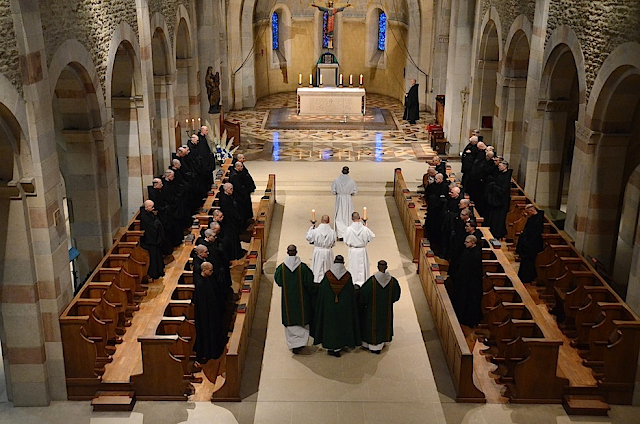
The Reading of the Rule of Saint Benedict for August 7
LV DE VESTIARIO VEL CALCIARIO FRATRUM
1 Vestimenta fratribus secundum locorum qualitatem ubi habitant vel aerum temperiem dentur,
2 quia in frigidis regionibus amplius indigetur, in calidis vero minus.
3 Haec ergo consideratio penes abbatem est.
4 Nos tamen mediocribus locis sufficere credimus monachis per singulos cucullam et tunicam -
5 cucullam in hieme villosam, in aestate puram aut vetustam -
6 et scapulare propter opera, indumenta pedum pedules et caligas.
7 De quarum rerum omnium colore aut grossitudine non causentur monachi, sed quales inveniri possunt in provincia qua degunt aut quod vilius comparari possit.
8 Abbas autem de mensura provideat ut non sint curta ipsa vestimenta utentibus ea, sed mensurata.
9 Accipientes nova, vetera semper reddant in praesenti reponenda in vestiario propter pauperes.
10 Sufficit enim monacho duas tunicas et duas cucullas habere propter noctes et propter lavare ipsas res;
11 iam quod supra fuerit superfluum est, amputari debet.
12 Et pedules et quodcumque est vetere reddant dum accipiunt novum.
13 Femoralia hi qui in via diriguntur de vestario accipiant, quae revertentes lota ibi restituant.
14 Et cucullae et tunicae sint aliquanto a solito quas habent modice meliores; quas exeuntes in via accipiant de vestiario et revertentes restituant.
CHAPTER 55: THE CLOTHING AND FOOTWEAR OF THE BROTHERS
1 Clothing is to be given to the brothers according to the nature of the place where they live and according to its climate;
2 for in cold regions more is required and in warm regions less.
3 This therefore is for the abbot to consider.
4 We believe, however, that in temperate places a cowl and a tunic will suffice for each monk,
5 the cowl to be of shaggy wool in winter, but in summer thin or worn;
6 also a scapular for work, and to cover their feet stockings and shoes.
7 Concerning the color or coarseness of all these things the monks should not complain; rather, whatever can be easily obtained in the province where they live or can be bought cheaply they should use.
8 The abbot is to see to the measurements, so that these garments are not too short for those who use them, but rather are properly measured.
9 On receiving new clothes the old should always be returned at once, to be stored in the wardrobe for the poor.
10 For it is sufficient for a monk to have two tunics and two cowls, on account of night wear and on account of laundering these items;
11 anything beyond this is superfluous and is to be cut off.
12 And stockings and whatever else is old are to be returned when they receive new things.
13 Underclothing for those who are sent on a journey is to be received from the wardrobe, which those who return are to wash and replace.
14 Their cowls and tunics should also be somewhat better than their usual wear: those leaving on a journey are to receive these from the wardrobe and those returning are to replace them.
Today's Celebration of the Mass
Also today

Feast of Blesseds Agathangelus and Cassian
Jesus is lead before the Tribunal of Annas (top left in the picture)

Jesus XPI Passio sit semper in cordibus nostris
May the Passion of Jesus Christ be always in our hearts

"The Cross is our trophy against the demons, our sword against sin, and the sword Christ used to pierce the serpent. The Cross is the Father's will, the glory of the Only-Begotten, the joy of the Spirit, the pride of the angels, the guarantee of the Church." -St. John Chrysostom







.jpeg)

Comments