Catholic devotions for 12th August
Scroll down for today's:
Saint of the Day/ Feast
Reading of the Martyrology
Dedication of the Month
Dedication of the Day
Rosary
Five Wounds Rosary in Latin
Seven Sorrows Rosary in English
Latin Monastic Office
Reading of the Rule of Saint Benedict
Celebration of Mass
Reading from the School of Jesus Crucified
Reading from the School of Jesus Crucified

Feast of Saint Clare
There was a marvelous holy woman in the city of Assisi, who was named Clare. First ye shall understand that her nativity was much worthy and noble. It is read that as touching the world she was of right noble lineage, and as touching the spirit to the regard of the estate of virtues and noble manners towards God, she was of right noble reputation. Then for to show that after her nativity she was a devout spouse of God, she is worthy to be of great recommendation.
Qualities of St. Clare
Her Worthy and Noble Nativity
It is read that when her mother was pregnant or great with child of her, on a time as she was before the crucifix, weeping and praying that of his grace he would grant to her the deliverance of her fruit with joy and gladness, she heard a voice suddenly saying to her, "Woman, have thou no doubt, for without peril thou shalt be delivered of a daughter which shall by her doctrine illuminate all the world." And therefore, as soon as she was born, she did name her at the font, Clare.
Her Virtues
Secondly, is found in her life and known, great plenty of virtues. It is read that this holy virgin, after the time of her infancy, was so composed in all good manners, in port, in maintenance, and in continuance, that all others might take of her fair and good ensample for to maintain and govern them. And in especial she had so great pity of the poor people, that ofttimes she spared her own mouth and sent by secret messengers such as she should herself have been sustained by. Also in making devout prayer she had so great pleasure that ofttimes it seemed to her, being in orisons, that her spirit was refreshed with the sweetness of heaven.
She was in her array like others, but by penance she chastised her body, for how well that for the honor of her friends she was nobly attired, yet nevertheless she ware always the hair on her bare body, and from her infancy her heart had determined that for to die she would never have other spouse than Jesu Christ. And many others and plenty of virtues shone in her, the which were overlong to recount.
Spouse of God
Thirdly, how St. Francis showed to her the way of truth; it is read that as soon as St. Clare heard the fame of St. Francis, it was spread over all the world as it were a new man sent into the world, showing how we ought to follow the new way of Jesu Christ, she never might have rested in her heart until she was come to him, and that to him she had opened her heart. Then after she had sweetly understood him, and had received of him many a holy, sweet, and angelic word, St. Francis exhorted her above all other things to flee the world both with heart and her body. And to this he enjoined her that on Palm Sunday she should hallow the feast with the other people, but the night following, in remembrance of the passion of Jesu Christ, she should turn her joy into weeping and afflictions, for in such wise to weep the passion of Jesu Christ, finally she might come to heaven as virgin and spouse of God, well euroous and happy.
Her Entry into the Convent
Fourthly, how she had no quietness in her heart until she had accomplished her thought and purpose; it is read that St. Clare, thus informed of St. Francis, could have no rest in her heart until that, the night assigned and the hour, she issued out of the city of Assisi, in which she dwelled, and came to the church of our Lady of Portiuncula. And then the friars received her, who awoke in the said church, and abode for her tofore the altar of the Blessed Virgin Mary. And there her hair was cut off, and after, they led her into an abbey of nuns and there left her.
She Leaves Behind Her Worldly Friends
Fifthly, how her friends despised this work ordained by our Lord; it is read when this lady was thus ordained, she labored and did so much that she drew her sister named Agnes into her company, wherefore as well for that one as for that other, the carnal friends of St. Clare had her in indignation beyond measure, wherefore St. Francis translated them into the church of St. Damian, which church by the commandment of the crucifix he had repaired. And there this lady began the religion that was called of poor sisters, and there she was enclosed in a little cell which St. Francis had edified.
Her Humility
Sixthly, how she had humility in her heart; it is read that St. Clare glorified herself sovereignly in humility, like as the wise man saith: Of so much that a creature is promoted, of so much ought he to be the more humble. Therefore, after that she had assembled a great convent of holy virgins, unnethe and with great pain, if it had not been for the obedience of St. Francis, she had never received the sovereignty of them. And after that she had received the domination over them and governance, she was tofore all others ready to serve them that were sick, as she had been a handmaid or servant, and was so humble that she would wash the feet of her hand-maidens and servants when they came from without from their work, and dried them and kissed them.
Her Poverty
Seventhly, how St. Clare kept poverty; it is read that for to keep and to follow poverty after the gospel of Jesu Christ, St. Clare put thereto all her entent, wherefore sith the beginning of her holy life, all that ever that came to her of father and mother, she sold and gave it for God's sake, insomuch that for her ne for her sisters she had but simple feeding and clothing, ne would have none other. And notwithstanding that she was associated with the pope of the vow of poverty, and thereupon had received letters from the pope, much suddenly weeping, she wrote again saying. I will well be assailed by my sins, but the vow of poverty I shall keep unto the death.
How Jesus Provided for Her
The eighth, how in necessity Jesu Christ visited her; it is read that, on a time that at the hour of dinner in the college of St. Clare was but one loaf of bread, ne there might no more be had. Then St. Clare took this loaf of the hand of the dispenser, and then made her prayer, and after, of that loaf made as many loaves and parts as there were sisters. And as soon as each each had received her part, how well it was but little, the divine grace multiplied it so much that each each left some and had enough.
Item similarly it is read that that God did for her when in her college the pots were failed.
Her Self-Denial
Ninthly, how in straitness St. Clare was ruled; this holy lady was happy with one poor coat lined with a mantlet; she never used pendants ne furs of skins, but dispensed all her time in keeping her body in servage of the spirit. And herewith thrice in the week she fasted in this manner that she never tasted thing that was sodden.
Item, every year she fasted two lentens to bread and water only, save the Sunday she took a little wine.
And shortly, she lived so straitly that she became so feeble that St. Francis commanded her by virtue of obedience that she should fail no day but that she should take for her refection an ounce and a half of bread.
She was never without hair next to her flesh, and for a pillow, she took a block or a great stone; she lay always on the bare ground, or for to take the better her rest she lay otherwhile upon the cuttings of vines, until the time that St. Francis had commanded her, because that it was over crowd, that she should use to lie on a sack full of straw.
Her Enmity with the Devil
Tenthly, how she hath despised the iniquity of the fiend our enemy; it is read that in especial she had a custom that from midday she was in prayers and remembering the passion and suffering of Jesu Christ, two hours during, and after the eventide she was always a long while in orisons. And it is read that ofttimes the fiend appeared to her by night saying: If so be that ye abstain you not from waking and weeping, ye shall for certain be blind.
And she answered: He shall not be blind that shall see our Lord in his glory.
And when the fiend heard this answer, anon he departed all confused, ne durst never after tempt her ne let her of her prayers.
Her Devotion to the Passion of Jesus
Eleventhly, God of his grace had pierced her heart, it is read that St. Clare for to dispend amorously the time that God had lent her, in especial she was determined that from the hour of mid-day unto evensong time, she would dispend all that time in thinking and beweeping the passion of Jesu Christ, and say prayers and orisons according to thereto, after unto the five wounds of the precious body of Jesu Christ, as smitten and pierced to the heart with the dart of the divine love.
It is read that from the time on a Shere Thursday the hour of the Maundy, unto Easter even the Saturday she was remembering and thinking on the suffering of our Lord Jesu Christ so burningly, that she was ravished as all drunken in the love of God, that she knew not what was said ne done about her, but as unmovable or as all insensible, in standing she held her eyes fixed in one place.
Her Patience in Times of Sickness
Twelfthly, how in her illness and pain she was of God comforted; it is said that she was by the space of eight and twenty days in continual languor and sickness, nevertheless was never seen in her sign of impatience, but always sweet words and amicable in praising and thanking God of all. And in especial it is read that, in the sickness in which she passed toward the end of her life she was seventeen days without meat or drink. And nevertheless she was so sweetly visited by God that it seemed unto all them that saw her that she had no pain and no disease, but yet more every creature that came to her was comforted in God.
And in especial it is read that, when the hour of death approached, she, which long time had lost her speech, began to speak and say: Go out surely, thou hast a good safe conduct.
And when one of her sisters, being there present, heard that, she asked her to whom she spake.
And she answered: To my soul, whom I see abashed to depart from my body, for he ought not for to doubt, for I see the holy Virgin Mary which abideth for me.
And this said, our Blessed Lady entered into the chamber where St. Clare lay. And she was crowned with a crown right clear shining, that the obscurity of the night was changed into clearness of mid-day. And she brought with her a right great multitude of other virgins all nobly crowned, among whom there was one that bare a rich mantle, to whom she said: Give hither the mantle.
And when she had sweetly embraced her she clad her with the mantle. And at that same time was weeping about her the college of sisters, and in particular Agnes the sister of St. Clare, making great moan and sorrow. Then St. Clare said sweetly: My sisters, discomfort you not, for ye shall have unto God of me a good and a true advocate. And thou Agnes shalt soon after follow me into glory.
Source with miracles following
Semen est sanguis Christianorum
The blood of Christians is the seed of the Church
Tertullian, Apologeticum, 50
The Reading from the Martyrology
This Day, the Twelfth Day of August
At Assisi, in Umbria, St. Clare, virgin, the first of the Poor Women of the Order of Friars Minor. Being celebrated for holiness of life and miracles, she was placed among holy virgins by Alexander IV.
At Catania, in Sicily, the birthday of St. Euplius, deacon, under the emperors Diocletian and Maximian. He was a long time tortured for the confession of the Lord, and finally obtained the palm of martyrdom by being put to the sword.
At Augsburg, St. Hilaria, mother of the blessed martyr Afra. Because she watched at the sepulchre of her daughter, she was cast into the fire for the faith of Christ, together with her maid-servants Digna, Euprepia, and Eunomia. On the same day there suffered also in that city Quiriacus, Largius, Crescentian, Nimmia, and Juliana, with twenty others.
In Syria, the holy martyrs Macarius and Julian.
At Nicomedia, the holy martyrs, the Count Anicetus and his brother Photinus, with many others, under the emperor Diocletian.
At Faleria, in Tuscany, the Saints Gracilian, and Felicissima, virgin, who, for the confession of the faith, had their mouths bruised with stones, and being afterwards struck with the sword, received the palm of martyrdom.
The same day, the holy martyrs Porcarius, abbot of the monastery of Lerins, and five hundred monks, who were slain for the Catholic faith by barbarians, and were thus crowned with martyrdom.
At Milan, the demise of St. Eusebius, bishop and confessor.
At Brescia, St. Herculanus, bishop.
Omnes sancti Mártyres, oráte pro nobis.
("All ye Holy Martyrs, pray for us", from the Litaniae Sanctorum, the Litany of the Saints)
August is the Month of the Immaculate Heart of Mary

Composed by Saint John Henry Cardinal Newman, shortly after his reception into the One, True Fold of the Redeemer
Tuesday is the Day dedicated to the Holy Angels
Prayers for Every Day of the Week.
The Sorrowful Mysteries of the Rosary are prayed on Tuesday
"I would like to remind you that the Rosary is a biblical prayer, all filled with the Holy Scriptures." It is a prayer from the heart, in which the repetition of the Ave Maria directs the thought and affection towards Christ, and thus is made a confident prayer to Him and our Mother. It is a prayer that helps to meditate on the Word of God and assimilate the Eucharistic Communion, on the model of Mary who kept in her heart everything Jesus did and said and even His Presence. " Pope Benedict XVI
The Rosary in Latin
Chaplet of the Five Holy Wounds of Christ in Latin
Chaplet of the Seven Sorrows of Our Lady in English
Latin Monastic Office for today from Le Barroux in France Texts also provided
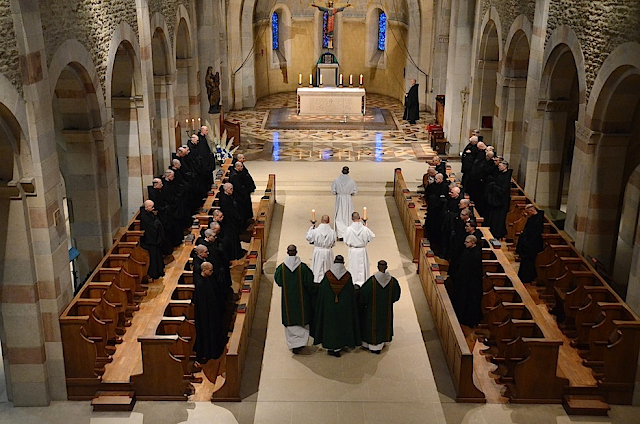
The Reading of the Rule of Saint Benedict for August 12
17 Suscipiendus autem in oratorio coram omnibus promittat de stabilitate sua et conversatione morum suorum et oboedientia,
18 coram Deo et sanctis eius, ut si aliquando aliter fecerit, ab eo se damnandum sciat quem irridit.
19 De qua promissione sua faciat petitionem ad nomen sanctorum quorum reliquiae ibi sunt et abbatis praesentis.
20 Quam petitionem manu sua scribat, aut certe, si non scit litteras, alter ab eo rogatus scribat et ille novicius signum faciat et manu sua eam super altare ponat.
21 Quam dum imposuerit, incipiat ipse novicius mox hunc versum: Suscipe me, Domine, secundum eloquium tuum et vivam, et ne confundas me ab exspectatione mea.
22 Quem versum omnis congregatio tertio respondeat, adiungentes Gloria Patri.
23 Tunc ille frater novicius prosternatur singulorum pedibus ut orent pro eo, et iam ex illa die in congregatione reputetur.
24 Res, si quas habet, aut eroget prius pauperibus aut facta sollemniter donatione conferat monasterio, nihil sibi reservans ex omnibus,
25 quippe qui ex illo die nec proprii corporis potestatem se habiturum scit.
26 Mox ergo in oratorio exuatur rebus propriis quibus vestitus est et induatur rebus monasterii.
27 Illa autem vestimenta quibus exutus est reponantur in vestiario conservanda,
28 ut si aliquando suadenti diabolo consenserit ut egrediatur de monasterio - quod absit - tunc exutus rebus monasterii proiciatur.
29 Illam tamen petitionem eius, quam desuper altare abbas tulit, non recipiat, sed in monasterio reservetur.
CHAPTER 58: THE DISCIPLINE OF RECEIVING BROTHERS
17 The one being received is to make in the oratory before all a promise of his stability, his faithfulness to the way of life, and obedience.
18 This is done before God and His saints so that if he ever acts otherwise he will know Who it is that condemns him - the One whom he mocks.
19 Concerning his promise he is to make a petition in the name of the saints whose relics are there and of the abbot who is present.
20 This petition he is to write with his own hand: or if he is illiterate, another is to write it at his request; and the novice is then to make his sign on it with his own hand and place it upon the altar.
21 When he has placed it there, the novice himself is to begin this verse:
Uphold me, Lord, according to your word, and I shall live; let not my hope be put to shame (Ps 119:116).
22 This verse is to be repeated by the whole community three times, adding to it a “Glory be”.
23 Then the brother novice is to prostrate himself at the feet of all, so that they may pray for him: and from that day he is to be considered part of the community.
24 If he has any possessions he should either first bestow them on the poor, or by a solemn deed of gift donate them to the monastery, keeping nothing for himself;
25 knowing that from that day onwards he will not even have power concerning his own body.
26 Immediately afterwards in the oratory he is to be stripped of his own garments which he is wearing, and be clothed in those of the monastery(Cas.Inst.4.5).
27 Those garments which are taken from him are to be placed in the clothes-room and kept there,
28 so that if ever by the persuasion of the devil he consents (may it never happen!) to leave the monastery, he may be stripped of the things of the monastery and cast forth.
29 The petition, however, which the abbot received on the altar will not be given back to him, but will be kept in the monastery.


18 This is done before God and His saints so that if he ever acts otherwise he will know Who it is that condemns him - the One whom he mocks.
19 Concerning his promise he is to make a petition in the name of the saints whose relics are there and of the abbot who is present.
20 This petition he is to write with his own hand: or if he is illiterate, another is to write it at his request; and the novice is then to make his sign on it with his own hand and place it upon the altar.
21 When he has placed it there, the novice himself is to begin this verse:
Uphold me, Lord, according to your word, and I shall live; let not my hope be put to shame (Ps 119:116).
22 This verse is to be repeated by the whole community three times, adding to it a “Glory be”.
23 Then the brother novice is to prostrate himself at the feet of all, so that they may pray for him: and from that day he is to be considered part of the community.
24 If he has any possessions he should either first bestow them on the poor, or by a solemn deed of gift donate them to the monastery, keeping nothing for himself;
25 knowing that from that day onwards he will not even have power concerning his own body.
26 Immediately afterwards in the oratory he is to be stripped of his own garments which he is wearing, and be clothed in those of the monastery(Cas.Inst.4.5).
27 Those garments which are taken from him are to be placed in the clothes-room and kept there,
28 so that if ever by the persuasion of the devil he consents (may it never happen!) to leave the monastery, he may be stripped of the things of the monastery and cast forth.
29 The petition, however, which the abbot received on the altar will not be given back to him, but will be kept in the monastery.
Today's Celebration of the Mass
Also today
Jesus is led before Pilate

Jesus XPI Passio sit semper in cordibus nostris
May the Passion of Jesus Christ be always in our hearts








.jpeg)

Comments