Catholic devotions for 3rd July
Scroll down for today's
Saint of the Day/ Feast
Reading of the Martyrology
Dedication of the Month
Dedication of the Day
Rosary
Five Wounds Rosary in Latin
Seven Sorrows Rosary in English
Latin Monastic Office
Reading of the Rule of Saint Benedict
Celebration of Mass
Reading from the School of Jesus Crucified

Feast of Pope Saint Leo II
Exposition of faith
The only Son and Word of God the Father, who became a man like us in all things but sin, Christ our true God, proclaimed clearly in the words of the gospel; I am the light of the world; anyone who follows me shall not walk in darkness but shall have the light of life, and again, My peace I leave to you, my peace I give you. Our most mild emperor, champion of right belief and adversary of wrong belief, guided in godly wisdom by this teaching of peace spoken by God, has brought together this holy and universal assembly of ours and set at one the whole judgment of the church.
Wherefore this holy and universal synod of ours, driving afar the error of impiety which endured for some time even till the present, following without deviation in a straight path after the holy and accepted fathers, has piously accorded in all things with the five holy and universal synods: that is to say, withthe synod of 318 holy fathers who gathered at Nicaea against the madman Arius, and
that which followed it at Constantinople of 150 God-led men against Macedonius, opponent of the Spirit, and the impious Apollinarius; similarly too, with
the first at Ephesus of 200 godly men brought together against Nestorius, who thought as the Jews and
that at Chalcedon of 630 God-inspired fathers against Eutyches and Dioscorus, hateful to God; also, in addition to these, with
the fifth holy synod, the latest of them, which was gathered here against Theodore of Mopsuestia, Origen, Didymus and Evagrius, and the writings of Theodoret against the twelve chapters of the renowned Cyril, and the letter said to have been written by Ibas to Mari the Persian.
Reaffirming the divine tenets of piety in all respects unaltered, and banishing the profane teachings of impiety, this holy and universal synod of ours has also, in its turn, under God’s inspiration, set its seal on the creed which was made out by the 318 fathers and confirmed again with godly prudence by the 150 and which the other holy synods too accepted gladly and ratified for the elimination of all soul-corrupting heresy
We believe in one God …[Creed of Nicaea and of Constantinople 1]
The holy and universal synod said:
This pious and orthodox creed of the divine favour was enough for a complete knowledge of the orthodox faith and a complete assurance therein. But since from the first, the contriver of evil did not rest, finding an accomplice in the serpent and through him bringing upon human nature the poisoned dart of death, so too now he has found instruments suited to his own purpose–namely Theodore, who was bishop of Pharan, Sergius, Pyrrhus, Paul and Peter, who were bishops of this imperial city, and further Honorius, who was pope of elder Rome, Cyrus, who held the see of Alexandria, and Macarius, who was recently bishop of Antioch, and his disciple Stephen — and has not been idle in raising through them obstacles of error against the full body of the church sowing with novel speech among the orthodox people the heresy of a single will and a single principle of action in the two natures of the one member of the holy Trinity Christ our true God, a heresy in harmony with the evil belief, ruinous to the mind, of the impious Apollinarius, Severus and Themistius, and one intent on removing the perfection of the becoming man of the same one lord Jesus Christ our God, through a certain guileful device, leading from there to the blasphemous conclusion that his rationally animate flesh is without a will and a principle of action.
Therefore Christ our God has stirred up the faithful emperor, the new David, finding in him a man after his own heart, who, as the scripture says, did not allow his eyes sleep or his eyelids drowsing until through this holy assembly of ours, brought together by God, he found the perfect proclamation of right belief; for according to the God-spoken saying, Where there are two or three gathered in my name, there am I in their midst.
This same holy and universal synod, here present, faithfully accepts and welcomes with open hands the report of Agatho, most holy and most blessed pope of elder Rome, that came to our most reverend and most faithful emperor Constantine, which rejected by name those who proclaimed and taught, as has been already explained, one will and one principle of action in the incarnate dispensation of Christ our true God; and likewise it approves as well the other synodal report to his God-taught serenity, from the synod of 125 bishops dear to God meeting under the same most holy pope, as according with the holy synod at Chalcedon and with the Tome of the all-holy and most blessed Leo, pope of the same elder Rome, which was sent to Flavian, who is among the saints, and which that synod called a pillar of right belief, and furthermore with the synodal letters written by the blessed Cyril against the impious Nestorius and to the bishops of the east.
Following the five holy and universal synods and the holy and accepted fathers, and defining in unison, it professes our lord Jesus Christ our true God, one of the holy Trinity, which is of one same being and is the source of life, to be perfect in divinity and perfect in humanity, the same truly God and truly man, of a rational soul and a body; consubstantial with the Father as regards his divinity, and the same consubstantial with us as regards his humanity, like us in all respects except for sin; begotten before the ages from the Father as regards his divinity, and in the last days the same for us and for our salvation from the holy Spirit and the virgin Mary, who is properly and truly called mother of God, as regards his humanity; one and the same Christ, Son, Lord, only-begotten, acknowledged in two natures which undergo no confusion, no change, no separation, no division; at no point was the difference between the natures taken away through the union, but rather the property of both natures is preserved and comes together into a single subsistent being [in unam personam et in unam subsistentiam concurrente]; he is not parted or divided into two persons, but is one and the same only-begotten Son, Word of God, lord Jesus Christ, just as the prophets taught from the beginning about him, and as Jesus the Christ himself instructed us, and as the creed of the holy fathers handed it down to us.
And we proclaim equally two natural volitions or wills in him and two natural principles of action which undergo no division, no change, no partition, no confusion, in accordance with the teaching of the holy fathers. And the two natural wills not in opposition, as the impious heretics said, far from it, but his human will following, and not resisting or struggling, rather in fact subject to his divine and all powerful will. For the will of the flesh had to be moved, and yet to be subjected to the divine will, according to the most wise Athanasius. For just as his flesh is said to be and is flesh of the Word of God, so too the natural will of his flesh is said to and does belong to the Word of God, just as he says himself: I have come down from heaven, not to do my own will, but the will of the Father who sent me, calling his own will that of his flesh, since his flesh too became his own. For in the same way that his all holy and blameless animate flesh was not destroyed in being made divine but remained in its own limit and category, so his human will as well was not destroyed by being made divine, but rather was preserved, according to the theologian Gregory, who says: “For his willing, when he is considered as saviour, is not in opposition to God, being made divine in its entirety.” And we hold there to be two natural principles of action in the same Jesus Christ our lord and true God, which undergo no division, no change, no partition, no confusion, that is, a divine principle of action and a human principle of action, according to the godly-speaking Leo, who says most clearly: “For each form does in a communion with the other that activity which it possesses as its own, the Word working that which is the Word’s and the body accomplishing the things that are the body’s”. For of course we will not grant the existence of only a single natural principle of action of both God and creature, lest we raise what is made to the level of divine being, or indeed reduce what is most specifically proper to the divine nature to a level befitting creatures for we acknowledge that the miracles and the sufferings are of one and the same according to one or the other of the two natures out of which he is and in which he has his being, as the admirable Cyril said. Therefore, protecting on all sides the “no confusion” and “no division”, we announce the whole in these brief words: Believing our lord Jesus Christ, even after his incarnation, to be one of the holy Trinity and our true God, we say that he has two natures [naturas] shining forth in his one subsistence[subsistentia] in which he demonstrated the miracles and the sufferings throughout his entire providential dwelling here, not in appearance but in truth, the difference of the natures being made known in the same one subsistence in that each nature wills and performs the things that are proper to it in a communion with the other; then in accord with this reasoning we hold that two natural wills and principles of action meet in correspondence for the salvation of the human race.
So now that these points have been formulated by us with all precision in every respect and with all care, we definitely state that it is not allowable for anyone to produce another faith, that is, to write or to compose or to consider or to teach others; those who dare to compose another faith, or to support or to teach or to hand on another creed to those who wish to turn to knowledge of the truth, whether from Hellenism or Judaism or indeed from any heresy whatsoever, or to introduce novelty of speech, that is, invention of terms, so as to overturn what has now been defined by us, such persons, if they are bishops or clerics, are deprived of their episcopacy or clerical rank, and if they are monks or layfolk they are excommunicated.
The Reading from the Martyrology
The blood of Christians is the seed of the Church
Tertullian, Apologeticum, 50
This Day, the Third Day of July
At Alexandria, St. Tryphon, and twelve other martyrs.
At Constantinople, the holy martyrs Eulogius and his companions.
At Caesarea, in Cappadocia, St. Hyacinthus, chamberlain of the emperor Trajan. Accused of being a Christian, he was scourged and thrown into prison, where, consumed with hunger, he breathed his last.
At Chiusi, in Tuscany, in the reign of the emperor Trajan, the holy martyrs Irenaeus, deacon, and Mustiola, a matron, who were subjected to various atrocious tortures and merited the crown of martyrdom.
The same day, the holy martyrs Mark and Mucian, who were put to the sword for Christ. As a small boy cried out to them not to sacrifice to idols, he was whipped, but confessing Christ all the more vigorously, he was killed with a man named Paul, who had also exhorted the martyrs.
At Laodicea, in Syria, St. Anatolius, a bishop, whose writings were admired not only by religious men, but even by philosophers.
At Altino, St. Heliodorus, a bishop distinguished for holiness and learning.
At Ravenna, St. Dathus, bishop and confessor.
At Edessa, in Mesopotamia, the translation of the Apostle St. Thomas from India. His relics were afterwards taken to Tortona.
And elsewhere in divers places, many other holy martyrs, confessors, and holy virgins.
Omnes sancti Mártyres, oráte pro nobis.
("All ye Holy Martyrs, pray for us", from the Litaniae Sanctorum, the Litany of the Saints)
July is the Month of the Most Precious Blood

Litaniae Pretiosissimi Sanguinis Domini Nostri Iesu Christi (Litany of the Most
Precious Blood of Our Lord Jesus Christ)
This Litany in honor of Jesus in His Most Precious Blood was drawn up by the Sacred
Congregation of Rites and promulgated by Pope John XXIII on February 24, 1960. The
devotion to Jesus in His most Precious Blood was first popularized by St. Gaspar del
Bufalo (1786-1837, feast Dec. 28) who founded the Missioners of the Most Precious
Blood. A partial indulgence is granted to the faithful who recite this litany.
Kyrie, eleison Kyrie, eleison.
Christe, eleison Christe, eleison.
Kyrie, eleison Kyrie, eleison.
Christe, audi nos Christe, audi nos.
Christe, exaudi nos. Christe, exaudi nos.
Pater de caelis, Deus, miserere nobis.
Fili, Redemptor mundi, Deus, miserere nobis.
Spiritus Sancte, Deus, miserere nobis.
Sancta Trinitas, unus Deus, miserere nobis.
Sanguis Christi, Unigeniti Patris aeterni, salva nos.
Sanguis Christi, Verbi Dei incarnati, salva nos.
Sanguis Christi, Novi et Aeterni Testamenti, salva nos.
Sanguis Christi, in agonia decurrens in terram, salva nos.
Sanguis Christi, in flagellatione profluens, salva nos.
Sanguis Christi, in coronatione spinarum emanans, salva nos.
Sanguis Christi, in Cruce effusus, salva nos.
Sanguis Christi, pretium nostrae salutis, salva nos.
Sanguis Christi, sine quo non fit remissio, salva nos.
Sanguis Christi, in Eucharistia potus et lavacrum animarum, salva nos.
Sanguis Christi, flumen misericordiae, salva nos.
Sanguis Christi, victor daemonum, salva nos.
Sanguis Christi, fortitudo martyrum, salva nos.
Sanguis Christi, virtus confessorum, salva nos.
Sanguis Christi, germinans virgines, salva nos.
Sanguis Christi, robur periclitantium, salva nos.
Sanguis Christi, levamen laborantium, salva nos.
Sanguis Christi, in fletu solatium, salva nos.
Sanguis Christi, spes poenitentium, salva nos.
Sanguis Christi, solamen morientium, salva nos.
Sanguis Christi, pax et dulcedo cordium, salva nos.
Sanguis Christi, pignus vitae aeternae, salva nos.
Sanguis Christi, animas liberans de lacu Purgatorii, salva nos.
Sanguis Christi, omni gloria et honore dignissimus, salva nos.
Agnus Dei, qui tollis peccata mundi, parce nobis, Domine.
Agnus Dei, qui tollis peccata mundi, exaudi nos, Domine.
Agnus Dei, qui tollis peccata mundi, miserere nobis, Domine.
V. redimisti nos, Domine, in sanguine tuo.
R. Et fecisti nos Deo nostro regnum.
Oremus;
Omnipotens sempiterne Deus, qui unigenitum Filium tuum mundi Redemptorem
constituisti, ac eius sanguine placari voluisti: concede, quaesumus, salutis nostrae
pretium ita venerari, atque a praesentis vitae malis eius virtute defendi in terris, ut
fructu perpetuo laetemur in caelis. Per eundem Christum Dominum nostrum. Amen.
Lord, have mercy. Lord, have mercy.
Christ, have mercy. Christ, have mercy.
Lord, have mercy. Lord, have mercy.
Christ, hear us. Christ, hear us.
Christ, graciously hear us. Christ, graciously hear us.
God the Father of Heaven, have mercy on us.
God the Son, Redeemer of the world, have mercy on us.
God, the Holy Spirit, have mercy on us.
Holy Trinity, One God, have mercy on us.
Blood of Christ, only-begotten Son of the eternal Father, save us.
Blood of Christ, Incarnate Word or God, save us.
Blood of Christ, of the New and Eternal Testament, save us.
Blood of Christ, falling upon the earth in Agony, save us.
Blood of Christ, shed profusely in the Scourging, save us.
Blood of Christ, flowing forth in the Crowning with Thorns, save us.
Blood of Christ, poured out on the Cross, save us.
Blood of Christ, price of our salvation, save us.
Blood of Christ, without which there is no forgiveness, save us.
Blood of Christ, Eucharistic drink and refreshment of souls, save us.
Blood of Christ, stream of mercy, save us.
Blood of Christ, victor over demons, save us.
Blood of Christ, courage of Martyrs, save us.
Blood of Christ, strength of Confessors, save us.
Blood of Christ, bringing forth Virgins, save us.
Blood of Christ, help of those in peril, save us.
Blood of Christ, relief of the burdened, save us.
Blood of Christ, solace in sorrow, save us.
Blood of Christ, hope of the penitent, save us.
Blood of Christ, consolation of the dying, save us.
Blood of Christ, peace and tenderness of hearts, save us.
Blood of Christ, pledge of eternal life, save us.
Blood of Christ, freeing souls from purgatory, save us.
Blood of Christ, most worthy of all glory and honor, save us.
Lamb of God, who taketh away the sins of the world, spare us, O Lord.
Lamb of God, who taketh away the sins of the world, graciously hear us, O Lord.
Lamb of God, who taketh away the sins of the world, have mercy on us, O Lord.
V. Thou hast redeemed us, O Lord, in Thy Blood.
R. And made us, for our God, a kingdom.
Let us pray;
Almighty and eternal God, Thou hast appointed Thine only-begotten Son the Redeemer
of the world and willed to be appeased by his blood. Grant, we beg of Thee, that we
may worthily adore this price of our salvation and through its power be safeguarded
from the evils of the present life so that we may rejoice in its fruits forever in heaven.
Through the same Christ our Lord. Amen.
Thursday is the Day dedicated to the Blessed Sacrament
The Pope at Corpus Christi
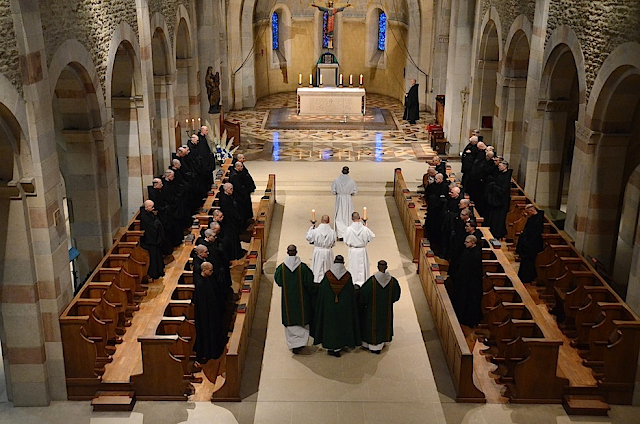
And at the wonderful Abbey of Heiligenkreuz
The Joyful Mysteries of the Rosary are prayed on Thursday
"I would like to remind you that the Rosary is a biblical prayer, all filled with the Holy Scriptures." It is a prayer from the heart, in which the repetition of the Ave Maria directs the thought and affection towards Christ, and thus is made a confident prayer to Him and our Mother. It is a prayer that helps to meditate on the Word of God and assimilate the Eucharistic Communion, on the model of Mary who kept in her heart everything Jesus did and said and even His Presence. " Pope Benedict XVI
The Rosary in Latin
Chaplet of the Five Holy Wounds of Christ in Latin
Chaplet of the Seven Sorrows of Our Lady in English
Latin Monastic Office for today from Le Barroux in France Texts also provided
The Reading of the Rule of Saint Benedict for July 3
XXVI DE HIS QUI SINE IUSSIONE IUNGUNT SE EXCOMMUNICATIS
1 Si quis frater praesumpserit sine iussione abbatis fratri excommunicato quolibet modo se iungere aut loqui cum eo vel mandatum ei dirigere,
2 similem sortiatur excommunicationis vindictam.
CHAPTER 26: THOSE WHO, WITHOUT PERMISSION, ASSOCIATE WITH THE EXCOMMUNICATED
1 If a brother presumes without permission from the abbot to associate in any way with an excommunicated brother, or to speak with him, or to send him a message,
2 he will incur the same kind of punishment of excommunication.
Today's Celebration of the Mass

Today, the Translation of Saint Thomas
Jesus XPI Passio sit semper in cordibus nostris
May the Passion of Jesus Christ be always in our hearts






.jpeg)

Comments