Catholic devotions for 31st July
Scroll down for today's
Saint of the Day/ Feast
Reading of the Martyrology
Dedication of the Month
Dedication of the Day
Rosary
Five Wounds Rosary in Latin
Seven Sorrows Rosary in English
Latin Monastic Office
Reading of the Rule of Saint Benedict
Celebration of Mass
Reading from the School of Jesus Crucified

The Glory of Saint Ignatius
Feast of Saint Ignatius Loyola
Later life and death
The later years of Ignatius were spent in partial retirement, the inevitable correspondence in governing the Society leaving no time for those works of active ministry which in themselves he much preferred. His health too began to fail. In 1551, when he had gathered the elder fathers to revise the constitutions, he laid his resignation of the generalate in their hands, but they refused to accept it then or later, when the saint renewed his prayer. In 1554 Father Nadal was given the powers of vicar-general, but it was often necessary to send him abroad as commissary, and in the end Ignatius continued, with Polanco's aid, to direct everything. With most of his first companions he had to part soon. Rodríguez started on 5 March, 1540, for Lisbon, where he eventually founded the Portuguese province, of which he was made provincial on 10 October, 1546. St. Francis Xavier followed Rodríguez immediately, and became provincial of India in 1549. In September, 1541, Salmeron and Broet started for their perilous mission to Ireland, which they reached (via Scotland) next Lent. But Ireland, the prey to Henry VIII's barbarous violence, could not give the zealous missionaries a free field for the exercise of the ministries proper to their institute. All Lent they passed in Ulster, flying from persecutors, and doing in secret such good as they might. With difficulty they reached Scotland, and regained Rome, Dec., 1542. The beginnings of the Society in Germany are connected with St. Peter Faber, Blessed Peter Canisius, Le Jay, and Bobadilla in 1542. In 1546 Laynez and Salmeron were nominated papal theologians for the Council of Trent, where Canisius, Le Jay, and Covillon also found places. In 1553 came the picturesque, but not very successful mission of Nuñez Barretto as Patriarch of Abyssinia. For all these missions Ignatius wrote minute instructions, many of which are still extant. He encouraged and exhorted his envoys in their work by his letters, while the reports they wrote back to him form our chief source of information on the missionary triumphs achieved. Though living alone in Rome, it was he who in effect led, directed, and animated his subjects all the world over.
The two most painful crosses of this period were probably the suits with Isabel Roser and Simón Rodríguez. The former lady had been one of Ignatius' first and most esteemed patronesses during his beginnings in Spain. She came to Rome later on and persuaded Ignatius to receive a vow of obedience to him, and she was afterwards joined by two or three other ladies. But the demands they made on his time were more than he could possibly allow them. "They caused me more trouble", he is reported to have said, "than the whole of the Society", and he obtained from the pope a relaxation of the vow he had accepted. A suit with Roser followed, which she lost, and Ignatius forbade his sons hereafter to become ex officio directors to convents of nuns (Scripta de S. Ignatio, pp. 652-5). Painful though this must have been to a man so loyal as Ignatius, the difference with Rodríguez, one of his first companions, must have been more bitter still. Rodríguez had founded the Province of Portugal, and brought it in a short time to a high state of efficiency. But his methods were not precisely those of Ignatius, and, when new men of Ignatius' own training came under him, differences soon made themselves felt. A struggle ensued in which Rodríguez unfortunately took sides against Ignatius' envoys. hesitate. Rodriguez having been recalled to Rome, the new provincial being empowered to dismiss him if he refused, he demanded a formal trial, which Ignatius, foreseeing the results, endeavoured to ward off. But on Simón's insistence a full court of inquiry was granted, whose proceedings are now printed and it unanimously condemned Rodriguez to penance and banishment from the province (Scripta etc., pp. 666-707). Of all his external works, those nearest his heart, to judge by his correspondence, were the building and foundation of the Roman College (1551), and of the German College (1552). For their sake he begged, worked, and borrowed with splendid insistence until his death. The success of the first was ensured by the generosity of St. Francis Borgia, before he entered the Society. The latter was still in a struggling condition when Ignatius died, but his great ideas have proved the true and best foundation of both.
In the summer of 1556 the saint was attacked by Roman fever. His doctors did not foresee any serious consequences, but the saint did. On 30 July, 1556, he asked for the last sacraments and the papal blessing, but he was told that no immediate danger threatened. Next morning at daybreak, the infirmarian found him lying in peaceful prayer, so peaceful that he did not at once perceive that the saint was actually dying. When his condition was realized, the last blessing was given, but the end came before the holy oils could be fetched. Perhaps he had prayed that his death, like his life, might pass without any demonstration. He was beatified by Paul V on 27 July, 1609, and canonized by Gregory XV on 22 May, 1622. His body lies under the altar designed by Pozzi in the Gesù. Though he died in the sixteenth year from the foundation of the Society, that body already numbered about 1000 religious (of whom, However, only 35 were yet professed) with 100 religious houses, arranged in 10 provinces. (Sacchini, op. cit. infra., lib. 1, cc. i, nn. 1-20.) It is impossible to sketch in brief Ignatius' grand and complex character: ardent yet restrained, fearless, resolute, simple, prudent, strong, and loving. The Protestant and Jansenistic conception of him as a restless, bustling pragmatist bears no correspondence at all with the peacefulness and perseverance which characterize the real man. That he was a strong disciplinarian is true. In a young and rapidly growing body that was inevitable; and the age loved strong virtues. But if he believed in discipline as an educative force, he despised any other motives for action except the love of God and man. It was by studying Ignatius as a ruler that Xavier learned the principle, "the company of Jesus ought to be called the company of love and conformity of souls". (Ep., 12 Jan., 1519)
Source and more besides
The Reading from the Martyrology
The blood of Christians is the seed of the Church
Tertullian, Apologeticum, 50
This Day, the Thirty-First Day of July
At Rome, the birthday of St. Ignatius, confessor, founder of the Society of Jesus, renowned for sanctity and miracles, and most zealous for propagating the Catholic religion in all parts of the world. At Caesarea, the martyrdom of the blessed martyr Fabius.
At Milan, during the persecution of Antoninus, St. Calimerius, bishop and martyr, who was arrested, covered with wounds, and pierced through the neck with a sword. He terminated his martyrdom by being precipitated into a well.
At Synnada, in Phrygia, the holy martyrs Democritus, Secundus and Denis.
In Syria, three hundred and fifty monks, who became martyrs by being slain by the heretics for defending the Council of Chalcedon.
At Ravenna, the departure from this world of St. Germanus, bishop of Auxerre, a man most renowned for his birth, faith, learning, and glorious miracles, who freed England completely from the heretical doctrines of the Pelagians.
At Tagaste, in Africa, St. Firmus, bishop, illustrious by a glorious confession of the faith.
At Siena, in Tuscany, the birthday of blessed John Colombini, founder of the Order of the Jesuati, renowned for sanctity and miracles.
At Caesarea in Mauretania, the martyrdom of the blessed martyr Fabius. Because he refused to carry the banners of the governor of the province, he was thrown into prison for some days, and as he persisted twice in confessing Christ when brought before the judge, he was condemned to death.
And elsewhere in divers places, many other holy martyrs, confessors, and holy virgins.
Omnes sancti Mártyres, oráte pro nobis.
("All ye Holy Martyrs, pray for us", from the Litaniae Sanctorum, the Litany of the Saints)
July is the Month of the Most Precious Blood

Litaniae Pretiosissimi Sanguinis Domini Nostri Iesu Christi (Litany of the Most
Precious Blood of Our Lord Jesus Christ)
This Litany in honor of Jesus in His Most Precious Blood was drawn up by the Sacred
Congregation of Rites and promulgated by Pope John XXIII on February 24, 1960. The
devotion to Jesus in His most Precious Blood was first popularized by St. Gaspar del
Bufalo (1786-1837, feast Dec. 28) who founded the Missioners of the Most Precious
Blood. A partial indulgence is granted to the faithful who recite this litany.
Kyrie, eleison Kyrie, eleison.
Christe, eleison Christe, eleison.
Kyrie, eleison Kyrie, eleison.
Christe, audi nos Christe, audi nos.
Christe, exaudi nos. Christe, exaudi nos.
Pater de caelis, Deus, miserere nobis.
Fili, Redemptor mundi, Deus, miserere nobis.
Spiritus Sancte, Deus, miserere nobis.
Sancta Trinitas, unus Deus, miserere nobis.
Sanguis Christi, Unigeniti Patris aeterni, salva nos.
Sanguis Christi, Verbi Dei incarnati, salva nos.
Sanguis Christi, Novi et Aeterni Testamenti, salva nos.
Sanguis Christi, in agonia decurrens in terram, salva nos.
Sanguis Christi, in flagellatione profluens, salva nos.
Sanguis Christi, in coronatione spinarum emanans, salva nos.
Sanguis Christi, in Cruce effusus, salva nos.
Sanguis Christi, pretium nostrae salutis, salva nos.
Sanguis Christi, sine quo non fit remissio, salva nos.
Sanguis Christi, in Eucharistia potus et lavacrum animarum, salva nos.
Sanguis Christi, flumen misericordiae, salva nos.
Sanguis Christi, victor daemonum, salva nos.
Sanguis Christi, fortitudo martyrum, salva nos.
Sanguis Christi, virtus confessorum, salva nos.
Sanguis Christi, germinans virgines, salva nos.
Sanguis Christi, robur periclitantium, salva nos.
Sanguis Christi, levamen laborantium, salva nos.
Sanguis Christi, in fletu solatium, salva nos.
Sanguis Christi, spes poenitentium, salva nos.
Sanguis Christi, solamen morientium, salva nos.
Sanguis Christi, pax et dulcedo cordium, salva nos.
Sanguis Christi, pignus vitae aeternae, salva nos.
Sanguis Christi, animas liberans de lacu Purgatorii, salva nos.
Sanguis Christi, omni gloria et honore dignissimus, salva nos.
Agnus Dei, qui tollis peccata mundi, parce nobis, Domine.
Agnus Dei, qui tollis peccata mundi, exaudi nos, Domine.
Agnus Dei, qui tollis peccata mundi, miserere nobis, Domine.
V. redimisti nos, Domine, in sanguine tuo.
R. Et fecisti nos Deo nostro regnum.
Oremus;
Omnipotens sempiterne Deus, qui unigenitum Filium tuum mundi Redemptorem
constituisti, ac eius sanguine placari voluisti: concede, quaesumus, salutis nostrae
pretium ita venerari, atque a praesentis vitae malis eius virtute defendi in terris, ut
fructu perpetuo laetemur in caelis. Per eundem Christum Dominum nostrum. Amen.
Lord, have mercy. Lord, have mercy.
Christ, have mercy. Christ, have mercy.
Lord, have mercy. Lord, have mercy.
Christ, hear us. Christ, hear us.
Christ, graciously hear us. Christ, graciously hear us.
God the Father of Heaven, have mercy on us.
God the Son, Redeemer of the world, have mercy on us.
God, the Holy Spirit, have mercy on us.
Holy Trinity, One God, have mercy on us.
Blood of Christ, only-begotten Son of the eternal Father, save us.
Blood of Christ, Incarnate Word or God, save us.
Blood of Christ, of the New and Eternal Testament, save us.
Blood of Christ, falling upon the earth in Agony, save us.
Blood of Christ, shed profusely in the Scourging, save us.
Blood of Christ, flowing forth in the Crowning with Thorns, save us.
Blood of Christ, poured out on the Cross, save us.
Blood of Christ, price of our salvation, save us.
Blood of Christ, without which there is no forgiveness, save us.
Blood of Christ, Eucharistic drink and refreshment of souls, save us.
Blood of Christ, stream of mercy, save us.
Blood of Christ, victor over demons, save us.
Blood of Christ, courage of Martyrs, save us.
Blood of Christ, strength of Confessors, save us.
Blood of Christ, bringing forth Virgins, save us.
Blood of Christ, help of those in peril, save us.
Blood of Christ, relief of the burdened, save us.
Blood of Christ, solace in sorrow, save us.
Blood of Christ, hope of the penitent, save us.
Blood of Christ, consolation of the dying, save us.
Blood of Christ, peace and tenderness of hearts, save us.
Blood of Christ, pledge of eternal life, save us.
Blood of Christ, freeing souls from purgatory, save us.
Blood of Christ, most worthy of all glory and honor, save us.
Lamb of God, who taketh away the sins of the world, spare us, O Lord.
Lamb of God, who taketh away the sins of the world, graciously hear us, O Lord.
Lamb of God, who taketh away the sins of the world, have mercy on us, O Lord.
V. Thou hast redeemed us, O Lord, in Thy Blood.
R. And made us, for our God, a kingdom.
Let us pray;
Almighty and eternal God, Thou hast appointed Thine only-begotten Son the Redeemer
of the world and willed to be appeased by his blood. Grant, we beg of Thee, that we
may worthily adore this price of our salvation and through its power be safeguarded
from the evils of the present life so that we may rejoice in its fruits forever in heaven.
Through the same Christ our Lord. Amen.
Thursday is the Day dedicated to the Blessed Sacrament
The Pope at Corpus Christi
And at the wonderful Abbey of Heiligenkreuz
The Joyful Mysteries of the Rosary are prayed on Thursday
"I would like to remind you that the Rosary is a biblical prayer, all filled with the Holy Scriptures." It is a prayer from the heart, in which the repetition of the Ave Maria directs the thought and affection towards Christ, and thus is made a confident prayer to Him and our Mother. It is a prayer that helps to meditate on the Word of God and assimilate the Eucharistic Communion, on the model of Mary who kept in her heart everything Jesus did and said and even His Presence. " Pope Benedict XVI
The Rosary in Latin
Chaplet of the Five Holy Wounds of Christ in Latin
Chaplet of the Seven Sorrows of Our Lady in English
Latin Monastic Office for today from Le Barroux in France Texts also provided
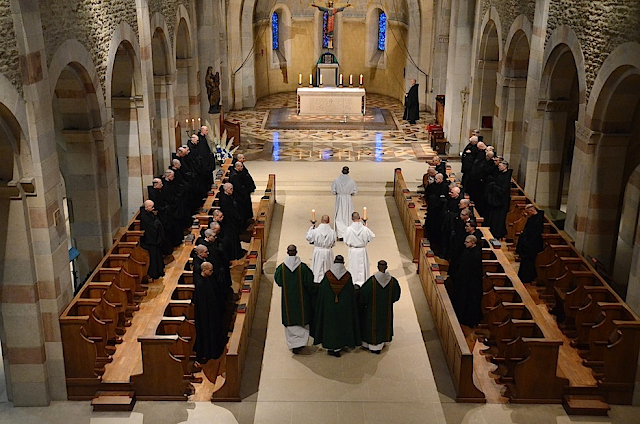
The Reading of the Rule of Saint Benedict for July 31
XLIX DE QUADRAGESIMAE OBSERVATIONE
1 Licet omni tempore vita monachi quadragesimae debet observationem habere,
2 tamen, quia paucorum est ista virtus, ideo suademus istis diebus quadragesimae omni puritate vitam suam custodire omnes pariter,
3 et neglegentas aliorum temporum his diebus sanctis diluere.
4 Quod tunc digne fit si ab omnibus vitiis temperamus, orationi cum fletibus, lectioni et compunctioni cordis atque abstinentiae operam damus.
5 Ergo his diebus augeamus nobis aliquid solid pensu servitutis nostrae, orationes peculiares, ciborum et potus Abstinentiam,
6 ut unusquisque super mensuram sibi indictam aliquid propria voluntate cum gaudio Sancti Spiritus offerat Deo,
7 id est subtrahat corpori suo de cibo, de potu, de somno, de loquacitate, de scurrilitate, et cum spiritalis desiderii gaudio sanctum Pascha exspectet.
8 Hoc ipsud tamen quod unusquisque offerit abbati suo suggerat, et cum eius Fiat oratione and voluntate,
9 quia quod sine permissione patris spiritalis fit, praesumptioni deputabitur and vanae gloriae, non mercedi.
10 Ergo cum voluntate abbatis omnia agenda sunt.
CHAPTER 49: THE OBSERVANCE OF LENT
1 Although at all times the life of a monk to be a Lenten observance,
2 yet since few have the strength for this we encourage all during these days of Lent to keep themselves in all purity of life,
3 and to wash away the negligences of other times during these holy days.
4 This we will do worthily do if we abstain from all vices and give ourselves to prayer with tears, reading, compunction of heart, and abstinence.
5 Therefore during these days let us augment somewhat our usual quota of service through private prayers and abstinence from food and drink,
6 so that each may offer, above his appointed measure and of his own free will, something to God in the joy of the Holy Spirit (1 Thess 1:6):
7 that is, by withholding from his body something of food, drink, sleep, excessive talking, ridiculing; and thus awaiting holy Easter with the joy of spiritual desire. (cf. Lk. 22:15)
8 Everyone is, however, is to make known to his abbot what he offers, and do it with his prayer and according to his will,
9 because what is done without permission of the spiritual father will be attributed to presumption and vainglory, and will merit no reward.
10 Therefore everything is to be according to the will of the abbot.
Today's Celebration of the Mass

Also Feast of Saint John Colombini
The side of Jesus is wounded by a spear

Jesus XPI Passio sit semper in cordibus nostris
May the Passion of Jesus Christ be always in our hearts

"The Cross is our trophy against the demons, our sword against sin, and the sword Christ used to pierce the serpent. The Cross is the Father's will, the glory of the Only-Begotten, the joy of the Spirit, the pride of the angels, the guarantee of the Church." -St. John Chrysostom








.jpeg)

Comments