Catholic devotions for 22nd July
Scroll down for today's:
Saint of the Day/ Feast
Reading of the Martyrology
Dedication of the Month
Dedication of the Day
Rosary
Five Wounds Rosary in Latin
Seven Sorrows Rosary in English
Latin Monastic Office
Reading of the Rule of Saint Benedict
Celebration of Mass
Reading from the School of Jesus Crucified
Reading from the School of Jesus Crucified

Feast of Saint Mary Magdalen
Miracles of St. Mary Magdalene
The Duke of Burgundy and the Translation of Her Relics
In the time of Charles the great, in the year of our Lord seven hundred and seventy-one, Gerard, duke of Burgundy might have no child by his wife, wherefore he gave largely alms to the poor people, and founded many churches, and many monasteries. And when he had made the abbey of Vesoul, he and the abbot of the monastery sent a monk with a good reasonable fellowship into Aix, for to bring thither if they might of the relics of St. Mary Magdalene.
And when the monk came to the said city, he found it all destroyed of paynims. Then by adventure he found the sepulchre, for the writing upon the sepulchre of marble showed well that the blessed lady Mary Magdalene rested and lay there, and the history of her was marvellously entailed and carved in the sepulchre. And then this monk opened it by night and took the relics, and bare them to his lodging. And that same night Mary Magdalene appeared to that monk, saying: Doubt thee nothing, make an end of the work. Then he returned homeward until he came half a mile from the monastery. But he might in no wise remove the relics from thence, till that the abbot and monks came with procession, and received them honestly. And soon after the duke had a child by his wife.
The Pilgrim Knight Revived
There was a knight that had a custom every year to go a pilgrimage unto the body of St. Mary Magdalene, which knight was slain in battle. And as his friends wept for him Iying on his bier, they said with sweet and devout quarrels, why she suffered her devout servant to die without confession and penance. Then suddenly he that was dead arose, all they being sore abashed, and made one to call a priest to him, and confessed him with great devotion, and received the blessed sacrament, and then rested in peace.
The Mother Saved from Shipwreck
There was a ship charged with men and women that was perished and all to-brake, and there was among them a woman with child, which saw herself in peril to be drowned, and cried fast on Mary Magdalene for succour and help, making her avow that if she might be saved by her merits, and escape that peril, if she had a son she should give him to the monastery. And anon as she had so avowed, a woman of honourable habit and beauty appeared to her, and took her by the chin and brought her to the rivage all safe, and the other perished and were drowned. And after, she was delivered and had a son, and accomplished her avow like as she had promised.
The Story of Mary Magdalene and St. John
Some say that St. Mary Magdalene was wedded to St. John the Evangelist when Christ called him from the wedding, and when he was called from her, she had thereof indignation that her husband was taken from her, and went and gave herself to all delight, but because it was not convenable that the calling of St. John should be occasion of her damnation, therefore our Lord converted her mercifully to penance, and because he had taken from her sovereign delight of the flesh, he replenished her with sovereign delight spiritual tofore all other, that is the love of God. And it is said that he ennobled St. John tofore all other with the sweetness of his familiarity, because he had taken him from the delight aforesaid.
She Helps a Blind Man See Her Church
There was a man which was blind on both his eyes, and did him to be led to the monastery of the blessed Mary Magdalene for to visit her body. His leader said to him that he saw the church. And then the blind man escried and said with a high voice: O blessed Mary Magdalene, help me that I may deserve once to see thy church. And anon his eyes were opened, and saw clearly all things about him.
The Man Whose Sins Were Erased
There was another man that wrote his sins in a schedule and laid it under the coverture of the altar of Mary Magdalene, meekly praying her that she should get for him pardon and forgiveness, and a while after, he took the schedule again, and found all his sins effaced and struck out.
The Man in Debtors’ Prison
Another man was holden in prison for debt of money, in irons. And he called unto his help ofttimes Mary Magdalene. And on a night a fair woman appeared to him and brake all his irons, and opened the door, and commanded him to go his way; and when he saw himself loose he fled away anon.
The Sinful Clerk of Flanders
There was a clerk of Flanders named Stephen Rysen, and mounted in so great and disordinate felony, that he haunted all manner sins. And such thing as appertained to his health he would not hear. Nevertheless he had great devotion in the blessed Mary Magdalene and fasted her vigil, and honoured her feast.
And on a time as he visited her tomb, he was not all asleep nor well awaked, when Mary Magdalene appeared to him like a much fair woman, sustained with two angels, one on the right side, and another on the left side, and said to him, looking on him despitously: Stephen, why reputest thou the deeds of my merits to be unworthy? Wherefore mayst not thou at the instance of my merits and prayers be moved to penance? For sith the time that thou begannest to have devotion in me, I have alway prayed God for thee firmly. Arise up therefore and repent thee, and I shall not leave thee till thou be reconciled to God.
And then forthwith he felt so great grace shed in him, that he forsook and renounced the world and entered into religion, and was after of right perfect life. And at the death of him was seen Mary Magdalene, standing beside the bier with angels which bare the soul up to heaven with heavenly song in likeness of a white dove.
Then let us pray to this blessed Mary Magdalene that she get us grace to do penance here for our sins, that after this life we may come to her in everlasting bliss in heaven. Amen.
Semen est sanguis Christianorum
The blood of Christians is the seed of the Church
Tertullian, Apologeticum, 50
The Reading from the Martyrology
This Day, the Twenty-Second Day of July
At Marseilles, the birthday of St. Mary Magdalen, out of whom our Lord expelled seven demons, and who deserved to be the first to see the Savior after He had risen from the dead.
At Philippi, St. Syntyches, mentioned by the blessed Apostle Paul.
At Ancyra, in Galatia, the birthday of the martyr St. Plato. Under the lieutenant-governor Agrippinus, he was scourged, lacerated with iron hooks, and subjected to other most atrocious torments, and finally being beheaded, he rendered his invincible soul to God. The miracles he wrougth in assisting the captives are attested in the Acts of the second Council of Nicaea.
In Cyprus, St. Theophilus, a praetor, who was apprehended by the Arabs, and as he could not be induced either by presents or threats to deny Christ, was put to the sword.
At Antioch, the holy bishop Cyril, who was distinguished for learning and holiness.
In the territory of Auvergne, St. Meneleus, abbot.
In the monastery of Blandine, the abbot St. Wandrille, celebrated for miracles.
At Marseilles, the birthday of St. Mary Magdalen, out of whom our Lord expelled seven demons, and who deserved to be the first to see the Savior after He had risen from the dead.
At Philippi, St. Syntyches, mentioned by the blessed Apostle Paul.
At Ancyra, in Galatia, the birthday of the martyr St. Plato. Under the lieutenant-governor Agrippinus, he was scourged, lacerated with iron hooks, and subjected to other most atrocious torments, and finally being beheaded, he rendered his invincible soul to God. The miracles he wrougth in assisting the captives are attested in the Acts of the second Council of Nicaea.
In Cyprus, St. Theophilus, a praetor, who was apprehended by the Arabs, and as he could not be induced either by presents or threats to deny Christ, was put to the sword.
At Antioch, the holy bishop Cyril, who was distinguished for learning and holiness.
In the territory of Auvergne, St. Meneleus, abbot.
In the monastery of Blandine, the abbot St. Wandrille, celebrated for miracles.

At Scythopolis, in Palestine, St. Joseph, a count.
At Lisbon, St. Lawrence of Brindisi, confessor, superior general of the Capuchin Friars Minor of St. Francis. Illustrious by his preaching and his arduous labor for the glory of God, he was canonized by Leo XIII, who appointed the 7th of July for his feast day.
Omnes sancti Mártyres, oráte pro nobis.
("All ye Holy Martyrs, pray for us", from the Litaniae Sanctorum, the Litany of the Saints)
July is the Month of the Most Precious Blood

Litaniae Pretiosissimi Sanguinis Domini Nostri Iesu Christi (Litany of the Most
Precious Blood of Our Lord Jesus Christ)
This Litany in honor of Jesus in His Most Precious Blood was drawn up by the Sacred
Congregation of Rites and promulgated by Pope John XXIII on February 24, 1960. The
devotion to Jesus in His most Precious Blood was first popularized by St. Gaspar del
Bufalo (1786-1837, feast Dec. 28) who founded the Missioners of the Most Precious
Blood. A partial indulgence is granted to the faithful who recite this litany.
Kyrie, eleison Kyrie, eleison.
Christe, eleison Christe, eleison.
Kyrie, eleison Kyrie, eleison.
Christe, audi nos Christe, audi nos.
Christe, exaudi nos. Christe, exaudi nos.
Pater de caelis, Deus, miserere nobis.
Fili, Redemptor mundi, Deus, miserere nobis.
Spiritus Sancte, Deus, miserere nobis.
Sancta Trinitas, unus Deus, miserere nobis.
Sanguis Christi, Unigeniti Patris aeterni, salva nos.
Sanguis Christi, Verbi Dei incarnati, salva nos.
Sanguis Christi, Novi et Aeterni Testamenti, salva nos.
Sanguis Christi, in agonia decurrens in terram, salva nos.
Sanguis Christi, in flagellatione profluens, salva nos.
Sanguis Christi, in coronatione spinarum emanans, salva nos.
Sanguis Christi, in Cruce effusus, salva nos.
Sanguis Christi, pretium nostrae salutis, salva nos.
Sanguis Christi, sine quo non fit remissio, salva nos.
Sanguis Christi, in Eucharistia potus et lavacrum animarum, salva nos.
Sanguis Christi, flumen misericordiae, salva nos.
Sanguis Christi, victor daemonum, salva nos.
Sanguis Christi, fortitudo martyrum, salva nos.
Sanguis Christi, virtus confessorum, salva nos.
Sanguis Christi, germinans virgines, salva nos.
Sanguis Christi, robur periclitantium, salva nos.
Sanguis Christi, levamen laborantium, salva nos.
Sanguis Christi, in fletu solatium, salva nos.
Sanguis Christi, spes poenitentium, salva nos.
Sanguis Christi, solamen morientium, salva nos.
Sanguis Christi, pax et dulcedo cordium, salva nos.
Sanguis Christi, pignus vitae aeternae, salva nos.
Sanguis Christi, animas liberans de lacu Purgatorii, salva nos.
Sanguis Christi, omni gloria et honore dignissimus, salva nos.
Agnus Dei, qui tollis peccata mundi, parce nobis, Domine.
Agnus Dei, qui tollis peccata mundi, exaudi nos, Domine.
Agnus Dei, qui tollis peccata mundi, miserere nobis, Domine.
V. redimisti nos, Domine, in sanguine tuo.
R. Et fecisti nos Deo nostro regnum.
Oremus;
Omnipotens sempiterne Deus, qui unigenitum Filium tuum mundi Redemptorem
constituisti, ac eius sanguine placari voluisti: concede, quaesumus, salutis nostrae
pretium ita venerari, atque a praesentis vitae malis eius virtute defendi in terris, ut
fructu perpetuo laetemur in caelis. Per eundem Christum Dominum nostrum. Amen.
Lord, have mercy. Lord, have mercy.
Christ, have mercy. Christ, have mercy.
Lord, have mercy. Lord, have mercy.
Christ, hear us. Christ, hear us.
Christ, graciously hear us. Christ, graciously hear us.
God the Father of Heaven, have mercy on us.
God the Son, Redeemer of the world, have mercy on us.
God, the Holy Spirit, have mercy on us.
Holy Trinity, One God, have mercy on us.
Blood of Christ, only-begotten Son of the eternal Father, save us.
Blood of Christ, Incarnate Word or God, save us.
Blood of Christ, of the New and Eternal Testament, save us.
Blood of Christ, falling upon the earth in Agony, save us.
Blood of Christ, shed profusely in the Scourging, save us.
Blood of Christ, flowing forth in the Crowning with Thorns, save us.
Blood of Christ, poured out on the Cross, save us.
Blood of Christ, price of our salvation, save us.
Blood of Christ, without which there is no forgiveness, save us.
Blood of Christ, Eucharistic drink and refreshment of souls, save us.
Blood of Christ, stream of mercy, save us.
Blood of Christ, victor over demons, save us.
Blood of Christ, courage of Martyrs, save us.
Blood of Christ, strength of Confessors, save us.
Blood of Christ, bringing forth Virgins, save us.
Blood of Christ, help of those in peril, save us.
Blood of Christ, relief of the burdened, save us.
Blood of Christ, solace in sorrow, save us.
Blood of Christ, hope of the penitent, save us.
Blood of Christ, consolation of the dying, save us.
Blood of Christ, peace and tenderness of hearts, save us.
Blood of Christ, pledge of eternal life, save us.
Blood of Christ, freeing souls from purgatory, save us.
Blood of Christ, most worthy of all glory and honor, save us.
Lamb of God, who taketh away the sins of the world, spare us, O Lord.
Lamb of God, who taketh away the sins of the world, graciously hear us, O Lord.
Lamb of God, who taketh away the sins of the world, have mercy on us, O Lord.
V. Thou hast redeemed us, O Lord, in Thy Blood.
R. And made us, for our God, a kingdom.
Let us pray;
Almighty and eternal God, Thou hast appointed Thine only-begotten Son the Redeemer
of the world and willed to be appeased by his blood. Grant, we beg of Thee, that we
may worthily adore this price of our salvation and through its power be safeguarded
from the evils of the present life so that we may rejoice in its fruits forever in heaven.
Through the same Christ our Lord. Amen.
Tuesday is the Day dedicated to the Holy Angels
Prayers for Every Day of the Week.
The Sorrowful Mysteries of the Rosary are prayed on Tuesday
"I would like to remind you that the Rosary is a biblical prayer, all filled with the Holy Scriptures." It is a prayer from the heart, in which the repetition of the Ave Maria directs the thought and affection towards Christ, and thus is made a confident prayer to Him and our Mother. It is a prayer that helps to meditate on the Word of God and assimilate the Eucharistic Communion, on the model of Mary who kept in her heart everything Jesus did and said and even His Presence. " Pope Benedict XVI
The Rosary in Latin
Chaplet of the Five Holy Wounds of Christ in Latin
Chaplet of the Seven Sorrows of Our Lady in English
Latin Monastic Office for today from Le Barroux in France Texts also provided
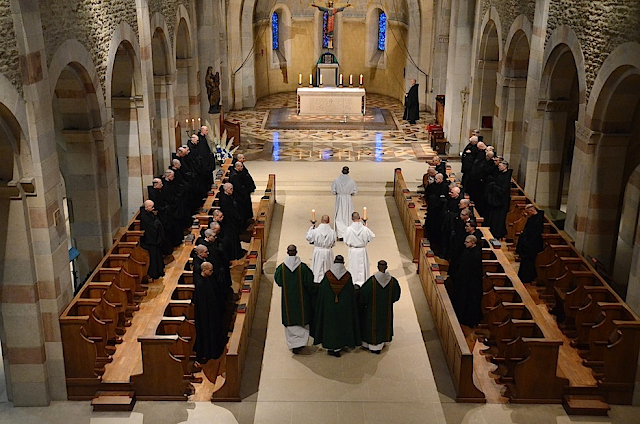
The Reading of the Rule of Saint Benedict for July 22
XLIII DE HIS QUI AD OPUS DEI VEL AD MENSAM TARDE OCCURRUNT
1 Ad horam divini officii, mox auditus fuerit signus, relictis omnibus quaelibet fuerint in manibus, summa cum festinatione curratur,
2 cum gravitate tamen, ut non scurrilitas inveniat fomitem.
3 Ergo nihil operi Dei praeponatur.
4 Quod si quis in nocturnis vigiliis post gloriam psalmi nonagesimi quarti, quem propter hoc omnino subtrahendo et morose volumus dici, occurrerit, non stet in ordine suo in choro,
5 sed ultimus omnium stet aut in loco quem talibus neglegentibus seorsum constituerit abbas, ut videantur ab ipso vel ab omnibus,
6 usque dum completo opere Dei publica satisfactione paeniteat.
7 Ideo autem eos in ultimo aut seorsum iudicavimus debere stare ut, visi ab omnibus, vel pro ipsa verecundia sua emendent;
8 nam, si foris oratorium remaneant, erit forte talis qui se aut recollocet et dormit, aut certe sedit sibi foris vel fabulis vacat, et datur occasio maligno;
9 sed ingrediantur intus, ut nec totum perdant et de reliquo emendent.
10 Diurnis autem horis, qui ad opus Dei post versum et gloriam primi psalmi qui post versum dicitur non occurrerit, lege qua supra diximus in ultimo stent,
11 nec praesumant sociari choro psallentium usque ad satisfactionem, nisi forte abbas licentiam dederit remissione sua,
12 ita tamen ut satisfaciat reus ex hoc.
CHAPTER 43, THOSE WHO ARRIVE LATE AT THE WORK OF GOD OR AT TABLE
1 At the hour for the Divine Office as soon as the signal is heard, he is to lay aside everything he is doing with his hands and hasten with all speed,
2 and yet seriously, so that no occasion is provided for ridiculing.
3 Thus nothing is to be preferred to the Work of God.
4 If anyone arrives at Vigils after the Gloria of Psalm Ninety-Four (which for this reason we wish to be said quite slowly and deliberately), he is not to stand in his usual rank in choir,
5 but last of all or in the place set apart by the abbot for the negligent, so that they may be seen by him and by all
6 until at the completion of the Work of God they make penance by public satisfaction.
7 The reason we have judged that they should stand in the last place or apart is so that, being seen by all, they will amend out of shame:
8 for if they remained outside the oratory there might be some who would go back to bed and sleep; or else sit outside and spend their time in idle story-telling and give occasion to the evil one (Eph 4:27; 1 Tim 5:14).
9 Instead they are to come in, so that they do not lose everything and may amend for the future.
10 But at the day hours, those who do not arrive at the Work of God until after the verse and the gloria of the first psalm which is said after the verse, must stand, as was said above, in the last place:
11 nor may they presume to join the choir in psalmody until they have made satisfaction, unless the abbot permits it by giving his pardon:
12 but even so, satisfaction is to be made for this.
Today's Celebration of the Mass

Also St Lawrence of Brindisi

Jesus XPI Passio sit semper in cordibus nostris
May the Passion of Jesus Christ be always in our hearts

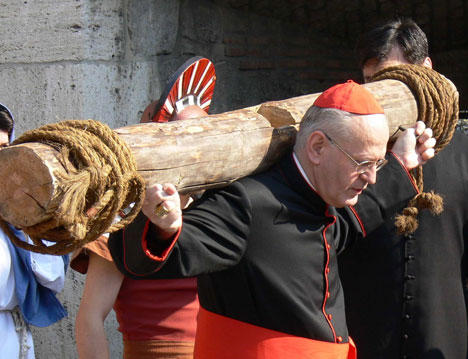
"The Cross is our trophy against the demons, our sword against sin, and the sword Christ used to pierce the serpent. The Cross is the Father's will, the glory of the Only-Begotten, the joy of the Spirit, the pride of the angels, the guarantee of the Church." -St. John Chrysostom








.jpeg)

Comments