Catholic devotions for 15th July
Scroll down for today's:
Saint of the Day/ Feast
Reading of the Martyrology
Dedication of the Month
Dedication of the Day
Rosary
Five Wounds Rosary in Latin
Seven Sorrows Rosary in English
Latin Monastic Office
Reading of the Rule of Saint Benedict
Celebration of Mass
Reading from the School of Jesus Crucified
Reading from the School of Jesus Crucified

Feast of Saint Henry, Holy Roman Emperor and Heavenly Patron of Benedictine Oblates
German King and Holy Roman Emperor, son of Duke Henry II (the Quarrelsome) and of the Burgundian Princess Gisela; b. 972; d. in his palace of Grona, at Gottingen, 13 July, 1024.
Like his predecessor, Otto III, he had the literary education of his time. In his youth he had been destined for the priesthood. Therefore he became acquainted with ecclesiastical interests at an early age.
Willingly he performed pious practices, gladly also he strengthened the Church of Germany, without, however, ceasing to regard ecclesiastical institutions as pivots of his power, according to the views of Otto the Great. With all his learning and piety, Henry was an eminently sober man, endowed with sound, practical common sense. He went his way circumspectly, never attempting anything but the possible and, wherever it was practicable, applying the methods of amiable and reasonable good sense. This prudence, however, was combined with energy and conscientiousness. Sick and suffering from fever, he traversed the empire in order to maintain peace. At all times he used his power to adjust troubles. The masses especially he wished to help.
The Church, as the constitutional Church of Germany, and therefore as the advocate of German unity and of the claims of inherited succession, raised Henry to the throne. The new king straightway resumed the policy of Otto I both in domestic and in foreign affairs. This policy first appeared in his treatment of the Eastern Marches. The encroachments of Duke Boleslaw, who had founded a great kingdom, impelled him to intervene. But his success was not marked.
In Italy the local and national opposition to the universalism of the German king had found a champion in Arduin of Ivrea. The latter assumed the Lombard crown in 1002. In 1004 Henry crossed the Alps. Arduin yielded to his superior power. The Archbishop of Milan now crowned him King of Italy. This rapid success was largely due to the fact that a large part of the Italian episcopate upheld the idea of the Roman Empire and that of the unity of Church and State.
On his second expedition to Rome, occasioned by the dispute between the Counts of Tuscany and the Crescentians over the nomination to the papal throne, he was crowned emperor on 14 February, 1014. But it was not until later, on his third expedition to Rome, that he was able to restore the prestige of the empire completely.
Before this happened, however, he was obliged to intervene in the west. Disturbances were especially prevalent throughout the entire northwest. Lorraine caused great trouble. The Counts of Lutzelburg (Luxemburg), brothers-in-law of the king, were the heart and soul of the disaffection in that country. Of these men, Adalbero had made himself Bishop of Trier by uncanonical methods (1003); but he was not recognized any more than his brother Theodoric, who had had himself elected Bishop of Metz.
True to his duty, the king could not be induced to abet any selfish family policy at the expense of the empire. Even though Henry, on the whole, was able to hold his own against these Counts of Lutzelburg, still the royal authority suffered greatly by loss of prestige in the northwest.
Burgundy afforded compensation for this. The lord of that country was Rudolph, who, to protect himself against his vassals, joined the party of Henry II, the son of his sister, Gisela, and to Henry the childless duke bequeathed his duchy, despite the opposition of the nobles (1006). Henry had to undertake several campaigns before he was able to enforce his claims. He did not achieve any tangible result, he only bequeathed the theoretical claims on Burgundy to his successors.
Better fortune awaited the king in the central and eastern parts of the empire. It is true that he had a quarrel with the Conradinians over Carinthia and Swabia: but Henry proved victorious because his kingdom rested on the solid foundation of intimate alliance with the Church.
That his attitude towards the Church was dictated in part by practical reasons, primarily he promoted the institutions of the Church chiefly in order to make them more useful supports his royal power, is clearly shown by his policy. How boldly Henry posed as the real ruler of the Church appears particularly in the establishment of the See of Bamberg, which was entirely his own scheme.
He carried out this measure, in 1007, in spite of the energetic opposition of the Bishop of Wurzburg against this change in the organization of the Church. The primary purpose of the new bishopric was the germanization of the regions on the Upper Main and the Regnitz, where the Wends had fixed their homes. field of culture, which it promoted chiefly by its prosperous schools. Henry, therefore, relied on the aid of the Church against the lay powers, which had become quite formidable. But he made no concessions to the Church.
Though naturally pious, and though well acquainted with ecclesiastical culture, he was at bottom a stranger to her spirit. He disposed of bishoprics autocratically. Under his rule the bishops, from whom he demanded unqualified obedience, seemed to be nothing but officials of the empire. He demanded the same obedience from the abbots. However, this political dependency did not injure the internal life of the German Church under Henry. By means of its economic and educational resources the Church had a blessed influence in this epoch.
But it was precisely this civilizing power of the German Church that aroused the suspicions of the reform party. This was significant, because Henry was more and more won over to the ideas of this party. At a synod at Goslar he confirmed decrees that tended to realize the demands made by the reform party. Ultimately this tendency could not fail to subvert the Othonian system, moreover could not fail to awaken the opposition of the Church of Germany as it was constituted.
This hostility on the part of the German Church came to a head in the emperor's dispute with Archbishop Aribo of Mainz. Aribo was an opponent of the reform movement of the monks of Cluny. The Hammerstein marriage imbroglio afforded the opportunity he desired to offer a bold front against Rome. Otto von Hammerstein had been communicated by Aribo on account of his marriage with Irmengard, and the latter had successfully appealed to Rome.
This called forth the opposition of the Synod of Seligenstadt, in 1023, which forbade an appeal to Rome without the consent of the bishop. This step meant open rebellion against the idea of church unity, and its ultimate result would have been the founding of a German national Church. In this dispute the emperor was entirely on the side of the reform party. He even wanted to institute international proceedings against the unruly archbishop by means of treaties with the French king. But his death prevented this.
Before this Henry had made his third journey to Rome in 1021. He came at the request of the loyal Italian bishops, who had warned him at Strasburg of the dangerous aspect of the Italian situation, and also of the pope, who sought him out at Bamberg in 1020. Thus the imperial power, which had already begun to withdraw from Italy, was summoned back thither. This time the object was to put an end to the supremacy of the Greeks in Italy. His success was not complete; he succeeded, however, in restoring the prestige of the empire in northern and central Italy.
Henry was far too reasonable a man to think seriously of readopting the imperialist plans of his predecessors. He was satisfied to have ensured the dominant position of the empire in Italy within reasonable bounds. Henry's power was in fact controlling, and this was in no small degree due to the fact that he was primarily engaged in solidifying the national foundations of his authority.
The later ecclesiastical legends have ascribed ascetic traits to this ruler, some of which certainly cannot withstand serious criticism. For instance, the highly varied theme of his virgin marriage to Cunegond has certainly no basis in fact.
The Church canonized this emperor in 1146, and his wife Cunegond in 1200.
Semen est sanguis Christianorum
The blood of Christians is the seed of the Church
Tertullian, Apologeticum, 50
The Reading from the Martyrology
This Day, the Fifteenth Day of July
At Bamberg, St. Henry II, emperor, who kept perpetual chastity with his wife Cunegunde, and induced St. Stephen, king of Hungary, with nearly all his kingdom, to receive the faith of Christ.
At Porto, the birthday of the holy martyrs Eutropius, and the sisters Zosima and Bonosa.
At Carthage, blessed Catulinus, deacon, whose glories were proclaimed by St. Augustine in a sermon to his people, and the Saints Januarius, Florentius, Julia and Justa, martyrs, who were entombed in the church of St. Faustus.
At Alexandria, the holy martyrs Philip, Zeno, Narseus, and ten children.
In the island of Tenedos, St. Abudemius, a martyr, who suffered under Diocletian.
At Sebaste, St. Antiochus, a physician, who was decapitated under the governor Adrian. On seeing milk flowing from his wounds instead of blood, Cyriaeus, his executioner, was converted to Christ and endured martyrdom.
At Pavia, St. Felix, bishop and martyr.
At Nisibis, the birthday of St. James, bishop of that city, a man celebrated for great holiness, miracles and erudition. He was one of those who confessed the faith during the persecution of Galerius Maximian, and afterwards, in the Council of Nicea, condemned the perverse heresy of Arius, by opposing to it the doctrine of consubstantiality. It was also owing to his prayers, and those of bishop Alexander, that Arius received at Constantinople the condign punishment of his iniquity, the extravasation of his intestines.
At Naples, in Campania, St. Athanasius, bishop of that city, who suffered much from his wicked nephew Sergius, by whom he was driven from his see. Consumed with afflictions, he departed for Heaven at Veroli, in the time of Charles the Bald.
At Palermo, the finding of the body of St. Rosalia, virgin of Palermo. Being miraculously discovered in the time of the Sovereign Pontiff, Urban VIII, it delivered Sicily from the plague in the year of the Jubilee.
At Campo in Italy, the birthday of St. Pompilio Maria Pirrotti of St. Nicholas, confessor, a member of the Congregation of Poor Clerks Regular of Pious Schools of the Mother of God, who spent his entire life in safeguarding the salvation of souls. He was registered among the saints by Pope Pius XI.
Omnes sancti Mártyres, oráte pro nobis.
("All ye Holy Martyrs, pray for us", from the Litaniae Sanctorum, the Litany of the Saints)
July is the Month of the Most Precious Blood

Litaniae Pretiosissimi Sanguinis Domini Nostri Iesu Christi (Litany of the Most
Precious Blood of Our Lord Jesus Christ)
This Litany in honor of Jesus in His Most Precious Blood was drawn up by the Sacred
Congregation of Rites and promulgated by Pope John XXIII on February 24, 1960. The
devotion to Jesus in His most Precious Blood was first popularized by St. Gaspar del
Bufalo (1786-1837, feast Dec. 28) who founded the Missioners of the Most Precious
Blood. A partial indulgence is granted to the faithful who recite this litany.
Kyrie, eleison Kyrie, eleison.
Christe, eleison Christe, eleison.
Kyrie, eleison Kyrie, eleison.
Christe, audi nos Christe, audi nos.
Christe, exaudi nos. Christe, exaudi nos.
Pater de caelis, Deus, miserere nobis.
Fili, Redemptor mundi, Deus, miserere nobis.
Spiritus Sancte, Deus, miserere nobis.
Sancta Trinitas, unus Deus, miserere nobis.
Sanguis Christi, Unigeniti Patris aeterni, salva nos.
Sanguis Christi, Verbi Dei incarnati, salva nos.
Sanguis Christi, Novi et Aeterni Testamenti, salva nos.
Sanguis Christi, in agonia decurrens in terram, salva nos.
Sanguis Christi, in flagellatione profluens, salva nos.
Sanguis Christi, in coronatione spinarum emanans, salva nos.
Sanguis Christi, in Cruce effusus, salva nos.
Sanguis Christi, pretium nostrae salutis, salva nos.
Sanguis Christi, sine quo non fit remissio, salva nos.
Sanguis Christi, in Eucharistia potus et lavacrum animarum, salva nos.
Sanguis Christi, flumen misericordiae, salva nos.
Sanguis Christi, victor daemonum, salva nos.
Sanguis Christi, fortitudo martyrum, salva nos.
Sanguis Christi, virtus confessorum, salva nos.
Sanguis Christi, germinans virgines, salva nos.
Sanguis Christi, robur periclitantium, salva nos.
Sanguis Christi, levamen laborantium, salva nos.
Sanguis Christi, in fletu solatium, salva nos.
Sanguis Christi, spes poenitentium, salva nos.
Sanguis Christi, solamen morientium, salva nos.
Sanguis Christi, pax et dulcedo cordium, salva nos.
Sanguis Christi, pignus vitae aeternae, salva nos.
Sanguis Christi, animas liberans de lacu Purgatorii, salva nos.
Sanguis Christi, omni gloria et honore dignissimus, salva nos.
Agnus Dei, qui tollis peccata mundi, parce nobis, Domine.
Agnus Dei, qui tollis peccata mundi, exaudi nos, Domine.
Agnus Dei, qui tollis peccata mundi, miserere nobis, Domine.
V. redimisti nos, Domine, in sanguine tuo.
R. Et fecisti nos Deo nostro regnum.
Oremus;
Omnipotens sempiterne Deus, qui unigenitum Filium tuum mundi Redemptorem
constituisti, ac eius sanguine placari voluisti: concede, quaesumus, salutis nostrae
pretium ita venerari, atque a praesentis vitae malis eius virtute defendi in terris, ut
fructu perpetuo laetemur in caelis. Per eundem Christum Dominum nostrum. Amen.
Lord, have mercy. Lord, have mercy.
Christ, have mercy. Christ, have mercy.
Lord, have mercy. Lord, have mercy.
Christ, hear us. Christ, hear us.
Christ, graciously hear us. Christ, graciously hear us.
God the Father of Heaven, have mercy on us.
God the Son, Redeemer of the world, have mercy on us.
God, the Holy Spirit, have mercy on us.
Holy Trinity, One God, have mercy on us.
Blood of Christ, only-begotten Son of the eternal Father, save us.
Blood of Christ, Incarnate Word or God, save us.
Blood of Christ, of the New and Eternal Testament, save us.
Blood of Christ, falling upon the earth in Agony, save us.
Blood of Christ, shed profusely in the Scourging, save us.
Blood of Christ, flowing forth in the Crowning with Thorns, save us.
Blood of Christ, poured out on the Cross, save us.
Blood of Christ, price of our salvation, save us.
Blood of Christ, without which there is no forgiveness, save us.
Blood of Christ, Eucharistic drink and refreshment of souls, save us.
Blood of Christ, stream of mercy, save us.
Blood of Christ, victor over demons, save us.
Blood of Christ, courage of Martyrs, save us.
Blood of Christ, strength of Confessors, save us.
Blood of Christ, bringing forth Virgins, save us.
Blood of Christ, help of those in peril, save us.
Blood of Christ, relief of the burdened, save us.
Blood of Christ, solace in sorrow, save us.
Blood of Christ, hope of the penitent, save us.
Blood of Christ, consolation of the dying, save us.
Blood of Christ, peace and tenderness of hearts, save us.
Blood of Christ, pledge of eternal life, save us.
Blood of Christ, freeing souls from purgatory, save us.
Blood of Christ, most worthy of all glory and honor, save us.
Lamb of God, who taketh away the sins of the world, spare us, O Lord.
Lamb of God, who taketh away the sins of the world, graciously hear us, O Lord.
Lamb of God, who taketh away the sins of the world, have mercy on us, O Lord.
V. Thou hast redeemed us, O Lord, in Thy Blood.
R. And made us, for our God, a kingdom.
Let us pray;
Almighty and eternal God, Thou hast appointed Thine only-begotten Son the Redeemer
of the world and willed to be appeased by his blood. Grant, we beg of Thee, that we
may worthily adore this price of our salvation and through its power be safeguarded
from the evils of the present life so that we may rejoice in its fruits forever in heaven.
Through the same Christ our Lord. Amen.
Tuesday is the Day dedicated to the Holy Angels
Prayers for Every Day of the Week.
The Sorrowful Mysteries of the Rosary are prayed on Tuesday
"I would like to remind you that the Rosary is a biblical prayer, all filled with the Holy Scriptures." It is a prayer from the heart, in which the repetition of the Ave Maria directs the thought and affection towards Christ, and thus is made a confident prayer to Him and our Mother. It is a prayer that helps to meditate on the Word of God and assimilate the Eucharistic Communion, on the model of Mary who kept in her heart everything Jesus did and said and even His Presence. " Pope Benedict XVI
The Rosary in Latin
Chaplet of the Five Holy Wounds of Christ in Latin
Chaplet of the Seven Sorrows of Our Lady in English
Latin Monastic Office for today from Le Barroux in France Texts also provided
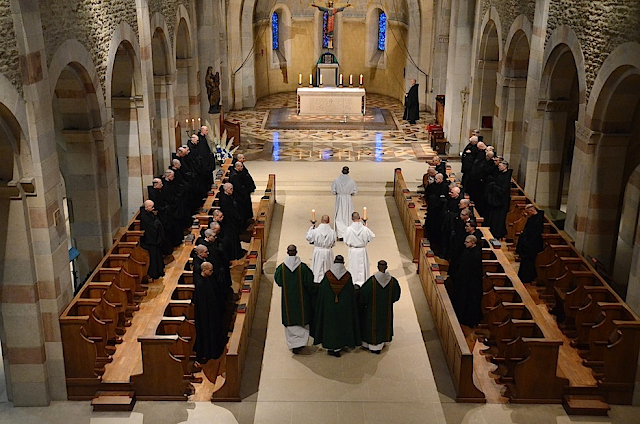
The Reading of the Rule of Saint Benedict for July 15
XXXVI DE INFIRMIS FRATRIBUS
1 Infirmorum cura ante omnia et super omnia adhibenda est, ut sicut revera Christo ita eis serviatur,
2 quia ipse dixit: Infirmus fui et visitastis me,
3 et: Quod fecistis uni de his minimis mihi fecistis.
4 Sed et ipsi infirmi considerent in honorem Dei sibi servire, et non superfluitate sua contristent fratres suos servientes sibi;
5 qui tamen patienter portandi sunt, quia de talibus copiosior merces acquiritur.
6 Ergo cura maxima sit abbati ne aliquam neglegentiam patiantur.
7 Quibus fratribus infirmis sit cella super se deputata et servitor timens Deum et diligens ac sollicitus.
8 Balnearum usus infirmis quotiens expedit offeratur ‑ sanis autem et maxime iuvenibus tardius concedatur.
9 Sed et carnium esus infirmis omnino debilibus pro reparatione concedatur; at, ubi meliorati fuerunt, a carnibus more solito omnes abstineant.
10 Curam autem maximam habeat abbas ne a cellarariis aut a servitoribus neglegantur infirmi. Et ipsum respicit quicquid a discipulis delinquitur.
CHAPTER 36: THE SICK BROTHERS
1 CARE of the sick must rank before and above everything, so that they may truly be served as Christ Himself,
2 for He said: I was sick and you visited me (Matt 25:36)
3 and, What you did for one of these who are least, you did for me (Matt 25:40).
4 But let the sick are themselves to consider that they are served out of honor for God, and they are not to sadden their brothers who serve them with superfluous demands;
5 Yet they are to be patiently borne with, because from such as these a more abundant reward is acquired.
6 The abbot shall therefore exercise the greatest care that they not suffer any neglect.
7 These brothers who are sick are to be assigned a separate room and a God-fearing attendant who is also diligent and solicitous.
8 Baths may be offered the sick whenever this is helpful, but those who are healthy, especially the young are to be allowed this less frequently.
9 Additionally, the sick who are very weak may be allowed to eat meat to recover their strength; but when they are better, all are to abstain from meat as usual.
10 Moreover the abbot is to maintain the greatest care that that the sick are not neglected by the cellarers or attendants. For he is responsible for whatever is lacking in his disciples.
Today's Celebration of the Mass

Saint Pompilio Maria Pirrotti, Founder of the Piarists, the Order of the Pious Schools
Barabbas preferred before Jesus

Jesus XPI Passio sit semper in cordibus nostris
May the Passion of Jesus Christ be always in our hearts

"The Cross is our trophy against the demons, our sword against sin, and the sword Christ used to pierce the serpent. The Cross is the Father's will, the glory of the Only-Begotten, the joy of the Spirit, the pride of the angels, the guarantee of the Church." -St. John Chrysostom







.jpeg)

Comments