Catholic devotions for 11th July
Scroll down for today's:
Saint of the Day/ Feast
Reading of the Martyrology
Dedication of the Month
Dedication of the Day
Rosary
Five Wounds Rosary in Latin
Seven Sorrows Rosary in English
Latin Monastic Office
Reading of the Rule of Saint Benedict
Celebration of Mass
Reading from the School of Jesus Crucified

Date of birth unknown; pope from about 140 to about 154. According to the earliest list of the popes, given by Irenaeus (Against Heresies II.31; cf. Eusebius, Church History V.6), Pius was the ninth successor of St. Peter. The dates given in the Liberian Catalog for his pontificate (146-61) rest on a false calculation of earlier chroniclers, and cannot be accepted. The only chronological datum we possess is supplied by the year of St. Polycarp of Smyrna's death, which may be referred with great certainty to 155-6. On his visit to Rome in the year before his death Polycarp found Anicetus, the successor of Pius, bishop there; consequently, the death of Pius must have occurred about 154. The "Liber Pontificalis" (ed. Duchesne, I, 132) says the father of Pius was Rufinus, and makes him a native of Aquileia; this is, however, probably a conjecture of the author, who had heard of Rufinus of Aquileia (end of fourth century). From a notice in the "Liberian Catalog" (in Duchesne, "Liber Pontificalis", I, 5), which is confirmed by the Muratorian Fragment (ed. Preuschen, "Analecta", I, Tübingen, 1910), we learn that a brother of this pope, Hermas by name, published "The Shepherd". If the information which the author gives concerning his personal conditions and station (first a slave, then a freedman) were historical, we should know more about the origin of the pope, his brother. It is very possible that the story which Hermas relates of himself is a fiction.
During the pontificate of Pius the Roman Church was visited by various heretics, who sought to propagate their false doctrine among the faithful of the capital. The Gnostic Valentinus, who had made his appearance under Pope Hyginus, continued to sow his heresy, apparently not without success. The Gnostic Cerdon was also active in Rome at this period, during which Marcion arrived in the capital (see MARCIONITES). Excluded from communion by Pius, the latter founded his heretical body (Irenaeus, Against Heresies III.3). But Catholic teachers also visited the Roman Church, the most important being St. Justin, who expounded the Christian teachings during the pontificate of Pius and that of his successor. A great activity thus marks the Christian community in Rome, which stands clearly conspicuous as the center of the Church. The "Liber Pontificalis" (ed. cit.) speaks of a decision of this pope to the effect that Jewish converts to Christianity should be admitted and baptized. What this means we do not know; doubtless the author of the "Liber Pontificalis", here as frequently, refers to the pope a decree valid in the Church of his own time. A later legend refers to the foundation of the two churches, the titulus Pudentis (ecclesia Pudentiana) and the titulus Praxedis, to the time of this pope, who is also supposed to have built a baptistry near the former and to have exercised episcopal functions there (Acta SS., IV May, 299 sqq.; cf. de Rossi, "Musaici delle chiese di Roma: S. Pudenziana, S. Prassede"). The story, however, can lay no claim to historical credibility. These two churches came into existence in the fourth century, although it is not impossible that they replaced Christian houses, in which the faithful of Rome assembled for Divine service before the time of Constantine; the legend, however, should not be alleged as proof of this fact. In many later writings (e.g. the "Liber Pontificalis") the "Pastor" or "Shepherd" in the work of Hermas is erroneously accepted as the name of the author, and, since a Roman priest Pastor is assigned an important role in the foundation of these churches, it is quite possible that the writer of the legend was similarly misled, and consequently interwove Pope Pius into his legendary narrative Two letters written to Bishop Justus of Vienne (P.L., V, 1125 sq.; Jaffé, "Regesta", I, 2nd ed., pp. 7 sq.), ascribed to Pius, are not authentic. The feast of St. Pius I is celebrated on 11 July.
Source
Semen est sanguis Christianorum
The blood of Christians is the seed of the Church
Tertullian, Apologeticum, 50
The Reading from the Martyrology
This Day, the Eleventh Day of July
At Rome, the blessed Pius, Pope and martyr, who was crowned with martyrdom in the persecution of Marcus Aurelius Antoninus.
At Nicopolis, in Armenia, the birthday of the holy martyrs Januarius and Pelagia, who for four days were racked, torn with iron claws and pieces of earthenware, and thus achieved their martyrdom.
In the territory of Sens, St. Sidronius, martyr.
At Iconium, St. Marcian, martyr, who obtained the palm of martyrdom by many torments, under the governor Perennius.
At Sida, in Pamphylia, St. Cindeus, priest, in the time of the emperor Diocletian and the governor Stratonicus. After suffering many torments, he was thrown into the fire, but remaining uninjured, he yielded up his soul in prayer.
At Brescia, the holy martyrs Savinus and Cyprian.
At Bergamo, St. John, a bishop, martyr, who was killed by the Arians for defending the Catholic faith.
At Cordova, St. Abundius, a priest, crowned with martyrdom whilst preaching against the sect of Mahomet.
In the territory of Poitiers, St. Sabinus, confessor.
And elsewhere in divers places, many other holy martyrs, confessors, and holy virgins.
Omnes sancti Mártyres, oráte pro nobis.
("All ye Holy Martyrs, pray for us", from the Litaniae Sanctorum, the Litany of the Saints)
July is the Month of the Most Precious Blood

Litaniae Pretiosissimi Sanguinis Domini Nostri Iesu Christi (Litany of the Most
Precious Blood of Our Lord Jesus Christ)
This Litany in honor of Jesus in His Most Precious Blood was drawn up by the Sacred
Congregation of Rites and promulgated by Pope John XXIII on February 24, 1960. The
devotion to Jesus in His most Precious Blood was first popularized by St. Gaspar del
Bufalo (1786-1837, feast Dec. 28) who founded the Missioners of the Most Precious
Blood. A partial indulgence is granted to the faithful who recite this litany.
Kyrie, eleison Kyrie, eleison.
Christe, eleison Christe, eleison.
Kyrie, eleison Kyrie, eleison.
Christe, audi nos Christe, audi nos.
Christe, exaudi nos. Christe, exaudi nos.
Pater de caelis, Deus, miserere nobis.
Fili, Redemptor mundi, Deus, miserere nobis.
Spiritus Sancte, Deus, miserere nobis.
Sancta Trinitas, unus Deus, miserere nobis.
Sanguis Christi, Unigeniti Patris aeterni, salva nos.
Sanguis Christi, Verbi Dei incarnati, salva nos.
Sanguis Christi, Novi et Aeterni Testamenti, salva nos.
Sanguis Christi, in agonia decurrens in terram, salva nos.
Sanguis Christi, in flagellatione profluens, salva nos.
Sanguis Christi, in coronatione spinarum emanans, salva nos.
Sanguis Christi, in Cruce effusus, salva nos.
Sanguis Christi, pretium nostrae salutis, salva nos.
Sanguis Christi, sine quo non fit remissio, salva nos.
Sanguis Christi, in Eucharistia potus et lavacrum animarum, salva nos.
Sanguis Christi, flumen misericordiae, salva nos.
Sanguis Christi, victor daemonum, salva nos.
Sanguis Christi, fortitudo martyrum, salva nos.
Sanguis Christi, virtus confessorum, salva nos.
Sanguis Christi, germinans virgines, salva nos.
Sanguis Christi, robur periclitantium, salva nos.
Sanguis Christi, levamen laborantium, salva nos.
Sanguis Christi, in fletu solatium, salva nos.
Sanguis Christi, spes poenitentium, salva nos.
Sanguis Christi, solamen morientium, salva nos.
Sanguis Christi, pax et dulcedo cordium, salva nos.
Sanguis Christi, pignus vitae aeternae, salva nos.
Sanguis Christi, animas liberans de lacu Purgatorii, salva nos.
Sanguis Christi, omni gloria et honore dignissimus, salva nos.
Agnus Dei, qui tollis peccata mundi, parce nobis, Domine.
Agnus Dei, qui tollis peccata mundi, exaudi nos, Domine.
Agnus Dei, qui tollis peccata mundi, miserere nobis, Domine.
V. redimisti nos, Domine, in sanguine tuo.
R. Et fecisti nos Deo nostro regnum.
Oremus;
Omnipotens sempiterne Deus, qui unigenitum Filium tuum mundi Redemptorem
constituisti, ac eius sanguine placari voluisti: concede, quaesumus, salutis nostrae
pretium ita venerari, atque a praesentis vitae malis eius virtute defendi in terris, ut
fructu perpetuo laetemur in caelis. Per eundem Christum Dominum nostrum. Amen.
Lord, have mercy. Lord, have mercy.
Christ, have mercy. Christ, have mercy.
Lord, have mercy. Lord, have mercy.
Christ, hear us. Christ, hear us.
Christ, graciously hear us. Christ, graciously hear us.
God the Father of Heaven, have mercy on us.
God the Son, Redeemer of the world, have mercy on us.
God, the Holy Spirit, have mercy on us.
Holy Trinity, One God, have mercy on us.
Blood of Christ, only-begotten Son of the eternal Father, save us.
Blood of Christ, Incarnate Word or God, save us.
Blood of Christ, of the New and Eternal Testament, save us.
Blood of Christ, falling upon the earth in Agony, save us.
Blood of Christ, shed profusely in the Scourging, save us.
Blood of Christ, flowing forth in the Crowning with Thorns, save us.
Blood of Christ, poured out on the Cross, save us.
Blood of Christ, price of our salvation, save us.
Blood of Christ, without which there is no forgiveness, save us.
Blood of Christ, Eucharistic drink and refreshment of souls, save us.
Blood of Christ, stream of mercy, save us.
Blood of Christ, victor over demons, save us.
Blood of Christ, courage of Martyrs, save us.
Blood of Christ, strength of Confessors, save us.
Blood of Christ, bringing forth Virgins, save us.
Blood of Christ, help of those in peril, save us.
Blood of Christ, relief of the burdened, save us.
Blood of Christ, solace in sorrow, save us.
Blood of Christ, hope of the penitent, save us.
Blood of Christ, consolation of the dying, save us.
Blood of Christ, peace and tenderness of hearts, save us.
Blood of Christ, pledge of eternal life, save us.
Blood of Christ, freeing souls from purgatory, save us.
Blood of Christ, most worthy of all glory and honor, save us.
Lamb of God, who taketh away the sins of the world, spare us, O Lord.
Lamb of God, who taketh away the sins of the world, graciously hear us, O Lord.
Lamb of God, who taketh away the sins of the world, have mercy on us, O Lord.
V. Thou hast redeemed us, O Lord, in Thy Blood.
R. And made us, for our God, a kingdom.
Let us pray;
Almighty and eternal God, Thou hast appointed Thine only-begotten Son the Redeemer
of the world and willed to be appeased by his blood. Grant, we beg of Thee, that we
may worthily adore this price of our salvation and through its power be safeguarded
from the evils of the present life so that we may rejoice in its fruits forever in heaven.
Through the same Christ our Lord. Amen.
Friday is the Day dedicated to the Christ's Passion and His Sacred Heart
Fridays are penitential days and Catholics are to keep in mind Christ's suffering and to sacrifice something for the sake of penance and discipline. The traditional way to do this is to abstain from meat. On this day also, many Catholics make what is known as the "First Fridays Devotion" in honor of the Sacred Heart. This entails going to Mass and receiving Communion in reparation to the Sacred Heart on the first Friday of the month for nine consecutive months (see Devotion to the Sacred Heart of Jesus). Another Friday practice is to kneel and pray five Paters and five Aves, especially at 3:00pm, the hour Christ died on the Cross.
The Sorrowful Mysteries of the Rosary are prayed on Friday
"I would like to remind you that the Rosary is a biblical prayer, all filled with the Holy Scriptures." It is a prayer from the heart, in which the repetition of the Ave Maria directs the thought and affection towards Christ, and thus is made a confident prayer to Him and our Mother. It is a prayer that helps to meditate on the Word of God and assimilate the Eucharistic Communion, on the model of Mary who kept in her heart everything Jesus did and said and even His Presence. " Pope Benedict XVI
The Rosary in Latin
Chaplet of the Five Holy Wounds of Christ in Latin
Chaplet of the Seven Sorrows of Our Lady in English
Latin Monastic Office for today from Le Barroux in France Texts also provided
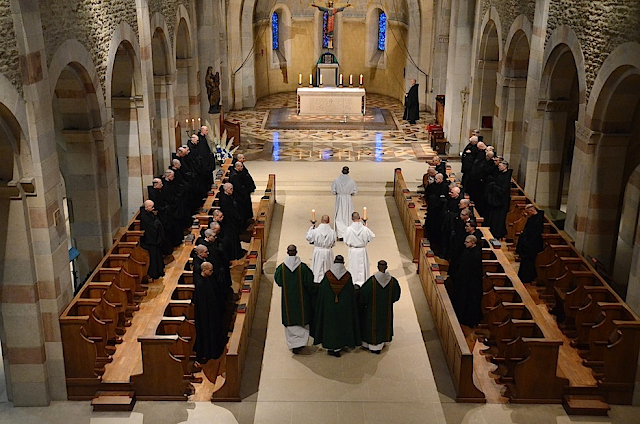
The Reading of the Rule of Saint Benedict for July 11
XXXIII SI QUID DEBEANT MONACHI PROPRIUM HABERE
1 Praecipue hoc vitium radicitus amputandum est de monasterio,
2 ne quis praesumat aliquid dare aut accipere sine iussione abbatis,
3 neque aliquid habere proprium, nullam omnino rem, neque codicem, neque tabulas, neque graphium, sed nihil omnino,
4 quippe quibus nec corpora sua nec voluntates licet habere in propria voluntate;
5 omnia vero necessaria a patre sperare monasterii, nec quicquam liceat habere quod abbas non dederit aut permiserit.
6 Omniaque omnium sint communia, ut scriptum est, ne quisquam suum aliquid dicat vel praesumat.
7 Quod si quisquam huic nequissimo vitio deprehensus fuerit delectari, admoneatur semel et iterum;
8 si non emendaverit, correptioni subiaceat.
CHAPTER 33: WHETHER MONKS SHOULD HAVE ANYTHING OF THEIR OWN
1 Above all this vice is to be cut out by the roots from the monastery,
2 no one may presume to give or receive anything without the abbot’s order
3 nor to have anything as their own - not anything - neither book, writing-tablet, pen, nor anything at all
4 since it is not allowed that even their body or their will should remain subject to their own will:
5 rather, for all necessary things let them trust to the father of the monastery, since none of them is allowed to have anything which the abbot has not given or permitted.
6 All things are to be held in common by all, as it is written, so that no one may say or presume that anything is his own (Acts 4:32).
7 But if anyone is found engaging in this most destructive vice he is to be admonished once or twice:
8 if he does not amend he is to be subjected to correction.
Today's Celebration of the Mass

Feast of Saint Ignatius Delgado OP, martyr
Jesus is derided and treated most ignominiously in the house of Caiaphas.

Jesus XPI Passio sit semper in cordibus nostris
May the Passion of Jesus Christ be always in our hearts







.jpeg)

Comments