Devotions for 30th June
Scroll down for today's
Saint of the Day/ Feast
Reading of the Martyrology
Dedication of the Month
Dedication of the Day
Rosary
Five Wounds Rosary in Latin
Seven Sorrows Rosary in English
Latin Monastic Office
Reading of the Rule of Saint Benedict
Celebration of Mass
Reading from the School of Jesus Crucified

The Martyrdom of St. Paul
And when he had said this he was led to the place of his martyrdom, and as he was led, the three knights that led him said to him: Tell to us, Paul, who is he your king that ye love so much that for his love ye had liefer die than live, and what reward shall ye have therefor?
Then Paul preached to them of the kingdom of heaven and of the pain of hell, in such wise that he converted them to the faith, and they prayed him to go freely whither he would.
God forbid, brethren, said he, that I should flee, I am not fugitive, but the lawful knight of Christ. I know well that from this transitory life I shall go to everlasting life. As soon as I shall be beheaded, true men shall take away my body; mark ye well the place, and come thither to-morrow, and ye shall find by my sepulchre two men, Luke and Titus, praying. To whom when ye shall tell for what cause I have sent you to them, they shall baptize you and make you heirs of the kingdom of heaven.
And whiles they thus spake together, Nero sent two knights to look if he were slain and beheaded or no, and when thus St. Paul would have converted them, they said: When thou art dead and risest again, then we shall believe, now come forth and receive that thou hast deserved.
And as he was led to the place of his passion in the gate of Hostence, a noble woman named Plautilla, a disciple of Paul, who after another name was called Lemobia, for haply she had two names, met there with Paul, which weeping, commended her to his prayers. To whom Paul said: Farewell, Plautilla, daughter of everlasting health, lend to me thy veil or keverchief with which thou coverest thy head, that I may bind mine eyes therewith, and afterwards I shall restore it to thee again.
And when she had delivered it to him, the butchers scorned her, saying: Why hast thou delivered to this enchanter so precious a cloth for to lose it?
Then, when he came to the place of his passion, he turned him toward the east, holding his hands up to heaven right long, with tears praying in his own language and thanking our Lord, and after that bade his brethren farewell, and bound his eyes himself with the keverchief of Plautilla, and kneeling down on both knees, stretched forth his neck, and so was beheaded. And as soon as the head was from the body, it said, "Jesus Christus!" which had been to "Jesus" or "Christus," or both, fifty times. From his wound sprang out milk into the clothes of the knight, and afterward flowed out blood. In the air was a great shining light, and from the body came a much sweet odour.
Dionysius, in an epistle to Timothy, saith of the death of Paul thus:
In that hour full of heaviness, my wellbeloved brother, the butcher saying, "Paul, make ready thy neck," then blessed Paul looked up into heaven, marking his forehead and his breast with the sign of the cross, and then said anon, "My Lord Jesu Christ, into thy hands I commend my spirit, etc." And then without heaviness and compulsion he stretched forth his neck and received the crown of martyrdom, the butcher so smiting off his head.
The blessed martyr Paul took the keverchief, and unbound his eyes, and gathered up his own blood, and put it therein and delivered to the woman. Then the butcher returned, and Plautilla met him and demanded him, saying: Where hast thou left my master?
The knight answered: He lieth without the town with one of his fellows, and his visage is covered with thy keverchief.
And she answered and said: I have now seen Peter and Paul enter into the city clad with right noble vestments, and also they had right fair crowns upon their heads, more clear and more shining than the sun, and hath brought again my keverchief all bloody which he hath delivered me.
For which thing and work many believed in our Lord and were baptized.
The Reading from the Martyrology
This Day, the Thirtieth Day of June
The commemoration of the holy Apostle Paul.
At Limoges, in France, St. Martial, bishop, with two priests, Alpinian and Austriclinian, whose lives were distinguished for miracles.
The same day, the saints Caius, priest, and Leo, subdeacon.
At Alexandria, the passion of St. Basilides, under the emperor Severus. He protected from the insults of profligate men the saintly virgin Potamioena, whom he was leading to execution, and received from her the reward of his pious action. For, at the end of three days, she appeared to him, and placing a crown on his head, not only converted him to Christ, but by her prayers made of him, after a short combat, a glorious martyr.
At Rome, St. Lucina, a disciple of the Apostles, who relieved the necessities of the saints with her goods, visited the Christians detained in prison, buried the martyrs, and was laid by their side in a crypt constructed by herself.
In the same city, St. Aemiliana, martyr.
In the territory of Viviers, St. Ostian, priest and confessor.
At Salanica, in the district of Vicenza, St. Theobald, priest and hermit, one of the counts of Champagne. He was added to the number of the saints by Alexander III because of his holiness and miracles.
And elsewhere in divers places, many other holy martyrs, confessors, and holy virgins.
Omnes sancti Mártyres, oráte pro nobis.
("All ye Holy Martyrs, pray for us", from the Litaniae Sanctorum, the Litany of the Saints)
June is the Month of the Sacred Heart
.jpg)
Amen.
V. Heart of Jesus once in agony.
R. Pity the dying.
(300 days every time said. Plenary indulgence under the usual conditions if said thrice daily'but at three distinct times during the day'for a month)
(a) V. Praised be Jesus Christ.
R. Amen'or'Forever.
(b) V. Praised be Jesus and Mary.
R. Today and forever.
(c) V. Glory to the Sacred Heart of Jesus.
R. Glory to the immaculate heart of Mary.
(300 days every time any one of the foregoing is said as salutation and answer)*
Graciously grant, O Lord, peace in our times, that, aided by the help of Thy mercy, we may always be free from sin and secure from all disturbance. Through Christ Our Lord. Amen.
(3 years every time said)*
Burn, O Lord, our loins and our hearts with the fire of the Holy Ghost, that we may serve Thee with a chaste body and please Thee with a pure heart. Through Christ Our Lord. Amen.
(3 years every time said)*
Prayers for Every Day of the Week
The Joyful Mysteries of the Rosary are prayed on Monday
"I would like to remind you that the Rosary is a biblical prayer, all filled with the Holy Scriptures." It is a prayer from the heart, in which the repetition of the Ave Maria directs the thought and affection towards Christ, and thus is made a confident prayer to Him and our Mother. It is a prayer that helps to meditate on the Word of God and assimilate the Eucharistic Communion, on the model of Mary who kept in her heart everything Jesus did and said and even His Presence. " Pope Benedict XVI
The Rosary in Latin
Chaplet of the Five Holy Wounds of Christ in Latin
Chaplet of the Seven Sorrows of Our Lady in English
Latin Monastic Office for today from Le Barroux in France Texts also provided
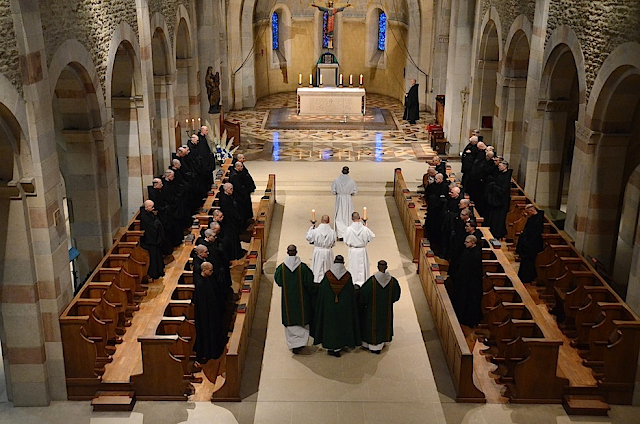
The Reading of the Rule of Saint Benedict for June 30
XXIII DE EXCOMMUNICATIONE CULPARUM
1 Si quis frater contumax aut inoboediens aut superbus aut murmurans vel in aliquo contrarius exsistens sanctae regulae et praeceptis seniorum suorum contemptor repertus fuerit,
2 hic secundum Domini nostri praeceptum admoneatur semel et secundo secrete a senioribus suis.
3 Si non emendaverit, obiurgetur publice coram omnibus.
4 Si vero neque sic correxerit, si intellegit qualis poena sit, excommunicationi subiaceat; 5 sin autem improbus est, vindictae corporali subdatur.
CHAPTER 23: EXCOMMUNICATION FOR FAULTS
1 If any brother is found to be contumacious, or disobedient, or proud, or a murmurer, or in any way has contempt for the Holy Rule and the precepts of his seniors,
2 let him, according to Our Lord’s precept, be admonished once or twice in private by his seniors (cf. Matt 18:15-16).
3 If he does not amend he should be publicly rebuked in the presence of all.
4 If he still refuses to be corrected, he should (provided he understands what this penalty signifies) be subjected to excommunication:
5 however, if he lacks such understanding he should undergo corporal punishment.
Today's Celebration of the Mass

Jesus XPI Passio sit semper in cordibus nostris
May the Passion of Jesus Christ be always in our hearts








.jpeg)

Comments