Catholic devotions for 25th June
Scroll down for today's
Saint of the Day/ Feast
Reading of the Martyrology
Dedication of the Month
Dedication of the Day
Rosary
Five Wounds Rosary in Latin
Seven Sorrows Rosary in English
Latin Monastic Office
Reading of the Rule of Saint Benedict
Celebration of Mass
Reading from the School of Jesus Crucified

Feast of Saint William of Montevirgine
William of Montevergine, or William of Vercelli, (Italian: Guglielmo) (Latin: Gulielmus) (1085 – 25 June 1142), also known as William the Abbot, was a Catholic hermit and the founder of the Congregation of Monte Vergine, or "Williamites". He is venerated as a saint by the Roman Catholic Church.
Life
He was born in 1085 into a noble family of Vercelli in northwest Italy and was brought up by a relation after the death of his parents. He undertook a pilgrimage to Santiago de Compostela. On his pilgrimage to Compostela, William asked a blacksmith to make an iron implement that would encircle his body and increase his suffering, and he wore it throughout the pilgrimage.
After he returned to Italy, he intended to go to Jerusalem and for this purpose, he reached South Italy, but he was beaten up and robbed by thieves. William considered this misfortune a sign of God's will to stay in South Italy and spread the message of Christ. Because of this, he decided not to travel to Jerusalem anymore and to settle in South Italy, on the summit of Monte Vergine (then known as Monte Vergiliana) between Nola and Benevento, where he lived as a hermit. Here he attracted a number of followers and founded the Monastery of Montevergine.
While at Montevergine, William of Vercelli is stated as having performed miracles. Roger II of Sicily served as a patron to William, who founded many monasteries for men and women in Sicily. The Catholic Encyclopedia states that Roger built a monastery opposite his palace at Salerno in order to have William always near him.
The inflow of the faithful was for the priests the opportunity to exercise their ministry, and the hermit life that William sought was compromised. Moreover, his confreres did not tolerate that lifestyle too austere and full of privations. Therefore, he left Montevergine in 1128 and settled on the plains in Goleto, in the territory of Sant'Angelo dei Lombardi, between Campania and Basilicata, where he founded the Abbey of San Guglielmo al Goleto.
Subsequently, he founded several other monasteries of the same rule but mostly remained in Goleto except for some trips to Apulia. Eventually, he died in Goleto on June 25, 1142. His remains were buried in Goleto, where they stayed until they were transferred to Montevergine on September 2, 1807, as ordered by the king of Naples Gioacchino Murat. Some of his relics are also located in other cathedrals (Benevento) and Italian churches. Catholic tradition states that William foresaw his own imminent death "by special revelation"
The Reading from the Martyrology
This Day, the Twenty Fifth Day of June
In the territory of Guletto, near Nusco, St. William, confessor, founder of the hermits of Mount Vergine.
At Beraea, the birthday of St. Sosipater, disciple of the blessed Apostle Paul.
At Rome, St. Lucy, virgin and martyr, with twenty-two others.
At Alexandria, St. Gallicanus, ex-consul and martyr, who had been honored with a triumph, and was held in affection by the emperor Constantine. Converted by Saints John and Paul, he withdrew to Ostia with St. Hilarinus, and devoted himself entirely to the duties of hospitality and to the service of the sick. The report of such an event spread through the whole world, and from all sides many persons came to see a man who had been a senator and consul washing, the feet of the poor, preparing their table, serving them, carefully waiting on the infirm, and performing other works of mercy. Driven from this place by Julian the Apostate, he repaired to Alexandria, where, for refusing to sacrifice to idols, at the command of the judge Raucian, he was put to the sword, and thus became a martyr of Christ.
At Sibapolis, in Syria, under the governor Lysimachus, in the persecution of Diocletian, St. Febronia, virgin and martyr, who was scourged and racked for defending her faith and her chastity, then torn with iron combs and exposed to fire. Finally, having her teeth plucked out and her breasts cut off, she was condemned to capital punishment, and went to her spouse adorned with her sufferings as with so many jewels.
At Besancon, in France, St. Antidius, bishop and martyr, who was killed by the Vandals for the faith of Christ.
At Riez, St. Prosper of Aquitaine, bishop of that city, distinguished by his erudition and piety. He valiantly combated the Pelagians in defense of the Catholic faith.
At Turin, the birthday of St. Maximus, bishop and confessor, most celebrated for his learning and sanctity.
In Holland, St. Adelbert, confessor, disciple of the sainted bishop Willibrord.
Omnes sancti Mártyres, oráte pro nobis.
("All ye Holy Martyrs, pray for us", from the Litaniae Sanctorum, the Litany of the Saints)
June is the Month of the Sacred Heart
.jpg)
Amen.
V. Heart of Jesus once in agony.
R. Pity the dying.
(300 days every time said. Plenary indulgence under the usual conditions if said thrice daily'but at three distinct times during the day'for a month)
(a) V. Praised be Jesus Christ.
R. Amen'or'Forever.
(b) V. Praised be Jesus and Mary.
R. Today and forever.
(c) V. Glory to the Sacred Heart of Jesus.
R. Glory to the immaculate heart of Mary.
(300 days every time any one of the foregoing is said as salutation and answer)*
Graciously grant, O Lord, peace in our times, that, aided by the help of Thy mercy, we may always be free from sin and secure from all disturbance. Through Christ Our Lord. Amen.
(3 years every time said)*
Burn, O Lord, our loins and our hearts with the fire of the Holy Ghost, that we may serve Thee with a chaste body and please Thee with a pure heart. Through Christ Our Lord. Amen.
(3 years every time said)*
Wednesday is the Day dedicated to Saint Joseph
On Wednesdays, many Catholics make a special devotion to St. Joseph by going to Mass on the first Wednesdays of nine consecutive months and offering their Communions in his honor and for the salvation of the dying.
Source
The Glorious Mysteries of the Rosary are prayed on Wednesday
"I would like to remind you that the Rosary is a biblical prayer, all filled with the Holy Scriptures." It is a prayer from the heart, in which the repetition of the Ave Maria directs the thought and affection towards Christ, and thus is made a confident prayer to Him and our Mother. It is a prayer that helps to meditate on the Word of God and assimilate the Eucharistic Communion, on the model of Mary who kept in her heart everything Jesus did and said and even His Presence. " Pope Benedict XVI
The Rosary in Latin
Chaplet of the Five Holy Wounds of Christ in Latin
Chaplet of the Seven Sorrows of Our Lady in English
Latin Monastic Office for today from Le Barroux in France Texts also provided
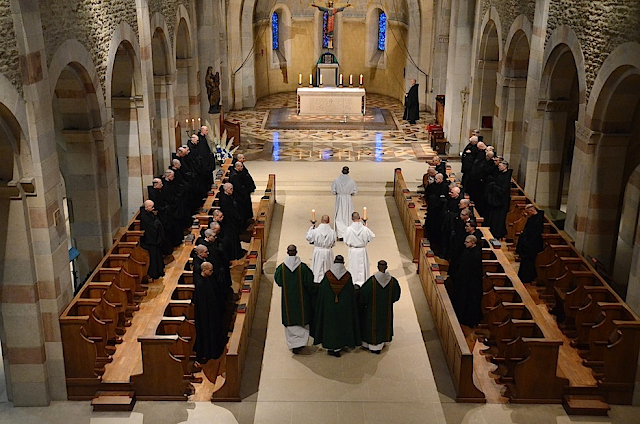
The Reading of the Rule of Saint Benedict for June 25
XVIII QUO ORDINE IPSI PSALMI DICENDI SUNT
20 Disposito ordine psalmodiae diurnae, reliqui omnes psalmi qui supersunt aequaliter dividantur in septem noctium vigilias,
21 partiendo scilicet qui inter eos prolixiores sunt psalmi et duodecim per unamquamque constituens noctem.
22 Hoc praecipue commonentes ut, si cui forte haec distributio psalmorum displicuerit, ordinet si melius aliter iudicaverit,
23 dum omnimodis id adtendat ut omni hebdomada psalterium ex integro numero centum quinquaginta psalmorum psallantur, et dominico die semper a caput reprehendatur ad vigilias.
24 Quia nimis inertem devotionis suae servitium ostendunt monachi qui minus a psalterio cum canticis consuetudinariis per septimanae circulum psallunt,
25 dum quando legamus sanctos patres nostros uno die hoc strenue implesse, quod nos tepidi utinam septimana integra persolvamus.
CHAPTER 18: IN WHAT ORDER THE PSALMS ARE TO BE SAID
20 The order of psalmody at the day hours being thus disposed, all the remaining psalms are to be equally divided into seven nocturnal Vigils
21 by spltting the longer psalms in two and assigning twelve to each night.
22 Above all we emphasize that if this distribution of the psalms is displeasing, one may order things differently as he judges better,
23 but by all means taking care that every week the psalter in its integral number of 150 psalms is sung, and that on Sunday the cycle always begins anew at Vigils.
24 For those monks show themselves sluggish in devotion to their service who sing less than the psalter with the customary canticles in the course of a week:
25 thus we read that our holy Fathers strenuously achieved in a single day what we, tepid as we are, take a whole week to render.
Today's Celebration of the Mass

Also, Feast of the Martyr, Blessed Dominic Henares
Jesus XPI Passio sit semper in cordibus nostris
May the Passion of Jesus Christ be always in our hearts








.jpeg)

Comments