Catholic devotions for the 11th June
Scroll down for today's
Saint of the Day/ Feast
Reading of the Martyrology
Dedication of the Month
Dedication of the Day
Rosary
Five Wounds Rosary in Latin
Seven Sorrows Rosary in English
Latin Monastic Office
Reading of the Rule of Saint Benedict
Celebration of Mass
Reading from the School of Jesus Crucified
.jpg)
Feast of Saint Barnabas
Seen here with Saint Paul contesting with pagans
From the Golden Legend
St. Barnabas was a deacon, and was born in Cyprus, and was one of the seventy-two disciples of our Lord, and is greatly praised in the history of the Acts of the Apostles of many good things that were in him, for he was right well informed and ordinate, as well to himself as to God and to his neighbour.
Well Ordinate In Himself He was well ordinate in himself after three virtues that be in the soul, that is to say reason, desire, and strength
Reason He had reason illumined with the clearness of very knowledge. Hereof is said in the Acts of the Apostles, the thirteenth chapter. It is said that there were in the church of Antioch doctors, prophets and great masters in holy scripture among whom were Barnabas, Simon, and many other great clerks.
Desire Yet had he desire well ordinate and expurged from the dust of all worldly affection, and thereof is found in the Acts of Apostles the fourth chapter, that he sold a field that he had, and the value and price thereof he laid at the feet of the apostles. And the gloss saith: St. Barnabas showed to us herein that we ought leave the things that men should not put thereon their desire ne their heart, and taught us to despise gold and silver, by that that he laid the silver at the feet of the apostles.
StrengthYet had he the virtue of the soul which is called strength, well affrmed with prowess of patience, and that may we see on the great things and high that he emprised, and on the great penances that he did, and on the great torments and pains that he suffered.
Great things then he emprised, and that may we see when he took upon him to convert so great a city as was Antioch. For when St. Paul came into Jerusalem anon after his conversion, and would accompany him with the disciples, they fled all away, like sheep do from wolves, but Barnabas went anon to him, and took and brought him in to the company of the apostles.
After, he enforced his body with great penances that he did, for he tormented it with aspre and hard fastings, yet was St. Barnabas a man enforced to suffer pains and torments; for he and St. Paul abandoned their lives overall for the love of our Lord Jesu Christ.
Well Ordinate As Touching To GodSecondly, he was ordained as touching to God in bearing [and] authority, majesty, and bounty.
Bearing and Authority He bare honour and reverence unto the great authority of God, after that we find in the Acts of the Apostles the thirteenth chapter, when the Holy Ghost said: Take ye to me apart, Barnabas and Paul, for to do the office that I have chosen them to.
Majesty Yet St. Barnabas bare honour to the great majesty of God, for when there should be done reverence to him and sacrifice as to a God, and was called Jupiter as he that went before, and they called Paul, Mercury, as a fair and wise speaker. Anon Barnabas and Paul rent and tare their coats, and cried all on high: Ye people, what do ye? We be mortal as ye be, which warn you to turn and convert to the very God living, Jesu Christ.
Bounty After, St. Barnabas bare reverence to the bounty of God, after that is found in the Acts of Apostles the fifteenth chapter. Some converts of the Jews would minish the bounty of the grace of God, and said that this grace that our Lord had done in his passion sufficed not to save us without circumcision. Against this error St. Paul and Barnabas withstood vigorously, and showed to them appertly that the grace and bounty that God hath done is sufficient, without the law, to our salvation. After they sent to the apostles this question, the which they sent anon through the world in epistles against this foolish error.
Well Ordinate as Touching to His NeighbourAfter, St. Barnabas was right strongly well ordained against his neighbours, for all them that were committed to his cure he nourished and fed, in word, in example and in benefits.
In Word In word, for he pronounced to them the holy word of God and the gospel. Hereof is said in the Acts of the Apostles, that Paul and Barnabas abode in Antioch preaching the word of God. That may be seen by the great multitude of people that he converted in the city of Antioch, for they converted so much people there, that the disciples lost their special name and were called Christian men as the other.
In Ensample Yet nourished he them that he had charge of by good ensample, for his life was to all them that saw him as a mirror of holiness and the exemplar of all religion. For he was in all his works noble and hardy, and well embellished of all good works, and was full of the Holy Ghost, and enlumined and light in the faith of our Lord.
In Benefits All these four things be touched of him in the Acts of the Apostles, and yet nourisheth he them by benefits in two manners, that is in alms temporal, in administering to the poor their necessity, and in other alms spiritual, in forgiving all rancour and evil will.
Alms Temporal The first alms did St. Barnabas, for he bare to such as were in right great poverty and misery, that as was needful for them to live, for after that we find in the Acts of the Apostles, there was a great famine in the time of Claudius the emperor, which famine had Agabus prophesied, and because the disciples that would return to their brethren into Judea, sent unto the most ancient their alms by the hands of Barnabas and Paul.
Alms Spiritual The second alms did St. Barnabas when he pardoned his anger to John, surnamed Mark. For when the said John, which was one of the disciples, was departed from the company of Barnabas and of Paul, he repented him, and would return to them, and Barnabas forgave it him and took him again to his disciple, but Paul would not receive him with him; nevertheless that which was done between them both was by good intention, for in this that Barnabas took him again, we may see the sweetness of his pity, and in this that St. Paul would not receive him, is showed the great savour of right that was in him, after that the gloss saith, Acts xv., because this John had been tofore the master of the law to defend the law of Jesu Christ, and had not contained him vigorously for to repress them, but had been negligent. For this reason St. Paul would not accord to receive him in to the company of the other.
Nevertheless this departing that John was thus departed from the company of St. Paul and from the other, was for no vice that was in him, but for the sharpness and inspiring of the Holy Ghost, to the end that they might preach in divers places; after that it happed after. For when Barnabas was on a time in the city of Iconium, a man with a clear shining visage appeared by night to this John aforesaid, his cousin, and said to him thus: John, have in thee no doubtance, but be strong and vigorous, for from henceforth thou shalt no more be called John, but thou shalt be called right high enhanced.
And when he had told this to his cousin St. Barnabas, he answered and said to him: Keep thee well that thou tell this vision to no man, for in the same form he appeared to me that night after.
Barnabas in CyprusWhen St. Barnabas and St. Paul had long preached in the city of Antioch, the angel of God appeared to St. Paul and said to him: Go hastily in to Jerusalem, for thou shalt find there some of the brethren that abide thee. Then Barnabas would go in to Cyprus to visit his friends and kin that were there, and St. Paul would go to Jerusalem; thus departed that one from that other by enticement of the Holy Ghost, that so had ordained it.
And when St. Paul had showed to St. Barnabas this that the angel said, St. Barnabas answered to him: The will of God be done like as he hath ordained it. I go now into Cyprus, and more hereafter shall I not see thee, for there shall I end my life.
Then he humbly kneeled down and fell to his feet weeping, and St. Paul, which had compassion of him, said unto him these words by consolation: Barnabas, weep no more, for our Lord will that it be so, our Lord hath appeared to me this night, and hath said to me: Let not ne give none empeshment to Barnabas for to go into Cyprus, for he shall there enlumine many folk and shall suffer there martyrdom.
On a time that Barnabas and John issued out of Cyprus and found an enchanter named Elymas, which by his enchantment had taken away the sight from some and after given it to them again, he was much contrary to them and would not suffer them enter into the temple. After this, Barnabas saw on a day men and women, being all naked, running through the town, and made then great feast, whereof he was much angry and gave his malediction and curse to the temple, and suddenly a great part thereof fell down and slew a great part of the people.
His Martyrdom At the last St. Barnabas came into the city of Salome, but this enchanter aforesaid moved the people greatly against him, so much that the Jews came and took him and led him through the city with great shame, and would have delivered him to the judge of the city for to punish him and to put him to death. But when they heard say that a great and a puissant man was come in to the city, which was named Euseblus, and was of the lineage of the emperor Nero, the Jews had doubt that he would take him out of their hands and let him go, and therefore anon they bound a cord about his neck, and drew him out of the city, and there anon burnt him, but yet the felon Jews were not satisfied to martyr him so, for they took the bones of him and put them in a vessel of lead, and would have cast them into the sea, but John, his disciple, with two other of his disciples went by night into the place and took the holy bones and buried them in an holy place.
Then, after that Sigbert saith, they abode in that place unto the time of the emperor Zeno and Gelasius the pope, that was the year of our Lord five hundred. After that then, as St. Dorotheus said, they were found by the revelation of St. Barnabas himself, and were from thence translated in to another place, and St. Dorotheus saith thus: Barnabas preached first at Rome of Christ. and was made bishop of Milan.
The Reading from the Martyrology
This Day, the Eleventh Day of June
The birthday of the Apostle St. Barnabas, born in Cyprus. By the disciples, he was ordained Apostle of the Gentiles with St. Paul, and with him traversed many regions, fulfilling his commission to preach the Gospel. At length he went to Cyprus, where he ennobled his apostolate by a glorious martyrdom. Through his own revelation his body was found, in the time of the emperor Zeno, together with a copy of St. Matthew's gospel copied with his own hand.
At Aquileia, the martyrdom of the Saints Feilx and Fortunatus, brothers. In the persecution of Diocletian and Maximian, they were racked, and had flaming torches held against their sides. These being extinguished by the power of God, boiling oil was poured over them, and as they persevered in confessing Christ, they were decapitated.
At Bologna, St. Parisius, confessor, a monk of the Order of Camaldoli.
At Rome, the translation of St. Gregory Nazianzen, whose sacred body after having been brought from Constantinople to Rome, and kept a long time in the church of the Mother of God, was, by the Sovereign Pontiff, Gregory XIII, transferred with great solemnity to a chapel of the basilica of St. Peter, most sumptuously decorated by his Holiness, and the next day placed with due honor beneath the altar.
Omnes sancti Mártyres, oráte pro nobis.
("All ye Holy Martyrs, pray for us", from the Litaniae Sanctorum, the Litany of the Saints)
June is the Month of the Sacred Heart
.jpg)
Amen.
V. Heart of Jesus once in agony.
R. Pity the dying.
(300 days every time said. Plenary indulgence under the usual conditions if said thrice daily'but at three distinct times during the day'for a month)
(a) V. Praised be Jesus Christ.
R. Amen'or'Forever.
(b) V. Praised be Jesus and Mary.
R. Today and forever.
(c) V. Glory to the Sacred Heart of Jesus.
R. Glory to the immaculate heart of Mary.
(300 days every time any one of the foregoing is said as salutation and answer)*
Graciously grant, O Lord, peace in our times, that, aided by the help of Thy mercy, we may always be free from sin and secure from all disturbance. Through Christ Our Lord. Amen.
(3 years every time said)*
Burn, O Lord, our loins and our hearts with the fire of the Holy Ghost, that we may serve Thee with a chaste body and please Thee with a pure heart. Through Christ Our Lord. Amen.
(3 years every time said)*
Wednesday is the Day dedicated to Saint Joseph
On Wednesdays, many Catholics make a special devotion to St. Joseph by going to Mass on the first Wednesdays of nine consecutive months and offering their Communions in his honor and for the salvation of the dying.
Source
The Glorious Mysteries of the Rosary are prayed on Wednesday
"I would like to remind you that the Rosary is a biblical prayer, all filled with the Holy Scriptures." It is a prayer from the heart, in which the repetition of the Ave Maria directs the thought and affection towards Christ, and thus is made a confident prayer to Him and our Mother. It is a prayer that helps to meditate on the Word of God and assimilate the Eucharistic Communion, on the model of Mary who kept in her heart everything Jesus did and said and even His Presence. " Pope Benedict XVI
The Rosary in Latin
Chaplet of the Five Holy Wounds of Christ in Latin
Chaplet of the Seven Sorrows of Our Lady in English
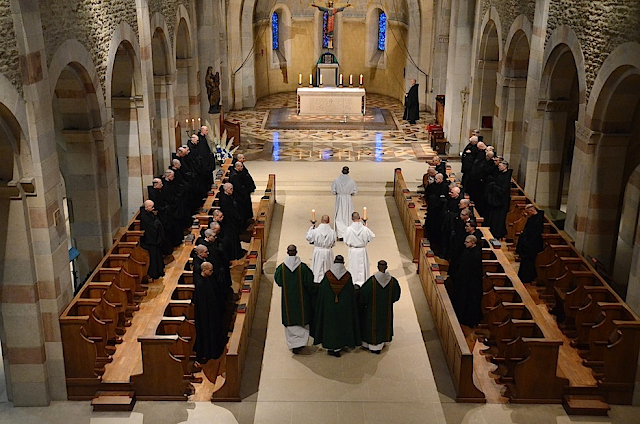
Latin Monastic Office for today from Le Barroux in France Texts also provided
The Reading of the Rule of Saint Benedict for June 11
From Chapter VIII
2 ut modice amplius de media nocte pausetur et iam digesti surgant.
3 Quod vero restat post vigilias a fratribus qui psalterii vel lectionum aliquid indigent meditationi inserviatur.
4 A Pascha autem usque ad supradictas Novembres, sic temperetur hora ut vigiliarum agenda parvissimo intervallo, quo fratres ad necessaria naturae exeant, mox matutini, qui incipiente luce agendi sunt, subsequantur.
1 In the winter season, that is from November first until Easter, we consider it reasonable to arise at the eighth hour of the night,


2 so that having rested a little past midnight they may arise with their food fully digested.
3 The time that remains after Vigils should be spent in meditation by those brothers who still need to memorize some part of the psalter or readings.
4 From Easter to the aforementioned first of November the hour of Vigils should be so arranged that after a very short interval, during which the brothers may go out for the necessities of nature, Lauds (which are to begin at first light) may follow without delay.
Today's Celebration of the Mass
Feast of Saint Paula Frasinetti, Foundress of the Dorothean Sisters
Jesus XPI Passio sit semper in cordibus nostris
May the Passion of Jesus Christ be always in our hearts








.jpeg)

Comments