The origin of the Rogation processios

It all began in the 5th century, in the Dauphiné (F). Vienne, nowadays a quiet town south of Lyon, was at the time an important metropolis of the Gallic Church. Saint Mamertus became bishop there in 463 and died in 477. His feast day is celebrated on May 11. His relics, which were venerated in the cathedral of Orléans, were unfortunately destroyed by the Huguenots in the 16th century. Besides his holiness, this prelate was known for his knowledge and miracles. It was a disastrous time, known as the time of 'the great invasions' of the Huns and the Goths. Moreover, Vienne had to endure many other setbacks: earthquakes, famines, epidemics… The holy bishop emphasized to his people that it was necessary to implore the grace of our Father in heaven and to do penance for sins. His successor, Saint Avitus, recounted in one of his sermons that a fire broke out in a building in Vienne on Easter night. The fire spread with such force that a general inferno was expected. Saint Mamertus prostrated himself before the altar and prayed fervently, thereby stopping the fire: everyone saw this as a miracle. That same night, Saint Mamertus devised the plan of the rogations—the prayer processions—before God. He established the psalms and prayers and added a fast to them, an encouragement to confession and repentance of heart. The three days preceding Ascension were chosen for this public prayer, which quickly spread throughout Gaul and subsequently throughout the West.
Saint Caesarius of Arles mentions at the beginning of the 6th century that this custom was already widespread. In 511, the Synod of Orléans officially established the period of the three days before Ascension for all of Gaul. In 567, the Synod of Tours imposed the obligation to fast. The rogations were instituted in Spain in the 7th century, subsequently spread to England and then to present-day Germany, and Rome adopted this custom at the end of the 8th century under St. Leo III, the pope who crowned Charlemagne. The liturgy of the Church subsequently adopted this custom and spread it throughout the world.
From the beginning, this prayer consisted of a procession, that is, a solemn journey accompanied by supplications. Over time, these processions were primarily intended to ask for good harvests, with the additional goal of protection against disasters or wars, which often began in the spring. Praying and doing penance at that time could also encourage true moderation in a season when the body seeks to overpower the soul of the Christian.
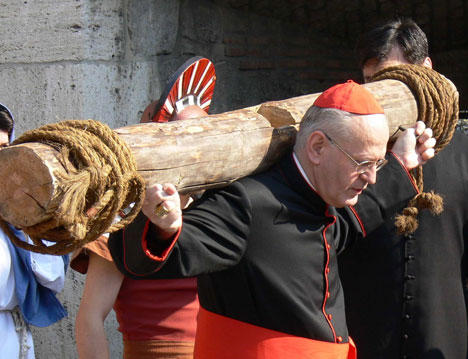
At the beginning of the ceremony, ashes were sprinkled on the heads of the procession members, followed by the sprinkling with holy water, and the procession set off. Everyone, clergy and laity alike, walked barefoot and sang antiphons, psalms, and, just as today, the Litany of All Saints. The Bishop of Arles, Saint Caesarius, adds that the procession lasted six hours! People proceeded to a church where the Sacrifice of the Mass was finally celebrated.
While these were urban customs, now forgotten, in the countryside people followed a route marked by temporary or permanent crosses, with stops at chapels or resting places decorated with flowers.
The first day was normally dedicated to the meadows, the second to the fields, and the third to the vineyards or other secondary crops. But naturally, the customs could be adapted to local needs.
In Gaul, a curious custom existed during the rogations: for the first two days, a long-tailed dragon filled with straw was carried behind the processional cross. The tail was emptied on the third day. This meant that the devil ruled over this world on the first and second days, the time before and during the Law of Moses; subsequently, on the third day, in the time of grace, after the Passion of Our Lord, he was driven out.
Let us not neglect the sacred custom of this procession and let us honor its spirit. Let us participate in it, for not only our fields, but also our fatherland and the Catholic Church need special help at this moment. Finally, let us strive to adopt the spirit of penance that accompanies our supplications and our supernatural trust in divine providence.







.jpeg)

Comments