Bishop who thinks a crucified frog is art opens exhibition showcasing Mickey Mouse as Christ in Pieta parody
Bishop Glettler opens anniversary exhibition at Graz's "Kultum"

And this image makes the evil intent clearer

Bishop of Innsbruck: The power and healing powerlessness of images is the central theme of the exhibition "God Has No Museum. Aspects of Religion in Contemporary Art"
"God Has No Museum. Aspects of Religion in Contemporary Art" - This is the programmatic title of the anniversary exhibition at Graz's "Kultum," which was opened by Bishop Hermann Glettler on Friday evening. The bishop responsible for art and culture in the Catholic Bishops' Conference addressed the "power and healing powerlessness of images." In ten sequences, the Bishop of Innsbruck acknowledged the ten sections of the exhibition marking the 50th anniversary of the Graz cultural institution and concluded: "One cannot escape the dramatic arc and fascination of this anniversary exhibition – nor can one escape the highly energetic setting here in the Minorite Monastery, which has established itself in recent decades as a truly 'different place' for the church."
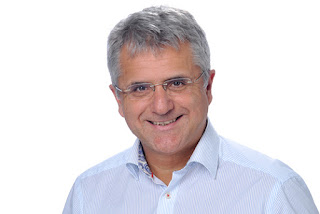
 The Bishop with his artwork "Crossfit"
Politics, society, social issues, religion – and everything human – are perceived, endured, and poetically negotiated in "Cultum" in artistic discourses, exhibitions, concerts, readings, and lectures. "Hopefully also in the future," said the Bishop, who praised the exhibition curator, Johannes Rauchenberger: "With impressive professionalism, love, and resilience, he dreamed up, fought for, and operated a museum that, with its vision and critical spirituality, is simply a blessing – and will continue to be so for the next 50 years."
"Clearly religious works are extremely rare in contemporary art – but there are many references, traces, hidden or obvious visual codes in the vast 'resource of contemporary art,'" the bishop stated. Johannes Rauchenberger exploited this resource with great enthusiasm and perseverance, as the exhibition testifies.
Power and healing powerlessness
The power and healing powerlessness of images is the theme of the anniversary exhibition, Glettler continued. "By showing wounds, an empathetic look at the countless wounds of our time is provoked and, at the same time – in paradoxical logic – a glimpse of glory is possible." The exhibition spaces of this new "museum" would miraculously make insight and transformation, inspiration and reconciliation, tangible. The bishop described the "cultum" as a place where there is sufficient space for believers, seekers, and doubters.
"In a time of unstoppable image tsunamis, live streams, and constantly triggered image nervousness, the impotence of familiar, iconographically reliable works of art is evident – perhaps also their new significance," the bishop pointed out at the beginning of his speech, adding: "In this exhibition, we enter spaces of discourse and longing. We witness the ongoing debate about the 'true image' – and are confronted with a whole palette of ironic refractions of familiar pictorial motifs."
Thus, the exhibition will feature "examples from contemporary art" that "rediscover what has been left behind, that recall the pivotal role of idealized figures, the legacy of a Christian-influenced visual and cultural tradition." Furthermore, the exhibition "explores the relationship between body and mind, between sensual presence and absence, between figuration and abstraction in very different ways. In emptiness, an unexpected abundance, in loss, life, in concealment, a touching presence."
The testimonies to the healing power of religion are manifold – also in this exhibition – but so are the frightening references to the misuse of religion, Glettler explained, saying: "Faith and knowledge need each other to avoid becoming banal or sterile." Furthermore, "careful approaches, positive unsettling, that make us 'pilgrims of hope' across religious and ideological boundaries are needed. It's always about a greater sense of humanity." Therefore, art can be understood as conveying consolation in the transience, vulnerability, and fragility of human existence. In other words: "Art as an advocacy voice for the vulnerable – with the attention and in the spirit of Jesus."
Warning against fundamentalism
The art shown and performed in this exhibition does not pay homage to sacred pathos, does not serve a superficial "propaganda fidei," nor does it serve catechesis. "However, it nevertheless addresses—and thus even more credibly—the sacred, the sacred in the human-divine face, the sacred as a translucent event of another order. Light from the light."
There are very clear, critical pictorial positions in the exhibition that warn against all forms of religious fundamentalism and this is more important than ever, emphasised the art bishop and said: "Whether Christian, Jewish, Muslim or Hindu - violence in the name of God is always a crime. Religious fundamentalism declares dissenters to be enemies who must be eradicated." Art, on the other hand, creates zones of encounter where human contact can occur - or at least moments of positive uncertainty that draw people out of the ideological bubbles.
The exhibition at the "Kultum" is part of the parallel programme of "steirischer herbst 25". It is open from Saturday and runs until 11 July 2026.





.jpeg)

Comments