Catholic devotions for 27th August
Scroll down for today's
Saint of the Day/ Feast
Reading of the Martyrology
Dedication of the Month
Dedication of the Day
Rosary
Five Wounds Rosary in Latin
Seven Sorrows Rosary in English
Latin Monastic Office
Reading of the Rule of Saint Benedict
Celebration of Mass
Reading from the School of Jesus Crucified

Feast of Saint Joseph Calasanctius
Called in religion "a Matre Dei", founder of the Piarists, b. 11 Sept., 1556, at the castle of Calasanza near Petralta de la Sal in Aragon; d. 25 Aug., 1648, at Rome; feast 27 Aug. His parents, Don Pedro Calasanza and Donna Maria Gastonia, gave Joseph, the youngest of five children, a good education at home and then at the school of Petralta. After his classical studies at Estadilla he took up philosophy and jurisprudence at Lérida and merited the degree of Doctor of Laws, and then with honours completed his theological course at Valencia and Alcalá de Henares. His mother and brother having died, Don Pedro wanted Joseph to marry and perpetuate the family. God interfered by sending a sickness in 1582 which soon brought Joseph to the brink of the grave. On his recovery he was ordained priest 17 Dec., 1583, by Hugo Ambrose de Moncada, Bishop of Urgel. Joseph began his labours as priest in the Diocese of Albarracin, where Bishop della Figuera appointed him his theologian and confessor, synodal examiner, and procurator, and when the bishop was transferred to Lérida his theologian followed him to the new diocese. In 1586 della Figuera was sent as Apostolic visitator to the Abbey of Montserrat, and Joseph accompanied him as secretary. The bishop died the following year and Joseph left, though urgently requested to remain. He hurried to Calasanza only to be present at the death of his father. He was then called by his Bishop of Urgel to act as vicar-general for the district of Trempe. In 1592 he embarked for Rome, where he found a protector in Cardinal Marcantonio Colonna who chose him as his theologian and instructor to his nephew. Rome offered a splendid field for works of charity, especially for the instruction of neglected and homeless children, many of whom had lost their parents. Joseph joined a Confraternity of Christian Doctrine and gathered the boys and girls from the streets and brought them to school. The teachers, being poorly paid, refused to accept the additional labour without remuneration. The pastor of S. Dorotea, Anthony Brendani, offered him two rooms and promised assistance in teaching, and when two other priests promised similar help, Joseph, in November, 1597, opened the first public free school in Europe. Pope Clement VIII gave an annual contribution and many others shared in the good work, so that in a short time Joseph had about a thousand children under his charge. In 1602 he rented a house at S. Andrea della Valle and commenced a community life with his assistants and laid the foundation of the Order of Piarists. Much envy and opposition arose against him and his new institute, but all were overcome in time. In 1612 the school was transferred to the Torres palace adjoining S. Pantaleone. Here Joseph spent the remaining years of his life in his chosen calling. He lived and died a faithful son of the church, a true friend of forsaken children. His body rests in S. Pantaleone. His beatification was solemnized on 7 Aug., 1748, and his canonization by Clement XIII, 16 July, 1767.
Semen est sanguis Christianorum
The blood of Christians is the seed of the Church
Tertullian, Apologeticum, 50
The Reading from the Martyrology
This Day, the Twenty-Seventh Day of August
At Rome, the demise of St. Joseph, confessor, illustrious by the innocence of his life and miracles, who, to instruct youth in piety and letters, founded the Order of the Poor Clerks Regular of the pious Schools of the Mother of God.
At Capua, in Campania, the birthday of St. Rufus, bishop and martyr, a patrician, who was baptized with all his family by blessed Apollinaris, disciple of St. Peter.
In the same place, the holy martyrs Rufus and Carpophorus, who suffered under Diocletian and Maximian.
At Tomis, in Pontus, the holy martyrs Marcellinus, tribune, and Mannea, his wife, and his sons John, Serapion, and Peter.
At Lentini, in Sicily, St. Euthalia, virgin. Because she was a Christian she was put to the sword by her brother Sermilian, and went to her spouse.
The same day, the martyrdom of St. Anthusa the Younger, who was made a martyr by being cast into a well for the faith of Christ.
At Bergamo, St. Narnus, who was baptized by blessed Barnabas, and consecrated by him first bishop of that city.
At Aries, the holy bishop Caesarius, a man of great sanctity and piety.
At Autun, St. Syagrius, bishop and confessor.
At Pavia, St. John, bishop.
At Lerida, in Spain, St. Licerius, bishop.
In Thebais, St. Poemon, anchoret.
At San Severino, in the March of Ancona, St. Margaret, widow.
And elsewhere in divers places, many other holy martyrs, confessors, and holy virgins.
Omnes sancti Mártyres, oráte pro nobis.
("All ye Holy Martyrs, pray for us", from the Litaniae Sanctorum, the Litany of the Saints)
August is the Month of the Immaculate Heart of Mary

Composed by Saint John Henry Cardinal Newman, shortly after his reception into the One, True Fold of the Redeemer
Wednesday is the Day dedicated to Saint Joseph
On Wednesdays, many Catholics make a special devotion to St. Joseph by going to Mass on the first Wednesdays of nine consecutive months and offering their Communions in his honor and for the salvation of the dying.
Source
The Glorious Mysteries of the Rosary are prayed on Wednesday
"I would like to remind you that the Rosary is a biblical prayer, all filled with the Holy Scriptures." It is a prayer from the heart, in which the repetition of the Ave Maria directs the thought and affection towards Christ, and thus is made a confident prayer to Him and our Mother. It is a prayer that helps to meditate on the Word of God and assimilate the Eucharistic Communion, on the model of Mary who kept in her heart everything Jesus did and said and even His Presence. " Pope Benedict XVI
The Rosary in Latin
Chaplet of the Five Holy Wounds of Christ in Latin
Chaplet of the Seven Sorrows of Our Lady in English
Latin Monastic Office for today from Le Barroux in France Texts also provided
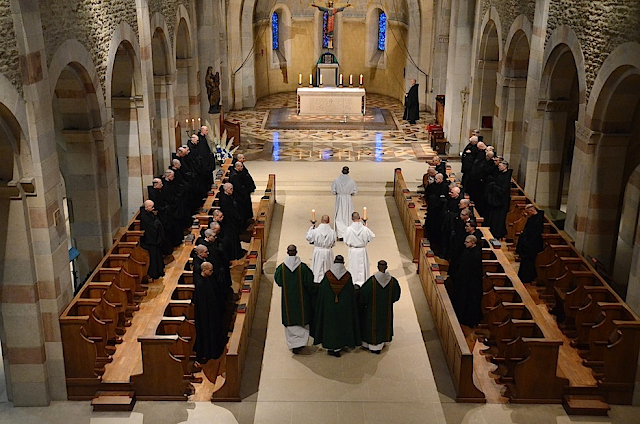
The Reading of the Rule of Saint Benedict for August 27
LXIX. UT IN MONASTERIO NON PRAESUMAT ALTER ALTERUM DEFENDERE
l Praecavendum est ne quavis occasione praesumat alter alium defendere monachum in monasterio aut quasi tueri,
2 etiam si qualivis consanguinitatis propinquitate iungantur.
3 Nec quolibet modo id a monachis praesumatur, quia exinde gravissima occasio scandalorum oriri potest.
4 Quod si quis haec transgressus fuerit, acrius coerceatur.
CHAPTER 69: IN THE MONASTERY THEY MAY NOT PRESUME TO DEFEND ONE ANOTHER
1 Every precaution must be taken that no one in the monastery presumes on any occasion to defend another monk or to act as his protector,
2 even if they are closely related by some sort of blood ties.
3 The monks must not presume to do this in any way whatever, because from it may arise the most grievous occasions of scandals.
4 If anyone transgresses this, he is to be severely punished.
Today's Celebration of the Mass
<
Also today

Blessed Gabriel Mary, Founder of the Annunciates
Jesus from His Cross bestows Mary upon us as Our Mother

Jesus XPI Passio sit semper in cordibus nostris
May the Passion of Jesus Christ be always in our hearts

"The Cross is our trophy against the demons, our sword against sin, and the sword Christ used to pierce the serpent. The Cross is the Father's will, the glory of the Only-Begotten, the joy of the Spirit, the pride of the angels, the guarantee of the Church." -St. John Chrysostom






.jpeg)

Comments