Catholic devotions for 26th August
Scroll down for today's:
Saint of the Day/ Feast
Reading of the Martyrology
Dedication of the Month
Dedication of the Day
Rosary
Five Wounds Rosary in Latin
Seven Sorrows Rosary in English
Latin Monastic Office
Reading of the Rule of Saint Benedict
Celebration of Mass
Reading from the School of Jesus Crucified
Reading from the School of Jesus Crucified

Feast of Saint Zephyrinus
Date of birth unknown; died 20 Dec., 217. After the death of Pope Victor in 198, Zephyrinus was elected his successor and consecrated. The pope is described by Hippolytus in the "Philosophymena" (IX, xi) as a simple man without education. This is evidently to be understood as meaning that Zephyrinus had not taken the higher studies and had devoted himself to the practical administration of the Church and not to theological learning. Immediately after his elevation to the Roman See, Zephyrinus called to Rome the confessor Callistus, who lived at Antium and who had received a monthly pension from Pope Victor, and intrusted him with the oversight of the coemeterium. It is evident that shortly before this the Roman Christian community had, under Victor, become the owner of a common place of burial on the Via Appia, and Zephyrinus now placed Callistus over this cemetery which was given the name of Callistus. Undoubtedly Callistus was also made a deacon of the Roman Church by Zephyrinus. He was the confidential counsellor of the pope, whom he succeeded. The positions of the Christians, which had remained favourable in the first years of the government of Emperor Septimus Severus (193-211), grew constantly worse, and in 202 or 203 the edict of persecution appeared which forbade conversion to Christianity under the severest penalties. Nothing is known as to the execution of the edict in Rome itself nor of the martyrs of the Roman Church in this era.
More, however, is certain concerning the internal disputes in the Roman Church over the doctrine of the Trinity. The adherents of the heretical teacher Theodotus the Tanner had been excommunicated with their leader by Pope Victor. They formed an independent heretical community at Rome which was ruled by another Theodotus, the Money Changer, and Aselepodotus. These men persuaded a confessor of Rome named Natalis, who had acknowledged his faith without wavering before the heathen judge and had suffered torture, to permit himself to be made the bishop of the sect for a monthly payment of 170 denarii. Natalis, however, received many warnings in dreams. At first he paid no attention to these visions, but on one occasion he believed that he had been severely tortured by angels and now he began to ponder the matter. Early in the morning he put on a penitential garment, covered himself with ashes, and threw himself with tears at the feet of Zephyrinus. He confessed his wrong-doing and begged to be received again into the communion of the Church, which was finally granted him (Eusebius, Church History V.32). In the same era the adherents of Montanus also worked with great energy at Rome. The Montanist Proculus (or Proclus) published a work in defense of the new prophecies. A refutation of Proclus in the form of a dialogue was written by a learned and rigidly orthodox Roman Christian named Caius, wherein he refers to the grave of St. Peter on the Vatican Hill and of St. Paul on the Via Ostiensis. Caius rejects the Apocalypse of St. John, which he regards as a work of the heretic Cerinthus. In opposition to Caius, Hippolytus wrote his "Capita contra Caium" (cf. Eusebius, Church History III.28 and VI.20).
Hippolytus was the most important theologian among the Roman presbyters of this era. He was an avowed adherent of the doctrine of the Divine Logos. He taught that the Divine Logos became man in Christ, that the Logos differs in every thing from God, that he is the mediary between God and the world of creatures. This doctrine in the form in which it was set forth by Hippolytus and his school aroused many doubts, and another theological school appeared in opposition to it. This latter school was represented at Rome in this era by Cleomenes and particularly by Sabellius. These men were rigid opponents of the Theodotians, but were not willing to acknowledge the incarnation of the Logos, and emphasized above all the absolute unity (monarchia) of God. They explained the Incarnation of Christ in the sense that this was another manifestation (modus) of God in His union with human nature. Consequently they were called Modalists or Patripassians, as according to them it was not the Son of God but the Father Who had been crucified. The Christian common people held firmly, above all, to the Unity of God and at the same time to the true Godhead of Jesus Christ. Originally no distrust of this doctrine was felt among them. Pope Zephyrinus did not interpose authoritatively in the dispute between the two schools. The heresy of the Modalists was not at first clearly evident, and the doctrine of Hippolytus offered many difficulties as regards the tradition of the Church. Zephyrinus said simply that he acknowledged only one God, and this was the Lord Jesus Christ, but it was the Son, not the Father, Who had died. This was the doctrine of the tradition of the Church. Hippolytus urged that the pope should approve of a distinct dogma which represented the Person of Christ as actually different from that of the Father and condemned the opposing views of the Monarchians and Patripassians. However, Zephyrinus would not consent to this. The result was that Hippolytus grew constantly more irritated and angry against the pope and particularly against the deacon Callistus whom, as the councillor of the pope, he made responsible for the position of the latter. When after the death of Zephyrinus Callistus was elected Roman bishop, Hippolytus withdrew from the Church with his scholars, caused a schism, and made himself a rival bishop.
Zephyrinus was buried in a separate sepulchral chamber over the cemetery of Calistus on the Via Appia (cf. Wilpert, "Die papstgruber und die Suciliengruft in der Katakombe des hl. Kallistus", Freiburg, 1909, 91 sqq.). The "Liber Pontificalis" attributes two Decrees to Zephyrinus; one on the ordination of the clergy and the other on the Eucharistic Liturgy in the title churches of Rome. The author of the biography has ascribed these Decrees to the pope arbitrarily and without historical basis.

The Pope Saint from whom the Gypsy Saint takes his name
Semen est sanguis Christianorum
The blood of Christians is the seed of the Church
Tertullian, Apologeticum, 50
The Reading from the Martyrology
This Day, the Twenty-Sixth Day of August
At Rome, St. Zephirinus, Pope and martyr.
In the same city, during the persecution of Valerian, the holy martyrs Irenaeus and Abundius, who were thrown into a sewer from which they had taken the body of blessed Concordia. Their bodies were drawn out by the priest Justin, and buried in a crypt near St. Lawrence.
At Vintimigilia, a city of Liguria, St. Secundus, martyr, a distinguished man and officer in the Theban Legion.
At Bergamo, in Lombardy, St. Alexander, martyr, who was one of the same legion, and endured martyrdom by being beheaded for the constant confession of the name of our Lord Jesus Christ.
Among the Marcians, the Saints Simplicius, and his sons Constantius and Victorian, who were first tortured in different manners, and then being struck with the axe, obtained the crown of martyrdom, in the time of the emperor Antoninus.
At Nicomedia, the martyrdom of St. Adrian, son of the emperor Probus. For reproaching Licinius on account of the persecution raised against Christians, he was put to death by his order. His body was buried at Argyopolis by his uncle Domitius, bishop of Byzantium.
In Spain, St. Victor, martyr, who merited the crown of martyrs by being slain by the Moors for the faith of Christ.
At Capua, St. Rufinus, bishop and confessor.
At Pistoia, St. Felix, priest and confessor.
At Lima, in Peru, St. Rose of St. Mary, virgin, of the third Order of St. Dominic. Her feast is celebrated on the 30th of this month

Omnes sancti Mártyres, oráte pro nobis.
("All ye Holy Martyrs, pray for us", from the Litaniae Sanctorum, the Litany of the Saints)
August is the Month of the Immaculate Heart of Mary

Composed by Saint John Henry Cardinal Newman, shortly after his reception into the One, True Fold of the Redeemer
Tuesday is the Day dedicated to the Holy Angels
Prayers for Every Day of the Week.
The Sorrowful Mysteries of the Rosary are prayed on Tuesday
"I would like to remind you that the Rosary is a biblical prayer, all filled with the Holy Scriptures." It is a prayer from the heart, in which the repetition of the Ave Maria directs the thought and affection towards Christ, and thus is made a confident prayer to Him and our Mother. It is a prayer that helps to meditate on the Word of God and assimilate the Eucharistic Communion, on the model of Mary who kept in her heart everything Jesus did and said and even His Presence. " Pope Benedict XVI
The Rosary in Latin
Chaplet of the Five Holy Wounds of Christ in Latin
Chaplet of the Seven Sorrows of Our Lady in English
Latin Monastic Office for today from Le Barroux in France Texts also provided
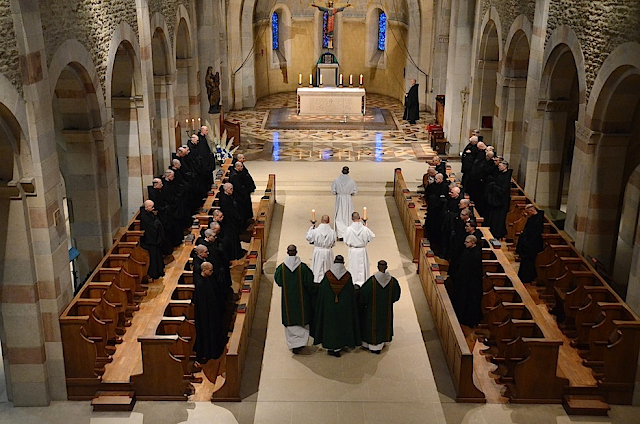
The Reading of the Rule of Saint Benedict for August 26
LXVIII. SI FRATRI IMPOSSIBILIA INIUNGANTUR
l Si cui fratri aliqua forte gravia aut impossibilia iniunguntur, suscipiat quidem iubentis imperium cum omni mansuetudine et oboedientia.
2 Quod si omnino virium suarum mensuram viderit pondus oneris excedere, impossibilitatis suae causas ei qui sibi praeest patienter et opportune suggerat,
3 non superbiendo aut resistendo vel contradicendo.
4 Quod si post suggestionem suam in sua sententia prioris imperium perduraverit, sciat iunior ita sibi expedire,
5 et ex caritate, confidens de adiutorio Dei, oboediat.
CHAPTER 68: IF IMPOSSIBLE THINGS ARE COMMANDED OF A BROTHER
1 If a brother is commanded to do hard or impossible things, he should receive the order of his superior with all gentleness and obedience.
2 But if he sees that the measure of his strength is exceeded by the weight of the burden, he is to explain the cause of his incapacity to his superior patiently and at an opportune time,
3 without showing pride, resistance, or contradiction.
4 But if after his explanation the superior persists in his command, the junior must know that this is best for him;
5 and out of love, confident of God’s help, he is to obey.
Today's Celebration of the Mass
Also today

Feast of Saint Felix of Pistoia
Jesus crucified prays for his enemies

Jesus XPI Passio sit semper in cordibus nostris
May the Passion of Jesus Christ be always in our hearts

"The Cross is our trophy against the demons, our sword against sin, and the sword Christ used to pierce the serpent. The Cross is the Father's will, the glory of the Only-Begotten, the joy of the Spirit, the pride of the angels, the guarantee of the Church." -St. John Chrysostom








.jpeg)

Comments