Catholic devotions for 25th August
Scroll down for today's
Saint of the Day/ Feast
Reading of the Martyrology
Dedication of the Month
Dedication of the Day
Rosary
Five Wounds Rosary in Latin
Seven Sorrows Rosary in English
Latin Monastic Office
Reading of the Rule of Saint Benedict
Celebration of Mass
Reading from the School of Jesus Crucified

Feast of Saint Louis, King of France
In 1238, Baldwin II, the Latin Emperor of Constantinople, anxious to obtain support for his tottering empire, offered the Crown of Thorns to Louis IX of France. It was then in the hands of the Venetians as security for a great loan of 13,134 gold pieces, yet it was redeemed and conveyed to Paris where Louis IX built the Sainte-Chapelle, completed in 1248, to receive it. The relic stayed there until the French Revolution, when, after finding a home for a while in the Bibliothèque Nationale, the Concordat of 1801 restored it to the Catholic Church, and it was deposited in the Cathedral of Notre-Dame de Paris.
The exact plant species used to make the crown is not confirmed. The relic that the church received was examined in the nineteenth century, and it appeared to be a twisted circlet of rushes of Juncus balticus, a plant native to maritime areas of northern Britain, the Baltic region, and Scandinavia. The thorns preserved in various other reliquaries appeared to be Ziziphus spina-christi, a plant native to Africa and Southern and Western Asia, and had allegedly been removed from the crown and kept in separate reliquaries since soon after they arrived in France. New reliquaries were provided for the relic, one commissioned by Napoleon Bonaparte, another, in jeweled rock crystal and more suitably Gothic, was made to the designs of Eugène Viollet-le-Duc. In 2001, when the surviving treasures from the Sainte-Chapelle were exhibited at the Louvre, the chaplet was solemnly presented every Friday at Notre-Dame. Pope John Paul II translated it personally to Sainte-Chapelle during World Youth Day. The relic can be seen only on the first Friday of every month, when it is exhibited for a special veneration Mass, as well as each Friday of Lent.
Members of the Paris Fire Brigade saved the relic during the Notre-Dame de Paris fire of April 15, 2019. It returned to the cathedral in December of 2024.
Semen est sanguis Christianorum
The blood of Christians is the seed of the Church
Tertullian, Apologeticum, 50
The Reading from the Martyrology
This Day, the Twenty-Fifth Day of August
At Paris, St. Louis, confessor, King of France, illustrious by the holiness of his life and the fame of his miracles.
At Rome, in the time of the emperor Commodus, the holy martyrs Eusebius, Pontian, Vincent, and Peregrinus, who were first racked, distended by ropes, then beaten with rods and burned on their sides. As they continued faithfully to praise Christ, they were scourged with leaded whips until they expired.
Also, at Rome, St. Genesius, martyr, who embraced the profession of actor while he was yet a Pagan. One day he was deriding the Christian mysteries in the theater in the presence of the emperor Diocletian; but by the inspiration of God he was suddenly converted to the faith and baptized. By the command of the emperor, he was forthwith most cruelly beaten with rods, then racked, and a long time lacerated with iron hooks, and burned with fire-brands. As he remained firm in the faith of Christ, and said: "There is no king besides Christ. Should you kill me a thousand times, you shall not be able to take Him from my lips or my heart," he was beheaded, and thus merited the palm of martyrdom.
At Italica, in Spain, St. Gerontius, a bishop, who preached the Gospel in that country in Apostolic times, and after many labors died in prison.
At Aries, in France, another blessed Genesius, who, filling the office of notary, and refusing to record the impious edicts by which Christians were commanded to be punished, threw away his tablets publicly, and declared himself a Christian. He was seized and beheaded, and thus attained to the glory of martyrdom through baptism in his blood.
In Syria, St. Julian, martyr.
At Tarragona, St. Maginus, martyr.
At Constantinople, St. Mennas, bishop.
At Utrecht, St. Gregory, bishop.
At Naples, St. Patricia, virgin.
And elsewhere in divers places, many other holy martyrs, confessors, and holy virgins.
Omnes sancti Mártyres, oráte pro nobis.
("All ye Holy Martyrs, pray for us", from the Litaniae Sanctorum, the Litany of the Saints)
August is the Month of the Immaculate Heart of Mary

Composed by Saint John Henry Cardinal Newman, shortly after his reception into the One, True Fold of the Redeemer
Prayers for Every Day of the Week
The Joyful Mysteries of the Rosary are prayed on Monday
"I would like to remind you that the Rosary is a biblical prayer, all filled with the Holy Scriptures." It is a prayer from the heart, in which the repetition of the Ave Maria directs the thought and affection towards Christ, and thus is made a confident prayer to Him and our Mother. It is a prayer that helps to meditate on the Word of God and assimilate the Eucharistic Communion, on the model of Mary who kept in her heart everything Jesus did and said and even His Presence. " Pope Benedict XVI
The Rosary in Latin
Chaplet of the Five Holy Wounds of Christ in Latin
Chaplet of the Seven Sorrows of Our Lady in English
Latin Monastic Office for today from Le Barroux in France Texts also provided
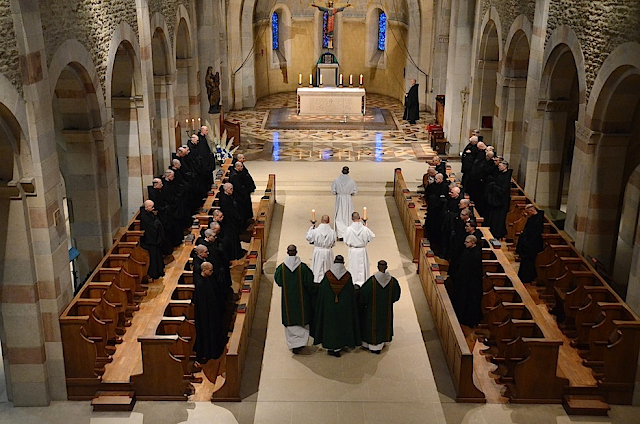
The Reading of the Rule of Saint Benedict for August 25
LXVII. DE FRATRIBUS IN VIAM DIRECTIS
1 Dirigendi fratres in via omnium fratrum vel abbatis se orationi commendent,
2 et semper ad orationem ultimam operis Dei commemoratio omnium absentum fiat.
3 Revertentes autem de via fratres ipso die quo redeunt per omnes canonicas horas, dum expletur opus Dei, prostrati solo oratorii
4 ab omnibus petant orationem propter excessos, ne qui forte surripuerint in via visus aut auditus malae rei aut otiosi sermonis.
5 Nec praesumat quisquam referre alio quaecumque foris monasterium viderit aut audierit, quia plurima destructio est.
6 Quod si quis praesumpserit, vindictae regulari subiaceat.
7 Similiter et qui praesumpserit claustra monasterii egredi vel quocumque ire vel quippiam quamvis parvum sine iussione abbatis facere.
CHAPTER 67: BROTHERS WHO ARE SENT ON A JOURNEY
1 Brothers sent on a journey are to commend themselves to the prayers of all the brothers and of the abbot;
2 and always, at the last prayer of the Work of God, all those who are absent should be remembered.
3 Brothers returning from a journey, on the same day they come back, are to lie prostrate on the floor of the oratory at all the canonical hours at the end of the Work of God:
4 they request the prayers of all for their faults, in case they have seen or heard anything evil on their journey or have fallen into idle talk.
5 No one shall presume to tell others what he may have seen or heard outside the monastery, for this is very destructive.
6 If anyone so presumes, he is to be subjected to the punishment of the Rule.
7 It is to be the same with one who presumes to leave the enclosure of the monastery, whether to go anywhere or do anything, however small, without the order of the abbot.
Today's Celebration of the Mass
Also today
.jpeg)
Saint Jane Antide Thouret

Saint Mary Michaela
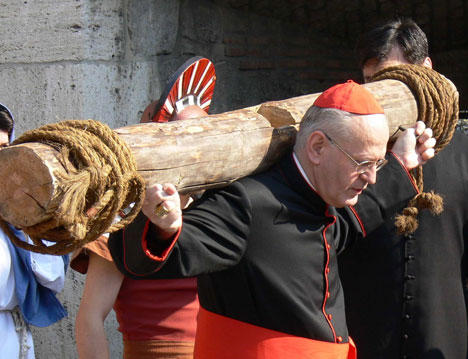
Jesus is elevated on his Cross in the sight of all

Jesus XPI Passio sit semper in cordibus nostris
May the Passion of Jesus Christ be always in our hearts

"The Cross is our trophy against the demons, our sword against sin, and the sword Christ used to pierce the serpent. The Cross is the Father's will, the glory of the Only-Begotten, the joy of the Spirit, the pride of the angels, the guarantee of the Church." -St. John Chrysostom








.jpeg)

Comments