Catholic devotions for 21st August
Scroll down for today's
Saint of the Day/ Feast
Reading of the Martyrology
Dedication of the Month
Dedication of the Day
Rosary
Five Wounds Rosary in Latin
Seven Sorrows Rosary in English
Latin Monastic Office
Reading of the Rule of Saint Benedict
Celebration of Mass
Reading from the School of Jesus Crucified

Feast of Saint Jane de Chantal, Foundress of the Order of the Visitation
Jane Frances was wife, mother, nun, and founder of a religious community. Her mother died when she was 18 months old, and her father, head of parliament at Dijon, France, became the main influence on her education. Jane developed into a woman of beauty and refinement, lively and cheerful in temperament. At 21, she married Baron de Chantal, by whom she had six children, three of whom died in infancy. At her castle, she restored the custom of daily Mass, and was seriously engaged in various charitable works.
Jane’s husband was killed after seven years of marriage, and she sank into deep dejection for four months at her family home. Her father-in-law threatened to disinherit her children if she did not return to his home. He was then 75, vain, fierce, and extravagant. Jane Frances managed to remain cheerful in spite of him and his insolent housekeeper.
When she was 32, Jane met Saint Francis de Sales who became her spiritual director, softening some of the severities imposed by her former director. She wanted to become a nun but he persuaded her to defer this decision. She took a vow to remain unmarried and to obey her director.
After three years, Francis told Jane of his plan to found an institute of women that would be a haven for those whose health, age, or other considerations barred them from entering the already established communities. There would be no cloister, and they would be free to undertake spiritual and corporal works of mercy. They were primarily intended to exemplify the virtues of Mary at the Visitation—hence their name the Visitation nuns—humility and meekness.
The usual opposition to women in active ministry arose and Francis de Sales was obliged to make it a cloistered community following the Rule of Saint Augustine. Francis wrote his famous Treatise on the Love of God for them. The congregation consisting of three women began when Jane Frances was 45. She underwent great sufferings: Francis de Sales died; her son was killed; a plague ravaged France; her daughter-in-law and son-in-law died. She encouraged the local authorities to make great efforts for the victims of the plague, and she put all her convent’s resources at the disposal of the sick.
During a part of her religious life, Jane Frances had to undergo great trials of the spirit—interior anguish, darkness, and spiritual dryness. She died while on a visitation of convents of the community.

The Reading from the Martyrology
The blood of Christians is the seed of the Church
Tertullian, Apologeticum, 50
This Day, the Twenty-First Day of August
At Annecy, in Savoy, the festival of St. Jane Frances Fremiot de Chantal, foundress of the Order of Nuns of the Visitation of St. Mary, who is commemorated on the 13th of December.
At Rome, in the Veran field, St. Cyriaca, widow and martyr. In the persecution of Valerian, after devoting herself and all her goods in the service of the saints, she gave up her life by suffering martyrdom for Christ.
At Salona, St. Anastasius, a law officer, who was converted to the faith by seeing the fortitude with which blessed Agapitus bore his torments, and being put to death by order of the emperor Aurelian, for confessing the name of Christ, went to Our Lord.
In Sardinia, the birthday of the holy martyrs Luxorius, Cisellus, and Camerinus, who were put to the sword in the persecution of Diocletian, under the governor Delphius.
In Gevaudan, St. Privatus, bishop and martyr, who suffered in the persecution of Valerian and Gallienus.
The same day, the holy martyrs Bonosus and Maximian.
At Fundi, in Campania, St. Paternus, a martyr, who came from Alexandria to Rome to visit the tomb of the Apostles. Then he retired to the neighborhood of Fundi, where, being seized by the tribune whilst he was burying the bodies of the martyrs, he died in captivity.
At Edessa, in Syria, during the persecution of Maximian, the holy martyrs Bassa, and her sons Theogonius, Agapius, and Fidelis, whom their pious mother exhorted to martyrdom and sent before her bearing their crowns. Being herself beheaded, she joyfully followed them and shared their victory.
At Verona, St. Euprepius, bishop and confessor.
Also St. Quadratus, bishop.
At Siena, in Tuscany, blessed Bernard Ptolemy, abbot and founder of the Congregation of Olivetans.
And elsewhere in divers places, many other holy martyrs, confessors, and holy virgins.
Omnes sancti Mártyres, oráte pro nobis.
("All ye Holy Martyrs, pray for us", from the Litaniae Sanctorum, the Litany of the Saints)
August is the Month of the Immaculate Heart of Mary

Composed by Saint John Henry Cardinal Newman, shortly after his reception into the One, True Fold of the Redeemer
Thursday is the Day dedicated to the Blessed Sacrament
The Pope at Corpus Christi
And at the wonderful Abbey of Heiligenkreuz
The Joyful Mysteries of the Rosary are prayed on Thursday
"I would like to remind you that the Rosary is a biblical prayer, all filled with the Holy Scriptures." It is a prayer from the heart, in which the repetition of the Ave Maria directs the thought and affection towards Christ, and thus is made a confident prayer to Him and our Mother. It is a prayer that helps to meditate on the Word of God and assimilate the Eucharistic Communion, on the model of Mary who kept in her heart everything Jesus did and said and even His Presence. " Pope Benedict XVI
The Rosary in Latin
Chaplet of the Five Holy Wounds of Christ in Latin
Chaplet of the Seven Sorrows of Our Lady in English
Latin Monastic Office for today from Le Barroux in France Texts also provided
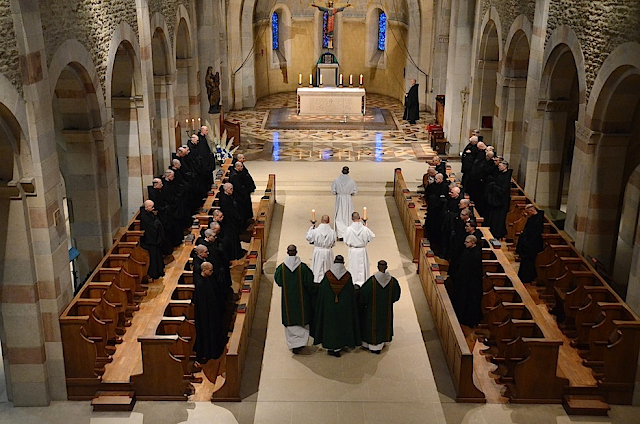
The Reading of the Rule of Saint Benedict for August 21
LXIV DE ORDINANDO ABBATE
7 Ordinatus autem abbas cogitet semper quale onus suscepit et cui redditurus est rationem vilicationis suae,
8 sciatque sibi oportere prodesse magis quam praeesse.
9 Oportet ergo eum esse doctum lege divina, ut sciat et sit unde proferat nova et vetera, castum, sobrium, misericordem,
10 et semper superexaltet misericordiam iudicio, ut idem ipse consequatur.
11 Oderit vitia, diligat fratres.
12 In ipsa autem correptione prudenter agat et ne quid nimis, ne dum nimis eradere cupit aeruginem frangatur vas;
13 suamque fragilitatem semper suspectus sit, memineritque calamum quassatum non conterendum.
14 In quibus non dicimus ut permittat nutriri vitia, sed prudenter et cum caritate ea amputet, ut viderit cuique expedire sicut iam diximus,
CHAPTER 64: THE APPOINTMENT OF THE ABBOT
7 The one appointed abbot should always ponder what a burden he has received, and to whom he will have to give an account of his stewardship (Luke 16:2)
8 and he must know how much more fitting it is to provide for others than to preside over them.
9 He should therefore be learned in divine law, so that he knows how to bring forth new things and old (Matt 13:52).; he is to be chaste, sober, merciful, 10 and he should always allow mercy to triumph above judgment (Jas 2:13), so that he may receive mercy (Mt. 5:7).
11 He is to hate vices and love the brothers.
12 But in correcting them he is to act prudently and avoid extremes, lest in trying too ardently to scrape off the rust, he breaks the vessel:
13 his own frailty he must always keep before his eyes, recalling that the bruised reed is not to be broken (Isa 42:3).
14 By this we do not mean he should permit vices to sprout: on the contrary, he should prudently and charitably cut them off as he sees best for each, as we have said:
Today's Celebration of the Mass
Also today

Feast of Saint Bernardo Tolomeo, founder of the Olivetans

Jesus XPI Passio sit semper in cordibus nostris
May the Passion of Jesus Christ be always in our hearts

"The Cross is our trophy against the demons, our sword against sin, and the sword Christ used to pierce the serpent. The Cross is the Father's will, the glory of the Only-Begotten, the joy of the Spirit, the pride of the angels, the guarantee of the Church." -St. John Chrysostom








.jpeg)

Comments