Catholic devotions for 17th August
Scroll down for today's
Saint of the Day/ Feast
Reading of the Martyrology
Dedication of the Month
Dedication of the Day
Rosary
Five Wounds Rosary in Latin
Seven Sorrows Rosary in English
Latin Monastic Office
Reading of the Rule of Saint Benedict
Celebration of Mass
Reading from the School of Jesus Crucified

Feast of Saint Hyacinth
The life of this thirteenth century “Apostle of the North,” known for his zeal for souls, makes him a great patron for our modern times, so much in need of young hearts fearlessly leaving all to proclaim the Gospel. Zeal such as that of St. Hyacinth is the driving force of the Order of Preachers.
If we consider the Greek etymology of the word “enthusiasm,” which means “to be full of God,” Hyacinth comes across as a figure unconditional in his enthusiasm for preaching the Good News. Born of noble parents in Poland around 1185, he was educated in Cracow. On a trip to Rome in 1218, he met St. Dominic, from whom both Hyacinth and his cousin, Ceslaus, received the habit of the Friars Preachers. A painting at the Dominican Church of Santa Sabina in Rome depicts this event with Ceslaus lying prostrate on the floor and Hyacinth being clothed by St. Dominic in the white robe of “the athletes of the faith.” Within a few months of his reception of the habit, Hyacinth embarked on his first mission, sent by St. Dominic to preach and establish the Order in Poland.
For the next 35 years, this great disciple of Dominic devoted himself to preaching the Gospel, encouraging his followers to nurture the practice of study, and opening new Dominican monasteries. He was tireless in his efforts, soon establishing Dominican Friaries in all the major cities in Poland. These houses became known as centers of theological thought and missionary activity. He extended his missionary activity through Russia, Lithuania, present day Czech Republic and Slovakia, Austria, Bohemia, Greece, Turkey and northern China. After crossing the Baltic Sea, he preached in Denmark, Sweden, and Norway and is also said to have visited Scotland.
After unceasing labors and vast journeys, Hyacinth spent his last few months of life in a monastery he had founded in Cracow. Although worn out and weakened by illness and fever, he kept watch in the service of God until his death by celebrating Mass on the Feast of the Assumption. He was anointed at the foot of the altar on August 15, 1257 and died the same day. Canonized over 300 years later, he was the seventh Dominican to be raised to sainthood.
How can we relate to this saint today and call on him to watch over re-evangelization efforts carried out by the followers of Christ around the world? The answer lies in Hyacinth’s fidelity to the charism of St. Dominic. This Polish Dominican responded without hesitation to the personal call of Christ, re-echoed centuries later by St. John Paul II in the words, duc in altum (cast out into the deep). Hyacinth followed Christ with all the idealism and fervor of his youth. With trust, Hyacinth put the little he had into the hands of the Lord, who blessed and multiplied his offering, feeding the thousands who were converted, baptized, re-evangelized or inspired to join the Order of Preachers.
The flame that set the heart of this “Polish St. Dominic” on fire to preach the Truth is still burning. That flame is the Person of Jesus Christ, searching for those who will give their lives for the Gospel in this “springtime of evangelization.” In 1957 the Polish Dominican Provincial remarked that strong devotion to St. Hyacinth was always followed by renewed activity and spiritual fervor among the Polish Dominicans, while a weakening in this filial dependence on his intercession invariably resulted in a far less energetic spirit among the brethren. From his place on the Bernini colonnade at St. Peter’s, Hyacinth urges us to assume our place in the glorious mission to spread the Kingdom of God.
Semen est sanguis Christianorum
The blood of Christians is the seed of the Church
Tertullian, Apologeticum, 50
The Reading from the Martyrology
This Day, the Seventeenth Day of August
The Octave of St. Lawrence, martyr.
At Cracow, in Poland, St. Hyacinth, confessor, of the Order of Preachers, who slept in the Lord on the 16th of this month.
At Carthage, in Africa, the holy martyrs Liberatus, abbot, Boniface, deacon, Servus and Rusticus, subdeacons, Rogatus and Septimus, monks, and Maximus, a young child. In the persecution of the Vandals, under king Hunneric, they were subjected to various unheard-of torments for the confession of the Catholic faith and the defense of one baptism. Finally, being nailed to the wood wherewith they were to be burned, as the fire was always put out miraculously whenever kindled, they were struck with iron bars by order of the tyrant until their brains were dashed out. Thus they terminated the glorious series of their combats, and were crowned by our Lord.
At Caesarea, in Cappadocia, the birthday of St. Mamas, martyr, who, from childhood to old age, endured a long martyrdom, and at length ended it happily in the reign of Aurelian, under the governor Alexander. He has been highly praised by the holy fathers Basil and Gregory Nazianzen.
In Achaia, St. Myron, priest and martyr, who was beheaded at Cyzicum, after undergoing many torments, in the time of the emperor Decius and the governor Antipater.
At Nicomedia, the holy martyrs Straton, Philip and Eutychian, who were condemned to the beasts, but being uninjured by them, ended their martyrdom by fire.
At Teramo, St. Anastasius, bishop and confessor.
At Ptolemais, in Palestine, the holy martyrs Paul, and his sister Juliana, who suffered under Valerian.
And elsewhere in divers places, many other holy martyrs, confessors, and holy virgins.
Omnes sancti Mártyres, oráte pro nobis.
("All ye Holy Martyrs, pray for us", from the Litaniae Sanctorum, the Litany of the Saints)
August is the Month of the Immaculate Heart of Mary

Composed by Saint John Henry Cardinal Newman, shortly after his reception into the One, True Fold of the Redeemer
Sunday is the Day dedicated to Resurrection & the Holy and Undivided Trinity
Prayers for Every Day of the Week
The Athanasian Creed in English
The Athanasian Creed in Latin
The Glorious Mysteries of the Rosary are prayed on Sunday
"I would like to remind you that the Rosary is a biblical prayer, all filled with the Holy Scriptures." It is a prayer from the heart, in which the repetition of the Ave Maria directs the thought and affection towards Christ, and thus is made a confident prayer to Him and our Mother. It is a prayer that helps to meditate on the Word of God and assimilate the Eucharistic Communion, on the model of Mary who kept in her heart everything Jesus did and said and even His Presence. " Pope Benedict XVI
The Rosary in Latin
Chaplet of the Five Holy Wounds of Christ in Latin
Chaplet of the Seven Sorrows of Our Lady in English
Latin Monastic Office for today from Le Barroux in France Texts also provided
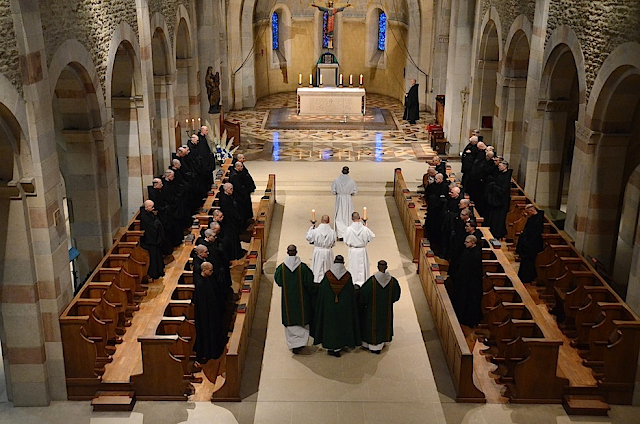
The Reading of the Rule of Saint Benedict for August 17
LXII DE SACERDOTIBUS MONASTERII
1 Si quis abbas sibi presbyterum vel diaconem ordinari petierit, de suis eligat qui dignus sit sacerdotio fungi.
2 Ordinatus autem caveat elationem aut superbiam,
3 nec quicquam praesumat nisi quod ei ab abbate praecipitur, sciens se multo magis disciplinae regulari subdendum.
4 Nec occasione sacerdotii obliviscatur regulae oboedientiam et disciplinam, sed magis ac magis in Deum proficiat.
5 Locum vero illum semper attendat quod ingressus est in monasterio,
6 praeter officium altaris, et si forte electio congregationis et voluntas abbatis pro vitae merito eum promovere voluerint.
7 Qui tamen regulam decanis vel praepositis constitutam sibi servare sciat.
8 Quod si aliter praesumpserit, non sacerdos sed rebellio iudicetur.
9 Et saepe admonitus si non correxerit, etiam episcopus adhibeatur in testimonio.
10 Quod si nec sic emendaverit, clarescentibus culpis, proiciatur de monasterio,
11 si tamen talis fuerit eius contumacia ut subdi aut oboedire regulae nolit.
CHAPTER 62: CONCERNING THE PRIESTS OF THE MONASTERY
1 If any abbot requests to have a priest or deacon ordained for himself, he should choose from among his own one who is worthy to function as a priest.
2 The one who is ordained is to be cautious of arrogance and pride
3 and not presume to do anything he has not been commanded by the abbot, knowing that he will be even more subject to the discipline of the Rule.
4 His priesthood must not cause him to forget the obedience and discipline of the Rule; rather he should advance more and more towards God.
5 He is to always regard as his place that which corresponds to his entrance into the monastery,
6 except with regard to the service of the altar, or if the choice of the community and the will of the abbot promote him on account of the merit of his life.
7 Nevertheless, he is to know how to keep the rule constituted for deans and priors.
8 Should he presume to do otherwise he will be judged not a priest, but a rebel.
9 And if after frequent admonition he does not amend, the bishop himself is to be brought in as a witness.
10 If even then he does not amend, and his guilt is well-known, he is to be expelled from the monastery;
11 but only if his stubbornness is such that he will not submit or obey the Rule.
Today's celebration of Mass


Also today
Saint Clare of Montefalco
Jesus is crowned with thorns
Jesus XPI Passio sit semper in cordibus nostris
May the Passion of Jesus Christ be always in our hearts

"The Cross is our trophy against the demons, our sword against sin, and the sword Christ used to pierce the serpent. The Cross is the Father's will, the glory of the Only-Begotten, the joy of the Spirit, the pride of the angels, the guarantee of the Church." -St. John Chrysostom


Comments