Catholic devotions for 11th August
Scroll down for today's
Saint of the Day/ Feast
Reading of the Martyrology
Dedication of the Month
Dedication of the Day
Rosary
Five Wounds Rosary in Latin
Seven Sorrows Rosary in English
Latin Monastic Office
Reading of the Rule of Saint Benedict
Celebration of Mass
Reading from the School of Jesus Crucified

Feast of Saint Peter Faber SJ
Semen est sanguis Christianorum
The blood of Christians is the seed of the Church
Tertullian, Apologeticum, 50
The Reading from the Martyrology
This Day, the Eleventh Day of August
At Rome, between the two laurels situated about three miles from the city, the birthday of St. Tiburtius, martyr, under the judge Fabian, in the persecution of Diocletian. After he had walked barefoot on burning coals and confessed Christ with increased constancy, he was put to the sword.
Also, at Rome, the holy virgin Susanna, a woman of noble race, and niece of the blessed Pontiff Caius. She deserved the palm of martyrdom by being beheaded in the time of Diocletian.
At Gomana, in Pontus, St. Alexander, bishop, surnamed Carbonarius, who added to a consummate knowledge of philosophy an eminent degree of Christian humility. He was promoted to the See of that church by St. Gregory Thaumaturgus, and became illustrious, not only by preaching, but also by suffering martyrdom by fire.
The same day, the martyrdom of St. Rufinus, bishop of the Marsi, and his companions, under the emperor Maximinus.
At Evreux, in France, St. Taurinus, bishop. Being made bishop of that city by the blessed Pope Clement, he propagated the Christian faith by the preaching of the Gospel, and the many labors he sustained for it. Celebrated for glorious miracles, he slept in the Lord.
At Cambrai, in France, St. Gaugericus, bishop and confessor.
In the province of Valeria, St. Equitius, abbot, whose sanctity is attested by the blessed Pope Gregory.
At Todi, St. Digna, virgin.
And elsewhere in divers places, many other holy martyrs, confessors, and holy virgins.
Omnes sancti Mártyres, oráte pro nobis.
("All ye Holy Martyrs, pray for us", from the Litaniae Sanctorum, the Litany of the Saints)
August is the Month of the Immaculate Heart of Mary

Composed by Saint John Henry Cardinal Newman, shortly after his reception into the One, True Fold of the Redeemer
Prayers for Every Day of the Week
The Joyful Mysteries of the Rosary are prayed on Monday
"I would like to remind you that the Rosary is a biblical prayer, all filled with the Holy Scriptures." It is a prayer from the heart, in which the repetition of the Ave Maria directs the thought and affection towards Christ, and thus is made a confident prayer to Him and our Mother. It is a prayer that helps to meditate on the Word of God and assimilate the Eucharistic Communion, on the model of Mary who kept in her heart everything Jesus did and said and even His Presence. " Pope Benedict XVI
The Rosary in Latin
Chaplet of the Five Holy Wounds of Christ in Latin
Chaplet of the Seven Sorrows of Our Lady in English
Latin Monastic Office for today from Le Barroux in France Texts also provided
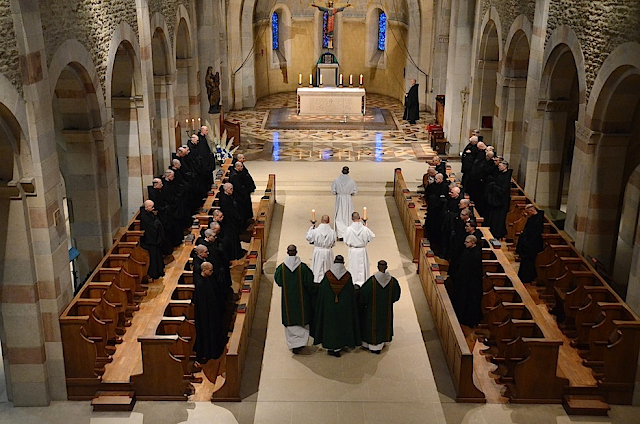
The Reading of the Rule of Saint Benedict for August 11
LVIII DE DISCIPLINA SUSCIPIENDORUM FRATRUM
1 Noviter veniens quis ad conversationem, non ei facilis tribuatur ingressus
2 sed sicut ait apostolus: Probate spiritus si ex Deo sunt.
3 Ergo si veniens perseveraverit pulsans et illatas sibi iniurias et difficultatem ingressus post quattuor aut quinque dies . visus fuerit patienter portare et persistere petitioni suae,
4 adnuatur ei ingressus et sit in cella hospitum paucis diebus
5 Postea autem sit in cella noviciorum ubi meditent et manducent et dormiant.
6 Et senior eis talis deputetur qui aptus sit ad lucrandas animas, qui super eos omnino curiose intendat.
7 Et sollicitudo sit
[1] si revera Deum quaerit,
[2] si sollicitus est ad opus Dei,
[3] ad oboedientiam,
[4] ad opprobria.
8 Praedicentur ei omnia dura et aspera per quae itur ad Deum.
9 Si promiserit de stabilitate sua perseverantia, post duorum mensuum circulum legatur ei haec regula per ordinem 10 et dicatur ei: Ecce lex sub qua militare vis; si potes observare, ingredere; si vero non potes, liber discede.
11 Si adhuc steterit, tunc ducatur in supradictam cellam noviciorum et iterum probetur in omni patientia.
12 Et post sex mensuum circuitum legatur ei regula, ut sciat ad quod ingreditur.
13 Et si adhuc stat, post quattuor menses iterum relegatur ei eadem regula.
14 Et si habita secum deliberatione promiserit se omnia custodire et
cuncta sibi imperata servare, tunc suscipiatur in congregatione,
15 sciens et lege regulae constitutum quod ei ex illa die non liceat egredi de monasterio,
16 nec collum excutere de sub iugo regulae quem sub tam morosam deliberationem licuit aut excusare aut suscipere.
CHAPTER 58: THE DISCIPLINE OF RECEIVING BROTHERS
1 One newly arriving to this way of life is not to be granted an easy entrance;
2 rather, as the apostle says, Test the spirits, whether they are from God (1 John 4:1).
3 Therefore if the one who comes perseveres in knocking and appears to patiently endure injuries done him and difficulties concerning his entrance for four or five days, and if he still persists in his petition,
4 entrance is to be granted him, and he is to stay in the guest-house for a few days.
5 But after this he is to stay in the novitiate, where he is to meditate, eat, and sleep.
6 And to him a senior is to be deputed who is skilled at winning souls, who will watch over him with all care.
7 And it should be eagerly ascertained
[1] whether he truly seeks God,
[2] whether he is eager for the Work of God,
[3] for obedience,
[4] and for humbling experiences.
8 To him should be proclaimed everything of the roughness and pain by which we journey towards God.
9 If he promises perseverance in his stability, after a period of two months this Rule is to be read to him straight through
10 and then he is to be told: “Behold the law under which you wish to fight: if you are able to observe it, enter; if you are not able, freely depart.”
11 If he still stands firm, he is to be taken to the novitiate described above and again tested in all patience.
12 After a period of six months, the Rule is to be read to him again, so that he knows what he is entering.
13 And if he still stands firm, after four months the same Rule is to be read to him once again.
14 And if, having deliberated within himself, he promises to keep everything and to submit in all that he is ordered, then he is to be received into the community
15 knowing that the law of the Rule establishes that from that day he is no longer free to depart from the monastery
16 nor remove his neck from beneath the yoke of the Rule which after such prolonged deliberation he was free to either refuse or to accept.
Today's Celebration of the Mass
Also today

Blesseds Peter and John Becchetti, Augustinians
Blessed Giovanni and Blessed Pietro were cousins who, entering the Augustinian Order, made their profession vows in the monastery of Saint Augustine in Fabriano (Ancona), Italy.
It is said that Blessed Giovanni was a relative of Thomas Becket. He had been a professor at Rimini and became a bachelor of theology in 1385. According to the Augustinian, Bartholomew of Venice, Blessed Giovanni “commended by his reputation for knowledge and his way of life.” That very same year he was assigned to study at Oxford, England, where he obtained the degree of master of theology. Shortly after his return to Italy in1391 he was named Master of the House of studies in Perugia. The last documentary evidence of his life is a letter written to him by the prior general on 7 May 1420.
In 1385, Blessed Pietro studied in Padua for the degree of lector. In 1338 he was appointed professor in the Augustinian house of studies in Rimini. While there the prior general appointed him as visitator to investigate complaints that had been received concerning this house. From there he was appointed professor in Venice and from there in 1393, because of his great devotion to the Lord’s passion, went on pilgrimage to the Lord’s sepulcher in the Holy Land. According to the records of the Augustinian Order, the last known date of his life is 20 February 1421, when the prior general wrote him a letter which is found in the Registers of the Priors General.
Jesus is derided and treated most ignominiously in the house of Caiaphas.

Jesus XPI Passio sit semper in cordibus nostris
May the Passion of Jesus Christ be always in our hearts

"The Cross is our trophy against the demons, our sword against sin, and the sword Christ used to pierce the serpent. The Cross is the Father's will, the glory of the Only-Begotten, the joy of the Spirit, the pride of the angels, the guarantee of the Church." -St. John Chrysostom








.jpeg)

Comments