Pro-abortion Rural Christian Youth Movement still in good standing with the Catholic bishops puts on drag shows and question gender. Liberation theology sent the movement mad.
Rural Christian Youth Movement (MRJC)
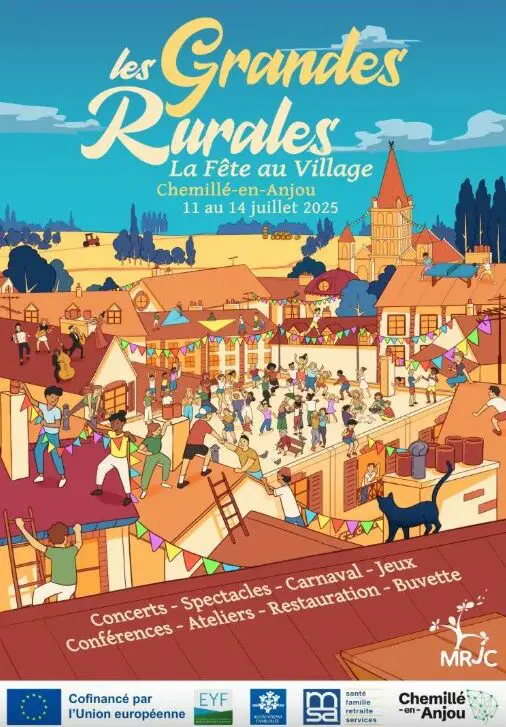
Managed and run by young people aged 13 to 30, the MRJC is both a Catholic Church movement and a popular education movement. It plays an educational role and offers young people the chance to participate in the development of their local area.
Activities
Thousands of young people come together in teams and camps to implement a project for social change based on real-life situations. Teams are the foundation and main activity of the movement. It is also a time for reflection and collective action for young people in rural areas.
President: Mrs Manon Rousselot Pailley
Here is some history.
Origins: the JAC
The Catholic Agricultural Youth (JAC) was founded in 1929 by Father Charles Jacques (1900-1939, born in Maixe) of the Diocese of Nancy-Toul. He called it JAC (Jeunesse Agricole Catholique), a play on his name. The movement grew rapidly under the leadership of the clergyman.
In 1935, 2,500 young people attended the first National Council. In 1939, there were 25,000 at the Vél d'Hiv in Paris. During the war, the JAC went underground. In 1950, the JAC gathered 50,000 young people for its twentieth anniversary. In 1954, for its twenty-fifth anniversary, the JAC had 350,000 young people across the country. It was then at its peak. But French society during the Trente Glorieuses was undergoing profound change: more and more non-farmers were living in villages, the number of rural workers was increasing, young people were staying in school for longer periods, and the rural exodus was increasing. There was no longer any coincidence between agricultural and rural realities.
The JAC decided to adapt to these new realities. In 1961, the Rural Catholic Youth Movement (MRJC) was born, gradually bringing together several organizations:
Catholic Agricultural Youth (JAC)
Christian Youth of Industry (JCI), formerly the Young Rural Christian Workers (JROC)
Christian Youth of Health and Social Services (JCSS)
Christian Youth of Crafts and Commerce (JCAC). At the same time, the Young Catholic Agricultural Women (JACF) followed the same process and, in 1963, gave birth to the Rural Movement of Young Catholic Women (MRJCF) through the merger of the JACF, the JROCF, the JCSSF, and the JCACF.
On January 16, 1966, the MRJC and the MRJCF officially merged, and the movement thus became mixed under the single name MRJC.
On May 25, 1966, the name of the MRJC was officially changed in the Official Journal: the MRJC was now "Christian" and no longer "Catholic"[2].
Political radicalisation and left-wing establishment
The late 1960s were marked by a political radicalization of the MRJC. Marxist ideology was gaining ground, particularly among members of the leadership teams. The May 1968 movement accelerated this trend. Many MRJC activists joined the student revolt. In March 1969, a session held in Jambville brought together around a hundred MRJC leaders and as many chaplains to analyze the "relationships of domination and exploitation within the capitalist system." The MRJC also organized training courses in Marxism for its members and supporters, featuring Marxist intellectuals such as Gilbert Mury and Henri Lefebvre, and the "Red Dominicans" Paul Blanquart, Jean-Pierre Jossua, and Jean-Yves Jolif, who were supportive of the Chinese and Cuban revolutions, as well as liberation theology.
In November 1972, an internal crisis erupted. The national team of the MRJC, converted to Maoism and close to the Marxist-Leninist Communist Party of France (PCMLF) banned by the Ministry of the Interior, advocated direct revolutionary action by MRJC activists, which would mean the end of the MRJC as a Church movement and its transformation into a leftist revolutionary organization[6]. But this strategy was rejected by the rank and file, which opted for involvement in existing trade union organizations (CGT, CFDT, etc.) and within the Union of the Left. The pro-Maoist national team had to resign after a bitter conflict. At the same time, this internal crisis disoriented many sympathizers who chose to distance themselves from the MRJC. In 1976, the MRJC, once a mass movement, had only about 10,000 activists left.
And the present reality
Les Grandes rurales, the MRJC festival that takes place every 7 years in the Angers diocese, with conferences that were initially organised on the premises of a Catholic teaching establishment (this has since changed): Drag queen make-up, drag queen show at the same time as mass, "single-sex only for cis men" workshops, gender and sexuality workshop for under-18s, What place for gender minorities in rural areas, "Les métamorphoses de Jean-Claude" show, etc.
Is the CEF still funding this subversive association?
In any case, the Sunday Mass on 13 July will certainly be reinvented in the spirit of active participation... It is being prepared and led by several Catholic Action movements: CMR 49 (Chrétiens dans le Monde Rural), ACE 49 (Action Catholique des Enfants), MRJC (Mouvement Rural de Jeunesse Chrétienne) and CCFD-Terre Solidaire. The celebration was designed to be participatory, with the Gospel being shared in small groups. The children will have the opportunity to take part in an animated time dedicated to them, after which they will return to the main assembly. The celebration is accompanied by several musicians. The songs were chosen by the various Movements and the MRJC's national Spirituality Commission.
Cathcon: I have some more material on the spineless response of the French bishops to the pro-abortion stance of the movement and the question of financing






.jpeg)

Comments