Catholic devotions for 27th July
Scroll down for today's
Saint of the Day/ Feast
Reading of the Martyrology
Dedication of the Month
Dedication of the Day
Rosary
Five Wounds Rosary in Latin
Seven Sorrows Rosary in English
Latin Monastic Office
Reading of the Rule of Saint Benedict
Celebration of Mass
Reading from the School of Jesus Crucified

Feast of Blessed Rudolph Acquaviva and 4 Companions
Rodolfo Acquaviva, SJ (2 October 1550 – 25 July 1583) was an Italian Jesuit missionary and priest in India who served the court of Akbar the Great from 1580 to 1583. He was killed in 1583 and beatified in 1893.
Family
Rodolfo Acquaviva was the son of Giangirolamo Acquaviva, the 10th Duke of Atri. He was the great-grandson of Andrea Matteo Acquaviva, condottiere and man of letters. Rodolfo (also known as Rudolfo) belonged to a powerful and illustrious family of Germanic origin settled in the Kingdom of Naples since the twelfth century. His mother was Marguerite Pio where on his mother's side, he was a cousin of Aloysius Gonzaga.
Priesthood
In April 1568, inspired by the example of his uncle Claudio Acquaviva who later became the 5th General of the Jesuits, he too joined the Society of Jesus. He became a novice at Sant'Andrea al Quirinale in Rome together with Stanislas Kostka. After completing his studies, Acquaviva was chosen by his superiors for the prestigious and challenging Indian missions, begun by Francis Xavier in the Portuguese territory of Goa. He then traveled to Lisbon, the starting point for the eastern voyage where he was ordained as a priest and sailed for India in 1578.
At Akbar's Court
At first Acquaviva taught at Saint Paul's College, Goa but was then assigned as the leader of a mission to the court of the Grand Mughal Akbar (1542–1605) who had requested missionaries be sent. In his new palace in Fatehpur Sikri Akbar built the Ibadat Khana (House of Worship) where he invited leaders of the Muslim, Hindu and other religions to debate points of religious truth, including Acquaviva and his companion Jesuit António de Monserrate (Antoni de Montserrat in his native Catalan), and their young translator, Francisco Henriques, who spoke Persian. Akbar was interested in founding a new pantheistic religion with elements from different traditions and his new faith was called Din-i-Ilahi ("Faith of the Divine").
Although Acquaviva came equipped with the Bible translated into many different languages, (though not yet Persian) and was the object of Akbar's sympathetic personal attention, the Jesuit felt his efforts were fruitless, one obstacle being the ruler's repugnance to monogamy, and after three years, decided to withdraw, though other Jesuits maintained the mission at the courts of the Mughal Emperors and in Agra for the next two centuries.
Martyrdom
Upon his return to Goa as part of his missionary commitments, Acquaviva led a mission to the Hindu Kshatriyas of Salcette, south of Goa. This was seen as a provocation by the locals, inciting the Cuncolim Revolt of July 1583. Acquaviva had his throat cut while praying to God.
Beatification
Acquaviva and his four Jesuit companions were beatified by Pope Leo XIII in 1893. He is commemorated with the Jesuit martyrs of the missions on 4 February by the order and its institutions.
Semen est sanguis Christianorum
The blood of Christians is the seed of the Church
Tertullian, Apologeticum, 50
The Reading from the Martyrology
This Day, the Twenty-Seventh Day of July
At Nicomedia, the martyrdom of St. Pantaleon, a physician. For the faith of Christ he was apprehended by the emperor Maximian, subjected to the torture and burned with torches, during which torments he was comforted by an apparition of our Lord. He ended his martyrdom by a stroke of the sword.
In the same city, St. Hermolaus, priest, by whose instructions blessed Pantaleon was converted to the faith.
Also, the Saints Hermippus and Hermocrates, brothers. After many sufferings borne for the confession of Christ, they were condemned to capital punishment by the same Maximian.
At Nola, the holy martyrs Felix, Julia and Jucunda.
At Biseglia, in Apulia, the holy martyrs Maurus, bishop, Pantaleemon, and Sergius, who suffered under Trajan.
At Rome, Pope St. Celestine I, who had condemned Nestorius, bishop of Constantinople, and put Pelagius to flight. By his command the holy universal Council of Ephesus was also held against the same Nestorius.
In the country of the Homerites (Arabia), the commemoration of the holy martyrs, who were delivered to the flames for faith of Christ, under the tyrant Dunaan.
At Cordova, in Spain, during the persecution of the Arabs, the holy martyrs George, deacon, Felix, Aurelius, Natalia, and Liliosa.
At Ephesus, the birthday of the seven holy sleepers, Maximian, Malchus, Martinian, Denis, John, Serapion, and Constantine.
At Auxerre, the demise of blessed Aetherius, bishop and confessor.
At Constantinople, blessed Anthusa, a virgin. Under Constantine Copronymus, after being scourged and banished, she rested in the Lord.
At Cordova in Spain, during the Arab persecution, the holy martyrs George, a deacon, Aurelius and his wife Natalia, Felix and his wife Liliosa.
And elsewhere in divers places, many other holy martyrs, confessors, and holy virgins.
Omnes sancti Mártyres, oráte pro nobis.
("All ye Holy Martyrs, pray for us", from the Litaniae Sanctorum, the Litany of the Saints)
July is the Month of the Most Precious Blood

Litaniae Pretiosissimi Sanguinis Domini Nostri Iesu Christi (Litany of the Most
Precious Blood of Our Lord Jesus Christ)
This Litany in honor of Jesus in His Most Precious Blood was drawn up by the Sacred
Congregation of Rites and promulgated by Pope John XXIII on February 24, 1960. The
devotion to Jesus in His most Precious Blood was first popularized by St. Gaspar del
Bufalo (1786-1837, feast Dec. 28) who founded the Missioners of the Most Precious
Blood. A partial indulgence is granted to the faithful who recite this litany.
Kyrie, eleison Kyrie, eleison.
Christe, eleison Christe, eleison.
Kyrie, eleison Kyrie, eleison.
Christe, audi nos Christe, audi nos.
Christe, exaudi nos. Christe, exaudi nos.
Pater de caelis, Deus, miserere nobis.
Fili, Redemptor mundi, Deus, miserere nobis.
Spiritus Sancte, Deus, miserere nobis.
Sancta Trinitas, unus Deus, miserere nobis.
Sanguis Christi, Unigeniti Patris aeterni, salva nos.
Sanguis Christi, Verbi Dei incarnati, salva nos.
Sanguis Christi, Novi et Aeterni Testamenti, salva nos.
Sanguis Christi, in agonia decurrens in terram, salva nos.
Sanguis Christi, in flagellatione profluens, salva nos.
Sanguis Christi, in coronatione spinarum emanans, salva nos.
Sanguis Christi, in Cruce effusus, salva nos.
Sanguis Christi, pretium nostrae salutis, salva nos.
Sanguis Christi, sine quo non fit remissio, salva nos.
Sanguis Christi, in Eucharistia potus et lavacrum animarum, salva nos.
Sanguis Christi, flumen misericordiae, salva nos.
Sanguis Christi, victor daemonum, salva nos.
Sanguis Christi, fortitudo martyrum, salva nos.
Sanguis Christi, virtus confessorum, salva nos.
Sanguis Christi, germinans virgines, salva nos.
Sanguis Christi, robur periclitantium, salva nos.
Sanguis Christi, levamen laborantium, salva nos.
Sanguis Christi, in fletu solatium, salva nos.
Sanguis Christi, spes poenitentium, salva nos.
Sanguis Christi, solamen morientium, salva nos.
Sanguis Christi, pax et dulcedo cordium, salva nos.
Sanguis Christi, pignus vitae aeternae, salva nos.
Sanguis Christi, animas liberans de lacu Purgatorii, salva nos.
Sanguis Christi, omni gloria et honore dignissimus, salva nos.
Agnus Dei, qui tollis peccata mundi, parce nobis, Domine.
Agnus Dei, qui tollis peccata mundi, exaudi nos, Domine.
Agnus Dei, qui tollis peccata mundi, miserere nobis, Domine.
V. redimisti nos, Domine, in sanguine tuo.
R. Et fecisti nos Deo nostro regnum.
Oremus;
Omnipotens sempiterne Deus, qui unigenitum Filium tuum mundi Redemptorem
constituisti, ac eius sanguine placari voluisti: concede, quaesumus, salutis nostrae
pretium ita venerari, atque a praesentis vitae malis eius virtute defendi in terris, ut
fructu perpetuo laetemur in caelis. Per eundem Christum Dominum nostrum. Amen.
Lord, have mercy. Lord, have mercy.
Christ, have mercy. Christ, have mercy.
Lord, have mercy. Lord, have mercy.
Christ, hear us. Christ, hear us.
Christ, graciously hear us. Christ, graciously hear us.
God the Father of Heaven, have mercy on us.
God the Son, Redeemer of the world, have mercy on us.
God, the Holy Spirit, have mercy on us.
Holy Trinity, One God, have mercy on us.
Blood of Christ, only-begotten Son of the eternal Father, save us.
Blood of Christ, Incarnate Word or God, save us.
Blood of Christ, of the New and Eternal Testament, save us.
Blood of Christ, falling upon the earth in Agony, save us.
Blood of Christ, shed profusely in the Scourging, save us.
Blood of Christ, flowing forth in the Crowning with Thorns, save us.
Blood of Christ, poured out on the Cross, save us.
Blood of Christ, price of our salvation, save us.
Blood of Christ, without which there is no forgiveness, save us.
Blood of Christ, Eucharistic drink and refreshment of souls, save us.
Blood of Christ, stream of mercy, save us.
Blood of Christ, victor over demons, save us.
Blood of Christ, courage of Martyrs, save us.
Blood of Christ, strength of Confessors, save us.
Blood of Christ, bringing forth Virgins, save us.
Blood of Christ, help of those in peril, save us.
Blood of Christ, relief of the burdened, save us.
Blood of Christ, solace in sorrow, save us.
Blood of Christ, hope of the penitent, save us.
Blood of Christ, consolation of the dying, save us.
Blood of Christ, peace and tenderness of hearts, save us.
Blood of Christ, pledge of eternal life, save us.
Blood of Christ, freeing souls from purgatory, save us.
Blood of Christ, most worthy of all glory and honor, save us.
Lamb of God, who taketh away the sins of the world, spare us, O Lord.
Lamb of God, who taketh away the sins of the world, graciously hear us, O Lord.
Lamb of God, who taketh away the sins of the world, have mercy on us, O Lord.
V. Thou hast redeemed us, O Lord, in Thy Blood.
R. And made us, for our God, a kingdom.
Let us pray;
Almighty and eternal God, Thou hast appointed Thine only-begotten Son the Redeemer
of the world and willed to be appeased by his blood. Grant, we beg of Thee, that we
may worthily adore this price of our salvation and through its power be safeguarded
from the evils of the present life so that we may rejoice in its fruits forever in heaven.
Through the same Christ our Lord. Amen.
Sunday is the Day dedicated to Resurrection & the Holy and Undivided Trinity
Prayers for Every Day of the Week
The Athanasian Creed in English
The Athanasian Creed in Latin
The Glorious Mysteries of the Rosary are prayed on Sunday
"I would like to remind you that the Rosary is a biblical prayer, all filled with the Holy Scriptures." It is a prayer from the heart, in which the repetition of the Ave Maria directs the thought and affection towards Christ, and thus is made a confident prayer to Him and our Mother. It is a prayer that helps to meditate on the Word of God and assimilate the Eucharistic Communion, on the model of Mary who kept in her heart everything Jesus did and said and even His Presence. " Pope Benedict XVI
The Rosary in Latin
Chaplet of the Five Holy Wounds of Christ in Latin
Chaplet of the Seven Sorrows of Our Lady in English
Latin Monastic Office for today from Le Barroux in France Texts also provided
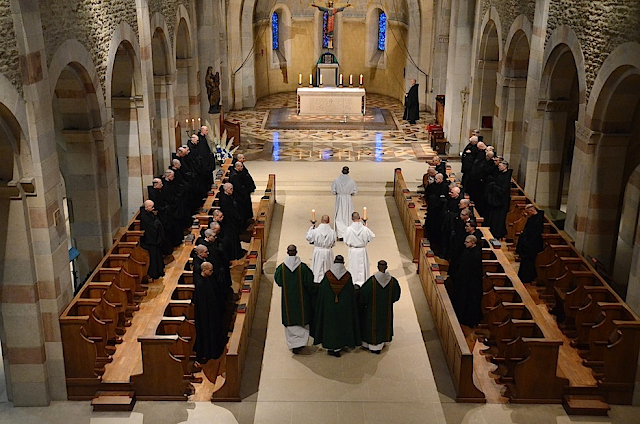
The Reading of the Rule of Saint Benedict for July 27
XLVII DE SIGNIFICANDA HORA OPERIS DEI
1 Nuntianda hora operis Dei dies noctesque sit cura abbatis: aut ipse nuntiare aut tali sollicito fratri iniungat hanc curam, ut omnia horis competentibus compleantur.
2 Psalmos autem vel antiphonas post abbatem ordine suo quibus iussum fuerit imponant.
3 Cantare autem et legere non praesumat nisi qui potest ipsud officium implere ut aedificentur audientes;
4 quod cum humilitate et gravitate et tremore fiat, et cui iusserit abbas.
CHAPTER 47: ANNOUNCING THE HOURS FOR THE WORK OF GOD
1 Announcing the hour for the Work of God day and night is the abbot’s responsibility, whether he gives the signal himself or assigns this responsibility to a conscientious brother; so that all things may be completed at the appropriate hours.
2 Psalms and antiphons, however, are to be led after the Abbot according to rank by those he apoints.
3 And no one may presume to sing or read unless he can fulfil this office by edifying his hearers:
4 this is to be done with humility, seriousness and reverence, and as the abbot orders.
Today's celebration of Mass


Also today

Jesus from His Cross bestows Mary upon us as Our Mother

Jesus XPI Passio sit semper in cordibus nostris
May the Passion of Jesus Christ be always in our hearts

"The Cross is our trophy against the demons, our sword against sin, and the sword Christ used to pierce the serpent. The Cross is the Father's will, the glory of the Only-Begotten, the joy of the Spirit, the pride of the angels, the guarantee of the Church." -St. John Chrysostom






.jpeg)

Comments