Catholic devotions for 18th July
Scroll down for today's:
Saint of the Day/ Feast
Reading of the Martyrology
Dedication of the Month
Dedication of the Day
Rosary
Five Wounds Rosary in Latin
Seven Sorrows Rosary in English
Latin Monastic Office
Reading of the Rule of Saint Benedict
Celebration of Mass
Reading from the School of Jesus Crucified

Feast of Saint Arnulf of Metz
Statesman, bishop under the Merovingians, born c. 580; died c. 640. His parents belonged to a distinguished Frankish family, and lived in Austrasia, the eastern section of the kingdom founded by Clovis. In the school in which he was placed during his boyhood he excelled through his talent and his good behaviour. According to the custom of the age, he was sent in due time to the court of Theodebert II, King of Austrasia (595-612), to be initiated in the various branches of the government. Under the guidance of Gundulf, the Mayor of the Palace, he soon became so proficient that he was placed on the regular list of royal officers, and among the first of the kings ministers. He distinguished himself both as a military commander and in the civil administration; at one time he had under his care six distinct provinces. In due course Arnulf was married to a Frankish woman of noble lineage, by whom he had two sons, Anseghisel and Clodulf. While Arnulf was enjoying worldly emoluments and honours he did not forget higher and spiritual things. His thoughts dwelled often on monasteries, and with his friend Romaricus, likewise an officer of the court, he planned to make a pilgrimage to the Abbey of Lérins, evidently for the purpose of devoting his life to God. But in the meantime the Episcopal See of Metz became vacant. Arnulf was universally designated as a worthy candidate for the office, and he was consecrated bishop of that see about 611. In his new position he set the example of a virtuous life to his subjects, and attended to matters of ecclesiastical government. In 625 he took part in a council held by the Frankish bishops at Reims. With all this Arnulf retained his station at the court of the king, and took a prominent part in the national life of his people. In 613, after the death of Theodebert, he, with Pepin of Landen and other nobles, called to Austrasia Clothaire II, King of Neustria. When, in 625, the realm of Austrasia was entrusted to the kings son Dagobert, Arnulf became not only the tutor, but also the chief minister, of the young king. At the time of the estrangement between the two kings, and 625, Arnulf with other bishops and nobles tried to effect a reconciliation. But Arnulf dreaded the responsibilities of the episcopal office and grew weary of court life. About the year 626 he obtained the appointment of a successor to the Episcopal See of Metz; he himself and his friend Romaricus withdrew to a solitary place in the mountains of the Vosges. There he lived in communion with God until his death. His remains, interred by Romaricus, were transferred about a year afterwards, by Bishop Goeric, to the basilica of the Holy Apostles in Metz.
Of the two sons of Arnulf, Clodulf became his third successor in the See of Metz. Anseghisel remained in the service of the State; from his union with Begga, a daughter of Pepin of Landen, was born Pepin of Heristal, the founder of the Carlovingian dynasty. In this manner Arnulf was the ancestor of the mighty rulers of that house. The life or Arnulf exhibits to a certain extent the episcopal office and career in the Merovingian State. The bishops were much considered at court; their advice was listened to; they took part in the dispensation of justice by the courts; they had a voice in the appointment of royal officers; they were often used as the king's ambassadors, and held high administrative positions. For the people under their care, they were the protectors of their rights, their spokesmen before the king and the link uniting royalty with its subjects. The opportunities for good were thus unlimited; and Arnulf used them to good advantage.
Semen est sanguis Christianorum
The blood of Christians is the seed of the Church
Tertullian, Apologeticum, 50
The Reading from the Martyrology
This Day, the Eighteenth Day of July
The feast of St. Camillus de Lellis, confessor, founder of the Clerks Regular ministering to the sick, whose birthday is the 14th of July. Leo XIII declared him Celestial Patron of hospitals and the infirm.
At Tivoli, in the time of the emperor Adrian, St. Symphorosa, wife of the martyr St. Getulius, with her seven sons, Crescens, Julian, Nemesius, Primitivus, Justinus, Stacteus, and Eugenius. Their mother, because of her invincible constancy, was first buffeted a long time, then suspended by her hair, and lastly thrown into the river with a stone tied to her body. Her sons had their limbs. distended by pulleys and bound to stakes, and terminated their martyrdom by different kinds of death. The bodies were subsequently taken to Rome, and were found in the sacristy of St. Angelo in Piscina,under the Sovereign Pontiff, Pius IV.
At Carthage, St. Gundenes, virgin. By order of the proconsul Rufinus, she was four different times stretched on the rack for the faith of Christ, horribly lacerated with iron hooks, confined for a long time in a filthy dungeon, and finally put to the sword.
At Dorostorum, in Mysia, in the time of Julian the Apostate and the governor Capitolinus, St. Aemilian, martyr, who was cast into a furnace, and thus received the palm of martyrdom.
At Utrecht, St. Frederick, bishop and martyr.
In Spanish Galicia, St. Marina, virgin and martyr.
At Milan, in the reign of Maximian, the holy Maternus. For the faith of Christ and the Church entrusted to him, he was thrown into prison and often scourged. Finally he went to his rest in the Lord with a great bishop renown for his repeated confession of the faith.
At Brescia, the birthday of St. Philastrius, bishop of that city, who in speech and writing combated heretics, especially the Arians, from whom he suffered much. Finally, he died in peace, renowned for miracles.
At Metz, in France, St. Arnulf, a bishop illustrious for holiness and the gift of miracles. He chose an eremitical life, and ended his blessed career in peace.
At Segni, St. Bruno, bishop and confessor.
At Forlimpopoli, in Aemilia, St. Ruffillus, bishop of that city.
At Silistria in Bulgaria, St. Emilian, martyr, who was cast into a furnace, in the time of Julian the Apostate, under the governor Capitolinus, and received the palm of martyrdom.
And elsewhere in divers places, many other holy martyrs, confessors, and holy virgins.
Omnes sancti Mártyres, oráte pro nobis.
("All ye Holy Martyrs, pray for us", from the Litaniae Sanctorum, the Litany of the Saints)
July is the Month of the Most Precious Blood

Litaniae Pretiosissimi Sanguinis Domini Nostri Iesu Christi (Litany of the Most
Precious Blood of Our Lord Jesus Christ)
This Litany in honor of Jesus in His Most Precious Blood was drawn up by the Sacred
Congregation of Rites and promulgated by Pope John XXIII on February 24, 1960. The
devotion to Jesus in His most Precious Blood was first popularized by St. Gaspar del
Bufalo (1786-1837, feast Dec. 28) who founded the Missioners of the Most Precious
Blood. A partial indulgence is granted to the faithful who recite this litany.
Kyrie, eleison Kyrie, eleison.
Christe, eleison Christe, eleison.
Kyrie, eleison Kyrie, eleison.
Christe, audi nos Christe, audi nos.
Christe, exaudi nos. Christe, exaudi nos.
Pater de caelis, Deus, miserere nobis.
Fili, Redemptor mundi, Deus, miserere nobis.
Spiritus Sancte, Deus, miserere nobis.
Sancta Trinitas, unus Deus, miserere nobis.
Sanguis Christi, Unigeniti Patris aeterni, salva nos.
Sanguis Christi, Verbi Dei incarnati, salva nos.
Sanguis Christi, Novi et Aeterni Testamenti, salva nos.
Sanguis Christi, in agonia decurrens in terram, salva nos.
Sanguis Christi, in flagellatione profluens, salva nos.
Sanguis Christi, in coronatione spinarum emanans, salva nos.
Sanguis Christi, in Cruce effusus, salva nos.
Sanguis Christi, pretium nostrae salutis, salva nos.
Sanguis Christi, sine quo non fit remissio, salva nos.
Sanguis Christi, in Eucharistia potus et lavacrum animarum, salva nos.
Sanguis Christi, flumen misericordiae, salva nos.
Sanguis Christi, victor daemonum, salva nos.
Sanguis Christi, fortitudo martyrum, salva nos.
Sanguis Christi, virtus confessorum, salva nos.
Sanguis Christi, germinans virgines, salva nos.
Sanguis Christi, robur periclitantium, salva nos.
Sanguis Christi, levamen laborantium, salva nos.
Sanguis Christi, in fletu solatium, salva nos.
Sanguis Christi, spes poenitentium, salva nos.
Sanguis Christi, solamen morientium, salva nos.
Sanguis Christi, pax et dulcedo cordium, salva nos.
Sanguis Christi, pignus vitae aeternae, salva nos.
Sanguis Christi, animas liberans de lacu Purgatorii, salva nos.
Sanguis Christi, omni gloria et honore dignissimus, salva nos.
Agnus Dei, qui tollis peccata mundi, parce nobis, Domine.
Agnus Dei, qui tollis peccata mundi, exaudi nos, Domine.
Agnus Dei, qui tollis peccata mundi, miserere nobis, Domine.
V. redimisti nos, Domine, in sanguine tuo.
R. Et fecisti nos Deo nostro regnum.
Oremus;
Omnipotens sempiterne Deus, qui unigenitum Filium tuum mundi Redemptorem
constituisti, ac eius sanguine placari voluisti: concede, quaesumus, salutis nostrae
pretium ita venerari, atque a praesentis vitae malis eius virtute defendi in terris, ut
fructu perpetuo laetemur in caelis. Per eundem Christum Dominum nostrum. Amen.
Lord, have mercy. Lord, have mercy.
Christ, have mercy. Christ, have mercy.
Lord, have mercy. Lord, have mercy.
Christ, hear us. Christ, hear us.
Christ, graciously hear us. Christ, graciously hear us.
God the Father of Heaven, have mercy on us.
God the Son, Redeemer of the world, have mercy on us.
God, the Holy Spirit, have mercy on us.
Holy Trinity, One God, have mercy on us.
Blood of Christ, only-begotten Son of the eternal Father, save us.
Blood of Christ, Incarnate Word or God, save us.
Blood of Christ, of the New and Eternal Testament, save us.
Blood of Christ, falling upon the earth in Agony, save us.
Blood of Christ, shed profusely in the Scourging, save us.
Blood of Christ, flowing forth in the Crowning with Thorns, save us.
Blood of Christ, poured out on the Cross, save us.
Blood of Christ, price of our salvation, save us.
Blood of Christ, without which there is no forgiveness, save us.
Blood of Christ, Eucharistic drink and refreshment of souls, save us.
Blood of Christ, stream of mercy, save us.
Blood of Christ, victor over demons, save us.
Blood of Christ, courage of Martyrs, save us.
Blood of Christ, strength of Confessors, save us.
Blood of Christ, bringing forth Virgins, save us.
Blood of Christ, help of those in peril, save us.
Blood of Christ, relief of the burdened, save us.
Blood of Christ, solace in sorrow, save us.
Blood of Christ, hope of the penitent, save us.
Blood of Christ, consolation of the dying, save us.
Blood of Christ, peace and tenderness of hearts, save us.
Blood of Christ, pledge of eternal life, save us.
Blood of Christ, freeing souls from purgatory, save us.
Blood of Christ, most worthy of all glory and honor, save us.
Lamb of God, who taketh away the sins of the world, spare us, O Lord.
Lamb of God, who taketh away the sins of the world, graciously hear us, O Lord.
Lamb of God, who taketh away the sins of the world, have mercy on us, O Lord.
V. Thou hast redeemed us, O Lord, in Thy Blood.
R. And made us, for our God, a kingdom.
Let us pray;
Almighty and eternal God, Thou hast appointed Thine only-begotten Son the Redeemer
of the world and willed to be appeased by his blood. Grant, we beg of Thee, that we
may worthily adore this price of our salvation and through its power be safeguarded
from the evils of the present life so that we may rejoice in its fruits forever in heaven.
Through the same Christ our Lord. Amen.
Friday is the Day dedicated to the Christ's Passion and His Sacred Heart
Fridays are penitential days and Catholics are to keep in mind Christ's suffering and to sacrifice something for the sake of penance and discipline. The traditional way to do this is to abstain from meat. On this day also, many Catholics make what is known as the "First Fridays Devotion" in honor of the Sacred Heart. This entails going to Mass and receiving Communion in reparation to the Sacred Heart on the first Friday of the month for nine consecutive months (see Devotion to the Sacred Heart of Jesus). Another Friday practice is to kneel and pray five Paters and five Aves, especially at 3:00pm, the hour Christ died on the Cross.
The Sorrowful Mysteries of the Rosary are prayed on Friday
"I would like to remind you that the Rosary is a biblical prayer, all filled with the Holy Scriptures." It is a prayer from the heart, in which the repetition of the Ave Maria directs the thought and affection towards Christ, and thus is made a confident prayer to Him and our Mother. It is a prayer that helps to meditate on the Word of God and assimilate the Eucharistic Communion, on the model of Mary who kept in her heart everything Jesus did and said and even His Presence. " Pope Benedict XVI
The Rosary in Latin
Chaplet of the Five Holy Wounds of Christ in Latin
Chaplet of the Seven Sorrows of Our Lady in English
Latin Monastic Office for today from Le Barroux in France Texts also provided
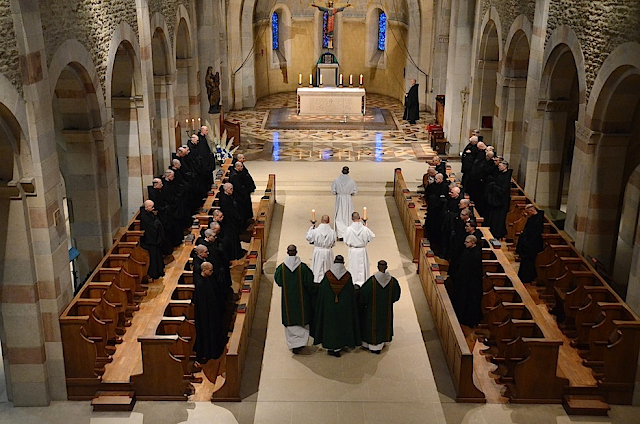
The Reading of the Rule of Saint Benedict for July 18
XXXIX DE MENSURA CIBUS
1 Sufficere credimus ad refectionem cotidianam tam sextae quam nonae, omnibus mensis, cocta duo pulmentaria, propter diversorum infirmitatibus,
2 ut forte qui ex illo non potuerit edere ex alio reficiatur.
3 Ergo duo pulmentaria cocta fratribus omnibus sufficiant et, si fuerit unde poma aut nascentia leguminum, addatur et tertium.
4 Panis libra una propensa sufficiat in die, sive una sit refectio sive prandii et cenae:
5 quod si cenaturi sunt, de eadem libra tertia pars a cellarario servetur reddenda cenandis.
6 Quod si labor forte factus fuerit maior, in arbitrio et potestate abbatis erit, si expediat, aliquid augere,
7 remota prae omnibus crapula et ut numquam surripiat monacho indigeries,
8 quia nihil sic contrarium est omni christiano quomodo crapula,
9 sicut ait Dominus noster: Videte ne graventur corda vestra crapula.
10 Pueris vero minori aetate non eadem servetur quantitas, sed minor quam maioribus, servata in omnibus parcitate.
11 Carnium vero quadrupedum omnimodo ab omnibus abstineatur comestio, praeter omnino debiles aegrotos.
CHAPTER 39: THE MEASURE OF FOOD
1 We believe it will suffice for the daily meal, whether at the sixth or ninth hour, that there be on all tables two dishes of cooked food on account of the variety of illnesses:
2 so that he who is not be able to eat one may make his meal of the other.
3 Therefore two cooked dishes will suffice for all the brothers; and if there is any fruit or young vegetables, a third dish is be added.
4 A liberal pound of bread should suffice each day, whether there is only one meal or both lunch and dinner:
5 and if they are to have dinner, a third part of their pound is to be kept back by the cellarer, and returned to them at dinner.
6 If it happens that the work is heavier the abbot can choose to exercise his power, when expedient, to add something,
7 provided that before all else overindulgence is avoided, and that no monk suffers indigestion.
8 For nothing is more contrary to all things Christian than overindulgence,
9 as Our Lord says: See that your hearts are not weighed down through overindulgence (Luke 21:34)
10 To children of immature years the same quantity should not be given: instead, they should receive less than their elders, frugality being observed in all matters.
11 But all are to abstain from eating the flesh of four-footed animals, except the sick who are very weak.
Today's Celebration of the Mass

Also Feast of Saint Camillus de Lellis
Pilate shows Christ to the people. Ecce Homo

Jesus XPI Passio sit semper in cordibus nostris
May the Passion of Jesus Christ be always in our hearts

"The Cross is our trophy against the demons, our sword against sin, and the sword Christ used to pierce the serpent. The Cross is the Father's will, the glory of the Only-Begotten, the joy of the Spirit, the pride of the angels, the guarantee of the Church." -St. John Chrysostom








.jpeg)

Comments