Catholic devotions for 17th July
Scroll down for today's
Saint of the Day/ Feast
Reading of the Martyrology
Dedication of the Month
Dedication of the Day
Rosary
Five Wounds Rosary in Latin
Seven Sorrows Rosary in English
Latin Monastic Office
Reading of the Rule of Saint Benedict
Celebration of Mass
Reading from the School of Jesus Crucified
.jpg)
Feast of Pope Saint Leo IV
A Roman and the son of Radoald, was unanimously elected to succeed Sergius II, and as the alarming attack of the Saracens on Rome in 846 caused the people to fear for the safety of the city, he was consecrated (10 April, 847) without the consent of the emperor. Leo received his early education at Rome in the monastery of St. Martin, near St. Peter's. His pious behavior attracted the notice of Gregory IV, who made him a subdeacon; and he was created Cardinal-Priest of the church of the Quatuor Coronati by Sergius II. As soon as Leo, much against his will, became pope, he began to take precautions against a repetition of the Saracen raid of 846. He put the walls of the city into a thorough state of repair, entirely rebuilding fifteen of the great towers. He was the first to enclose the Vatican hill by a wall. To do this, he received money from the emperor, and help from all the cities and agriculture colonies (domus cultae) of the Duchy of Rome. The work took him four years to accomplish, and the newly fortified portion was called the Leonine City, after him. In 852 the fortifications were completed, and were blessed by the pope with great solemnity.
Whilst the work of refortifying the city was in progress, a great fleet of the Saracens sailed for Rome, seemingly from Sardinia, but it was completely destroyed off Ostia by the allied fleets of Rome, Naples, Amalfi, and Gaeta, and by a tempest (849). When the rebuilding of the walls of Rome was accomplished, Leo rebuilt Portus, and handed it over to a number of Corsican exiles, whom the ravages of the Saracens had driven from their homes. Other cities too in the Roman duchy were fortified, either by the pope himself or in consequence of his exhortations. Leo also endeavoured to make good the damage which the Saracen raid of 846 had done to the different churches. St. Peter's had suffered very severely, and though as a whole it never again reached its former magnificence, Leo managed to make it in parts at least more beautiful than it had been before. St. Martin's, where he had been educated, the Quatuor Coronati, of which he had been the priest, the Lateran Palace, the Anglo-Saxon Borgo, Subiaco, and many other places both in Rome and out of it were renovated by the energetic Leo. It was by this pope that the church of S. Maria Nova was built, to replace S. Maria Antiqua, which the decaying Palace of the Caesars threatened to engulf, and of which the ruins have recently been brought to light. In 850 Leo associated with Lothair in the empire his son Louis, by imposing on him the imperial crown. Three years later "he hallowed the child Alfred to king [says an old English historian] by anointing; and receiving him for his own child by adoption, gave him confirmation, and sent him back [to England] with the blessing of St. Peter the Apostle."
The same year (853) he held an important synod in Rome, in which various decrees were passed for the furtherance of ecclesiastical discipline and learning, and for the condemnation of the refractory Anastasius, Cardinal of St. Marcellus, and sometimes librarian of the Roman Church. Equally rebellious conduct on the part of John, Archbishop of Ravenna, forced Leo to undertake a journey to that city to inspire John and his accomplices with respect for the law. It was while engaged in endeavouring to inspire another archbishop, Hincmar of Reims, with this same reverence, that Leo died. Another man who, till his death (851), defied the authority of the pope was Nomenoe, Duke of Brittany. Anxious to be independent of the imperial authority Nomenoe, in defiance both of Leo and Charles the Bald, not only deposed a number of bishops, but made new ones, and subjected them to a metropolitan see (Dol) of his own creation. It was not till the thirteenth century that the Archbishop of Tours recovered his jurisdiction over the Breton bishops. For consecrating a bishop outside his own diocese, St. Methodius, Patriarch of Constantinople, had suspended Gregory Asbestas, Bishop of Syracuse. St. Ignatius, who succeeded St. Methodius, in consequence forbade Gregory to be present at his consecration. This led Gregory to break all bounds. St. Ignatius accordingly caused him to be deposed, and begged the pope to confirm the deposition. This, however, Leo would not do, because, as he said, Ignatius had assembled bishops and deposed others without his knowledge, whereas he ought not to have done so "in the absence of our legates or of letters from us". Despite the fact that Leo was then in opposition to the Patriarch of Constantinople, one of his dependents, Daniel, a magister militum, accused him to the Frankish Emperor Louis of wishing to overthrow the domination of the Franks by a Greek alliance. Leo had, however, no difficulty in convincing Louis that the charge was absolutely groundless. Daniel was condemned to death and only escaped it by the intercession of the emperor. Shortly after this Leo died, and was buried in St. Peter's (17 July, 855)
The Reading from the Martyrology
The blood of Christians is the seed of the Church
Tertullian, Apologeticum, 50
This Day, the Sevententh Day of July
At Rome, St. Alexius, confessor, son of the senator Euphemian. Leaving his spouse untouched the night of his marriage, he withdrew from his house, and after a long pilgrimage returned to Rome, where he was for seventeen years harbored in his father's house as an unknown beggar, thus deluding the world by a new device. But after his death, becoming known through a voice heard in the churches of the city, and by his own writing, he was, under the Sovereign Pontiff, Innocent I, translated to the church of St. Boniface, where he wrought many miracles.
At Carthage, the birthday of the holy Scillitan martyrs Speratus, Narzales, Cythinus, Veturius, Felix, Acyllinus, Laetantius, Januaria, Generosa, Vestina, Donata, and Secunda. By order of the prefect Saturninus, after their first confession of the faith, they were sent to prison, nailed to pieces of wood, and finally beheaded. The relics of Speratus, with the bones of blessed Cyprian and the head of the martyr St. Pantaleon, were carried from Africa into France, and religiously placed in the basilica of St. John the Baptist at Lyons.
At Amastris, in Paphlagonia, St. Hyacinth, martyr, who died in prison after much suffering, under the prefect Castritius.
At Tivoli, St. Generosus, martyr.
At Constantinople, St. Theodota, martyr, under the Iconoclast Leo.
At Rome, the demise of Pope St. Leo IV.
At Pavia, St. Ennodius, bishop and confessor.
At Auxerre, St. Theodosius, bishop.
At Milan, the virgin St. Marcellina, sister of the blessed bishop Ambrose, who received the religious veil from Pope Liberius in the basilica of St. Peter at Rome. Her sanctity is attested by St. Ambrose in his writings.
At Venice, the translation of St. Marina, virgin.
And elsewhere in divers places, many other holy martyrs, confessors, and holy virgins.
Omnes sancti Mártyres, oráte pro nobis.
("All ye Holy Martyrs, pray for us", from the Litaniae Sanctorum, the Litany of the Saints)
July is the Month of the Most Precious Blood

Litaniae Pretiosissimi Sanguinis Domini Nostri Iesu Christi (Litany of the Most
Precious Blood of Our Lord Jesus Christ)
This Litany in honor of Jesus in His Most Precious Blood was drawn up by the Sacred
Congregation of Rites and promulgated by Pope John XXIII on February 24, 1960. The
devotion to Jesus in His most Precious Blood was first popularized by St. Gaspar del
Bufalo (1786-1837, feast Dec. 28) who founded the Missioners of the Most Precious
Blood. A partial indulgence is granted to the faithful who recite this litany.
Kyrie, eleison Kyrie, eleison.
Christe, eleison Christe, eleison.
Kyrie, eleison Kyrie, eleison.
Christe, audi nos Christe, audi nos.
Christe, exaudi nos. Christe, exaudi nos.
Pater de caelis, Deus, miserere nobis.
Fili, Redemptor mundi, Deus, miserere nobis.
Spiritus Sancte, Deus, miserere nobis.
Sancta Trinitas, unus Deus, miserere nobis.
Sanguis Christi, Unigeniti Patris aeterni, salva nos.
Sanguis Christi, Verbi Dei incarnati, salva nos.
Sanguis Christi, Novi et Aeterni Testamenti, salva nos.
Sanguis Christi, in agonia decurrens in terram, salva nos.
Sanguis Christi, in flagellatione profluens, salva nos.
Sanguis Christi, in coronatione spinarum emanans, salva nos.
Sanguis Christi, in Cruce effusus, salva nos.
Sanguis Christi, pretium nostrae salutis, salva nos.
Sanguis Christi, sine quo non fit remissio, salva nos.
Sanguis Christi, in Eucharistia potus et lavacrum animarum, salva nos.
Sanguis Christi, flumen misericordiae, salva nos.
Sanguis Christi, victor daemonum, salva nos.
Sanguis Christi, fortitudo martyrum, salva nos.
Sanguis Christi, virtus confessorum, salva nos.
Sanguis Christi, germinans virgines, salva nos.
Sanguis Christi, robur periclitantium, salva nos.
Sanguis Christi, levamen laborantium, salva nos.
Sanguis Christi, in fletu solatium, salva nos.
Sanguis Christi, spes poenitentium, salva nos.
Sanguis Christi, solamen morientium, salva nos.
Sanguis Christi, pax et dulcedo cordium, salva nos.
Sanguis Christi, pignus vitae aeternae, salva nos.
Sanguis Christi, animas liberans de lacu Purgatorii, salva nos.
Sanguis Christi, omni gloria et honore dignissimus, salva nos.
Agnus Dei, qui tollis peccata mundi, parce nobis, Domine.
Agnus Dei, qui tollis peccata mundi, exaudi nos, Domine.
Agnus Dei, qui tollis peccata mundi, miserere nobis, Domine.
V. redimisti nos, Domine, in sanguine tuo.
R. Et fecisti nos Deo nostro regnum.
Oremus;
Omnipotens sempiterne Deus, qui unigenitum Filium tuum mundi Redemptorem
constituisti, ac eius sanguine placari voluisti: concede, quaesumus, salutis nostrae
pretium ita venerari, atque a praesentis vitae malis eius virtute defendi in terris, ut
fructu perpetuo laetemur in caelis. Per eundem Christum Dominum nostrum. Amen.
Lord, have mercy. Lord, have mercy.
Christ, have mercy. Christ, have mercy.
Lord, have mercy. Lord, have mercy.
Christ, hear us. Christ, hear us.
Christ, graciously hear us. Christ, graciously hear us.
God the Father of Heaven, have mercy on us.
God the Son, Redeemer of the world, have mercy on us.
God, the Holy Spirit, have mercy on us.
Holy Trinity, One God, have mercy on us.
Blood of Christ, only-begotten Son of the eternal Father, save us.
Blood of Christ, Incarnate Word or God, save us.
Blood of Christ, of the New and Eternal Testament, save us.
Blood of Christ, falling upon the earth in Agony, save us.
Blood of Christ, shed profusely in the Scourging, save us.
Blood of Christ, flowing forth in the Crowning with Thorns, save us.
Blood of Christ, poured out on the Cross, save us.
Blood of Christ, price of our salvation, save us.
Blood of Christ, without which there is no forgiveness, save us.
Blood of Christ, Eucharistic drink and refreshment of souls, save us.
Blood of Christ, stream of mercy, save us.
Blood of Christ, victor over demons, save us.
Blood of Christ, courage of Martyrs, save us.
Blood of Christ, strength of Confessors, save us.
Blood of Christ, bringing forth Virgins, save us.
Blood of Christ, help of those in peril, save us.
Blood of Christ, relief of the burdened, save us.
Blood of Christ, solace in sorrow, save us.
Blood of Christ, hope of the penitent, save us.
Blood of Christ, consolation of the dying, save us.
Blood of Christ, peace and tenderness of hearts, save us.
Blood of Christ, pledge of eternal life, save us.
Blood of Christ, freeing souls from purgatory, save us.
Blood of Christ, most worthy of all glory and honor, save us.
Lamb of God, who taketh away the sins of the world, spare us, O Lord.
Lamb of God, who taketh away the sins of the world, graciously hear us, O Lord.
Lamb of God, who taketh away the sins of the world, have mercy on us, O Lord.
V. Thou hast redeemed us, O Lord, in Thy Blood.
R. And made us, for our God, a kingdom.
Let us pray;
Almighty and eternal God, Thou hast appointed Thine only-begotten Son the Redeemer
of the world and willed to be appeased by his blood. Grant, we beg of Thee, that we
may worthily adore this price of our salvation and through its power be safeguarded
from the evils of the present life so that we may rejoice in its fruits forever in heaven.
Through the same Christ our Lord. Amen.
Thursday is the Day dedicated to the Blessed Sacrament
The Pope at Corpus Christi
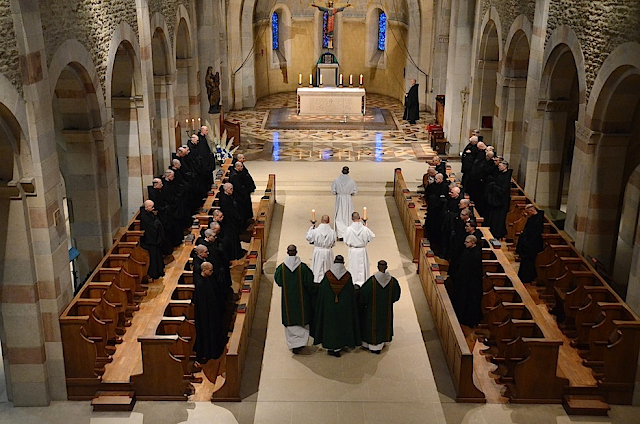
And at the wonderful Abbey of Heiligenkreuz
The Joyful Mysteries of the Rosary are prayed on Thursday
"I would like to remind you that the Rosary is a biblical prayer, all filled with the Holy Scriptures." It is a prayer from the heart, in which the repetition of the Ave Maria directs the thought and affection towards Christ, and thus is made a confident prayer to Him and our Mother. It is a prayer that helps to meditate on the Word of God and assimilate the Eucharistic Communion, on the model of Mary who kept in her heart everything Jesus did and said and even His Presence. " Pope Benedict XVI
The Rosary in Latin
Chaplet of the Five Holy Wounds of Christ in Latin
Chaplet of the Seven Sorrows of Our Lady in English
Latin Monastic Office for today from Le Barroux in France Texts also provided
The Reading of the Rule of Saint Benedict for July 17
XXXVIII DE HEBDOMADARIO LECTORE
1 Mensis fratrum lectio deesse non debet, nec fortuito casu qui arripuerit codicem legere ibi, sed lecturus tota hebdomada dominica ingrediatur.
2 Qui ingrediens post missas et communionem petat ab omnibus pro se orari, ut avertat ab ipso Deus spiritum elationis,
3 et dicatur hic versus in oratorio tertio ab omnibus, ipso tamen incipiente: Domine, labia mea aperies, et os meum adnuntiabit laudem tuam;
4 et sic accepta benedictione ingrediatur ad legendum.
5 Et summum fiat silentium, ut nullius mussitatio vel vox nisi solius legentis ibi audiatur.
6 Quae vero necessaria sunt comedentibus et bibentibus sic sibi vicissim ministrent fratres ut nullus indigeat petere aliquid;
7 si quid tamen opus fuerit, sonitu cuiuscumque signi potius petatur quam voce.
8 Nec praesumat ibi aliquis de ipsa lectione aut aliunde quicquam requirere, ne detur occasio;
9 nisi forte prior pro aedificatione voluerit aliquid breviter dicere.
10 Frater autem lector hebdomadarius accipiat mixtum priusquam incipiat legere, propter communionem sanctam, et ne forte grave sit ei ieiunium sustinere.
11 Postea autem cum coquinae hebdomadariis et servitoribus reficiat.
12 Fratres autem non per ordinem legant aut cantent, sed qui aedificant audientes.
CHAPTER 38: THE WEEKLY READER
1 At the brothers’ table there should always be reading, but this is not to be done carelessly by one who simply grabs for the book and reads; rather let the reader is to begin a whole week’s service on Sunday.
2 The one who begins his service is to ask after Mass and Communion that all pray for him, that God may protect him from the spirit of pride: 3 and this verse is to be said three times in the oratory by all after the reader begins it: O Lord, open my lips, and my mouth shall declare your praise (Ps 51:17);
4 and thus receiving the blessing he begins his service of reading.
5 And total silence is to be kept, so that no whispering or voice may be heard there except that of the reader alone.
6 With regard to things necessary for eating and drinking the brothers are to minister to one another in turn, so that no one need ask for anything:
7 If anything is wanted, it should be asked for by some audible sign rather than in words.Cas.In.4.17
8 No one is to presume there to ask any question about the reading or anything else, lest occasion be given (Eph 4:27; 1 Tim 5:4);
9 unless perhaps the superior wishes to briefly say something edifying.
10 However, the brother who is reader for the week is to receive mixed wine and water before he begins to read, on account of Holy Communion and so that it is not oppressive for him to continue his fast.
11 Afterwards he is to dine with the weekly kitchen servers and attendants.
12 The brothers, however, are not to read or sing according to their rank, but only those who edify the hearers.
Today's Celebration of the Mass
Also today the Holy Martyrs of Compiegne
Jesus is crowned with thorns

Jesus XPI Passio sit semper in cordibus nostris
May the Passion of Jesus Christ be always in our hearts

"The Cross is our trophy against the demons, our sword against sin, and the sword Christ used to pierce the serpent. The Cross is the Father's will, the glory of the Only-Begotten, the joy of the Spirit, the pride of the angels, the guarantee of the Church." -St. John Chrysostom







.jpeg)

Comments