Catholic devotions for 10th July
Scroll down for today's
Saint of the Day/ Feast
Reading of the Martyrology
Dedication of the Month
Dedication of the Day
Rosary
Five Wounds Rosary in Latin
Seven Sorrows Rosary in English
Latin Monastic Office
Reading of the Rule of Saint Benedict
Celebration of Mass
Reading from the School of Jesus Crucified

Feast of the Seven Holy Brothers, Martyrs
The names of the seven brothers whose martyrdom is commemorated today, are: Januarius, Felix, Philip, Sylvan, Alexander, Vitalis and Martialis. Their mother was St. Felicitas, a matron greatly renowned in Rome, not only on account of her noble birth, but still more for her edifying life. After her husband's death, she laid aside all worldly magnificence and vowed to live in perfect chastity for the remainder of her life. The education of her sons was her greatest care, and as at that period, the Christians were most cruelly persecuted, she directed all her exhortations and instructions in such a manner, that she might impress deeply into their hearts constancy to the true Faith, contempt of temporal happiness, and even of life itself, and, at the same time, a high estimation of eternal happiness and a great desire to obtain it. She frequently spoke to them of the torments of the Christian martyrs in and out of Rome, and the great glories which therefore had been prepared for them in heaven; of the happiness of suffering or dying for Christ's sake. "How happy should I be," said she, "if I should, one day, see you give your blood and life willingly out of love for Christ! How happy would you yourselves be for all eternity!" By these and similar words she awakened in the hearts of her sons a fervent desire to suffer and die for the faith of Christ. They spoke of nothing more frequently than of martyrdom, and declared to each other how they would despise all flatteries and caresses, all honors and riches of the world, and how gladly they would suffer pains and tortures. The pious mother listened with great inward joy to these words, and prayed daily to the Almighty to receive her children as an agreeable sacrifice.
God accepted her prayer. The idolatrous priests had observed that many were converted to the Christian faith by the edifying example of St. Felicitas and her sons. Hence they went to the Emperor, Marcus Aurelius, representing that the wrath of the gods rested on Rome because Felicitas, one of the most noble matrons, dared to alienate the inhabitants of the city from their worship; hence she ought to be compelled to offer a public sacrifice to the gods in order to appease them. The Emperor forthwith ordered Publius, the Prefect of the city, to attend to the request of the priests, and see that what they desired should be done. Publius, who greatly esteemed the Saint on account of her high birth and many noble qualities, sent for her, and, informing her of the Imperial command, entreated her to comply. He endeavored to persuade her by flatteries and promises, and at last, finding them of no avail, he proceeded to the most frightful menaces. But the Christian heroine said, fearlessly: "Thy menaces have no more power over me than thy flatteries. Neither I nor my sons will ever forsake the true Faith." "In that case," replied Publius, "you prepare your own ruin. But if you do not care for your own life, why should you become the murderess of your children? Consider, at least, their welfare and lives." "My children," said Felicitas, "will live in eternal happiness if they die for Christ's sake: should they, however, sacrifice to your gods, who are only devils, everlasting death will be their lot." Publius would say nothing further on that day, but dismissed her with the injunction to consider the matter well. The pious mother told her sons what had happened and spent the night with them in prayer, as she was convinced that they would suffer martyrdom.
On the following day, Publius repaired to the Place of Mars, and taking his seat as Judge, had Felicitas and her seven sons brought before him. All appeared cheerful, encouraging each other to bear bravely the approaching tortures. Publius, addressing the mother, said: "I presume that you have already changed your mind; but if not, look upon your children and take pity on them. In your power lies all their future happiness." After this he turned to the children and said: "Come, my dear children, I will procure you the happiest lot upon earth, if you are obedient to the emperor; but I am compelled to treat you most cruelly, should you oppose his commands." "Say rather," exclaimed Felicitas, solemnly addressing the Prefect, "that thou wilt be the cause of their eternal ruin with thy treacherons happiness." Then, turning towards her children, she encouraged them to constancy, like the heroic mother of the Maccabees, and said: "My beloved sons, look not upon the tyrant, but raise your eyes to heaven, and behold your God and Redeemer, Jesus Christ. He expects you, to place on your heads the crown of glory. As He has given His blood for your salvation, may you likewise give yours to His honor. Do not regard the torments with which you are menaced here below, but consider the joys which God promises you in heaven. Fight bravely, be not faint-hearted, but continue faithful in your love to Christ." Publius, furious that Felicitas dared in his presence to incite her children to disobey the imperial command, ordered her to be buffeted most barbarously. Then, calling the children to him one after another, he endeavored to win them with alternate promises and menaces. To the first he said: "Be wise, my son, obey the command of the emperor; if not, I shall have you scourged till you are dead." "My mother," said Januarius, "has spoken wisely, and I should act foolishly if I preferred the emperor's command to God's command. I do not fear scourging. My God will aid me that I may remain faithful, even unto death." Enraged at this dauntless answer, Publius ordered him to be scourged and cast into a dungeon. The same was done to the second, third, fourth, and fifth, as their answers breathed the same spirit as that of their brother. He then left nothing untried to induce at least the two youngest, Vitalis and Martialis, to forsake Christ, but found that they were not less brave and constant than the others. Vitalis said: "I am ready rather to give my life than sacrifice to the devils, your gods." Martialis, the youngest, fearing that they might spare him on account of his tender age, cried aloud: "I too am a Christian, like my brothers. I despise the idols as they do, and if their lives are taken, mine must be taken also." Publius, astonished at such unprecedented heroism, reported the whole proceedings to the emperor, who gave orders that they should all be executed.
Beyond description was the joy of the seven Christian heroes when their death was announced to them. They hastened to the place of execution with greater eagerness than others to a cheerful entertainment, and lost, during their martyrdom, neither their courage nor their joy. Each encouraged the other, until all had gone to heaven. Januarius was scourged with loaded whips until he expired; Felix and Philip were beaten to death with clubs; Sylvanus was thrown down a precipice; Alexander, Vitalis, and Martialis received the crown of martyrdom by being executed with the sword. Felicitas, the pious mother, was present at the dreadful martyrdom of her sons, but, like the above-mentioned mother of the Maccabees, she continued to encourage them until the last had expired. After this, she was brought back to prison, where she suffered four months longer, when at last she was beheaded, and thus rejoined her seven sons in heaven.
The Reading from the Martyrology
The blood of Christians is the seed of the Church
Tertullian, Apologeticum, 50
This Day, the Tenth Day of July
At Rome, the martyrdom of the seven holy brothers, sons of the saintly martyr Felicitas, namely, Januarius, Felix, Philip, Sylvanus, Alexander, Vitalis, and Martial, in the time of the emperor Antoninus, under Publius, prefect of the city. Januarius, after being scourged with rods and detained in prison, died under the blows inflicted with leaded whips. Felix and Philip were scourged to death, Sylvanus was thrown headlong from an eminence. Alexander, Vitalis, and Martial were condemned to capital punishment.
Also, at Rome, in the persecution of Valerian and Gallienus, the holy virgins and martyrs Rufina and Secunda, sisters, who, after being subjected to torments, the one having her head split open, the other being decapitated, departed for Heaven. Their bodies are kept with due honor in the Lateran Basilica, near the baptistery.
In Africa, the holy martyrs Januarius, Marinus, Nabor, and Felix, who were beheaded.
At Nicopolis, in Armenia, the holy martyrs Leontius, Mauritius, Daniel, and their companions, who after being tortured in different manners, were finally cast into the fire, and thus terminated their long martyrdom, in the time of the emperor Licinius and the governor Lysias.
In Pisidia, the holy martyrs Bianor and Silvanus, who merited an immortal crown by being decapitated, after enduring the most bitter torments for the name of Christ.
At Iconium, St. Apollonius, martyr, who consummated his glorious martyrdom by death on the cross.
At Ghent, St. Amelberga, virgin.
And elsewhere in divers places, many other holy martyrs, confessors, and holy virgins.
Omnes sancti Mártyres, oráte pro nobis.
("All ye Holy Martyrs, pray for us", from the Litaniae Sanctorum, the Litany of the Saints)
July is the Month of the Most Precious Blood

Litaniae Pretiosissimi Sanguinis Domini Nostri Iesu Christi (Litany of the Most
Precious Blood of Our Lord Jesus Christ)
This Litany in honor of Jesus in His Most Precious Blood was drawn up by the Sacred
Congregation of Rites and promulgated by Pope John XXIII on February 24, 1960. The
devotion to Jesus in His most Precious Blood was first popularized by St. Gaspar del
Bufalo (1786-1837, feast Dec. 28) who founded the Missioners of the Most Precious
Blood. A partial indulgence is granted to the faithful who recite this litany.
Kyrie, eleison Kyrie, eleison.
Christe, eleison Christe, eleison.
Kyrie, eleison Kyrie, eleison.
Christe, audi nos Christe, audi nos.
Christe, exaudi nos. Christe, exaudi nos.
Pater de caelis, Deus, miserere nobis.
Fili, Redemptor mundi, Deus, miserere nobis.
Spiritus Sancte, Deus, miserere nobis.
Sancta Trinitas, unus Deus, miserere nobis.
Sanguis Christi, Unigeniti Patris aeterni, salva nos.
Sanguis Christi, Verbi Dei incarnati, salva nos.
Sanguis Christi, Novi et Aeterni Testamenti, salva nos.
Sanguis Christi, in agonia decurrens in terram, salva nos.
Sanguis Christi, in flagellatione profluens, salva nos.
Sanguis Christi, in coronatione spinarum emanans, salva nos.
Sanguis Christi, in Cruce effusus, salva nos.
Sanguis Christi, pretium nostrae salutis, salva nos.
Sanguis Christi, sine quo non fit remissio, salva nos.
Sanguis Christi, in Eucharistia potus et lavacrum animarum, salva nos.
Sanguis Christi, flumen misericordiae, salva nos.
Sanguis Christi, victor daemonum, salva nos.
Sanguis Christi, fortitudo martyrum, salva nos.
Sanguis Christi, virtus confessorum, salva nos.
Sanguis Christi, germinans virgines, salva nos.
Sanguis Christi, robur periclitantium, salva nos.
Sanguis Christi, levamen laborantium, salva nos.
Sanguis Christi, in fletu solatium, salva nos.
Sanguis Christi, spes poenitentium, salva nos.
Sanguis Christi, solamen morientium, salva nos.
Sanguis Christi, pax et dulcedo cordium, salva nos.
Sanguis Christi, pignus vitae aeternae, salva nos.
Sanguis Christi, animas liberans de lacu Purgatorii, salva nos.
Sanguis Christi, omni gloria et honore dignissimus, salva nos.
Agnus Dei, qui tollis peccata mundi, parce nobis, Domine.
Agnus Dei, qui tollis peccata mundi, exaudi nos, Domine.
Agnus Dei, qui tollis peccata mundi, miserere nobis, Domine.
V. redimisti nos, Domine, in sanguine tuo.
R. Et fecisti nos Deo nostro regnum.
Oremus;
Omnipotens sempiterne Deus, qui unigenitum Filium tuum mundi Redemptorem
constituisti, ac eius sanguine placari voluisti: concede, quaesumus, salutis nostrae
pretium ita venerari, atque a praesentis vitae malis eius virtute defendi in terris, ut
fructu perpetuo laetemur in caelis. Per eundem Christum Dominum nostrum. Amen.
Lord, have mercy. Lord, have mercy.
Christ, have mercy. Christ, have mercy.
Lord, have mercy. Lord, have mercy.
Christ, hear us. Christ, hear us.
Christ, graciously hear us. Christ, graciously hear us.
God the Father of Heaven, have mercy on us.
God the Son, Redeemer of the world, have mercy on us.
God, the Holy Spirit, have mercy on us.
Holy Trinity, One God, have mercy on us.
Blood of Christ, only-begotten Son of the eternal Father, save us.
Blood of Christ, Incarnate Word or God, save us.
Blood of Christ, of the New and Eternal Testament, save us.
Blood of Christ, falling upon the earth in Agony, save us.
Blood of Christ, shed profusely in the Scourging, save us.
Blood of Christ, flowing forth in the Crowning with Thorns, save us.
Blood of Christ, poured out on the Cross, save us.
Blood of Christ, price of our salvation, save us.
Blood of Christ, without which there is no forgiveness, save us.
Blood of Christ, Eucharistic drink and refreshment of souls, save us.
Blood of Christ, stream of mercy, save us.
Blood of Christ, victor over demons, save us.
Blood of Christ, courage of Martyrs, save us.
Blood of Christ, strength of Confessors, save us.
Blood of Christ, bringing forth Virgins, save us.
Blood of Christ, help of those in peril, save us.
Blood of Christ, relief of the burdened, save us.
Blood of Christ, solace in sorrow, save us.
Blood of Christ, hope of the penitent, save us.
Blood of Christ, consolation of the dying, save us.
Blood of Christ, peace and tenderness of hearts, save us.
Blood of Christ, pledge of eternal life, save us.
Blood of Christ, freeing souls from purgatory, save us.
Blood of Christ, most worthy of all glory and honor, save us.
Lamb of God, who taketh away the sins of the world, spare us, O Lord.
Lamb of God, who taketh away the sins of the world, graciously hear us, O Lord.
Lamb of God, who taketh away the sins of the world, have mercy on us, O Lord.
V. Thou hast redeemed us, O Lord, in Thy Blood.
R. And made us, for our God, a kingdom.
Let us pray;
Almighty and eternal God, Thou hast appointed Thine only-begotten Son the Redeemer
of the world and willed to be appeased by his blood. Grant, we beg of Thee, that we
may worthily adore this price of our salvation and through its power be safeguarded
from the evils of the present life so that we may rejoice in its fruits forever in heaven.
Through the same Christ our Lord. Amen.
Thursday is the Day dedicated to the Blessed Sacrament
The Pope at Corpus Christi
And at the wonderful Abbey of Heiligenkreuz
The Joyful Mysteries of the Rosary are prayed on Thursday
"I would like to remind you that the Rosary is a biblical prayer, all filled with the Holy Scriptures." It is a prayer from the heart, in which the repetition of the Ave Maria directs the thought and affection towards Christ, and thus is made a confident prayer to Him and our Mother. It is a prayer that helps to meditate on the Word of God and assimilate the Eucharistic Communion, on the model of Mary who kept in her heart everything Jesus did and said and even His Presence. " Pope Benedict XVI
The Rosary in Latin
Chaplet of the Five Holy Wounds of Christ in Latin
Chaplet of the Seven Sorrows of Our Lady in English
Latin Monastic Office for today from Le Barroux in France Texts also provided
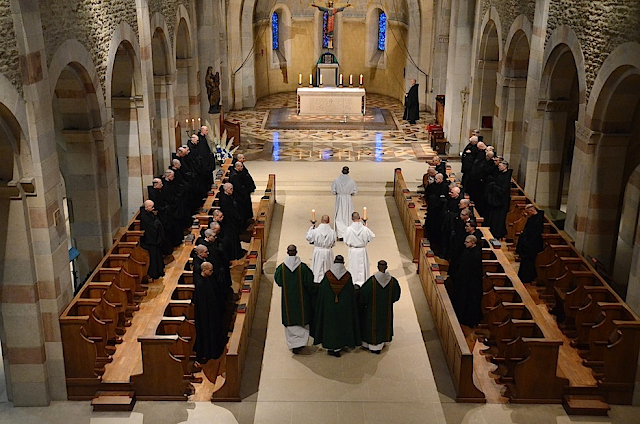
The Reading of the Rule of Saint Benedict for July 10
XXXII DE FERRAMENTIS VEL REBUS MONASTERII
1 Substantia monasterii in ferramentis vel vestibus seu quibuslibet rebus praevideat abbas fratres de quorum vita et moribus securus sit,
2 et eis singula, ut utile iudicaverit, consignet custodienda atque recolligenda.
3 Ex quibus abbas brevem teneat, ut dum sibi in ipsa assignata fratres vicissim succedunt, sciat quid dat aut quid recipit.
4 Si quis autem sordide aut neglegenter res monasterii tractaverit, corripiatur;
5 si non emendaverit, disciplinae regulari subiaceat.
CHAPTER 32, THE TOOLS and POSSESSIONS OF THE MONASTERY
1 The abbot is to provide for the material goods of the monastery - that is tools, clothes, and any other thing - by means of brothers whose life and character he trusts;
2 and he is to consign to them the different items as he judges best, to be conserved and then collected after use.
3 Of these items the abbot is to keep a list, so that as the brothers are successively assigned to different tasks, he will know what he gives out and what he receives back.
4 If anyone treats the goods of the monastery improperly or negligently he is to be corrected;
5 if he does not amend, he is to be subjected to the discipline of the Rule.
Today's Celebration of the Mass

Also today the 11 Martyrs of Damascus
Jesus is denied by Saint Peter

Jesus XPI Passio sit semper in cordibus nostris
May the Passion of Jesus Christ be always in our hearts








.jpeg)

Comments