Catholic devotions for the 4th June
Scroll down for today's
Saint of the Day/ Feast
Reading of the Martyrology
Dedication of the Month
Dedication of the Day
Rosary
Five Wounds Rosary in Latin
Seven Sorrows Rosary in English
Latin Monastic Office
Reading of the Rule of Saint Benedict
Celebration of Mass
Reading from the School of Jesus Crucified

Feast of Saint Francis Caracciolo
Francis (Francesco) Caracciolo was born in Villa Santa Maria in the Abruzzo region, in the Kingdom of Naples. He belonged to the Pisquizio branch of the Caracciolo family and received in baptism the name of Ascanio. From a young age, he had a reputation for gentleness and uprightness.When he was 22, he was attacked by one of the several skin maladies collectively described as "leprosy" in those days. So serious was this attack that he was considered hopeless. With death so near, he made a vow that if he regained his health, he would spend the rest of his life in the service of God and his fellow men. He recovered so quickly after this vow, that his cure was considered miraculous.Eager to fulfil his promise to God, he went to Naples to study for the priesthood.
Order of Clerics Regular Minor
Five years after he went to Naples, a letter from Giovanni Agostino Adorno of Genoa to another Caracciolo, Fabrizio, begging him to take part in founding a new religious institute, was delivered by mistake to the newly ordained priest, and he saw in this circumstance an assurance of the divine will towards him (1588). He assisted in drawing up rules for the new congregation, which was approved by Pope Sixtus V, July 1, 1588, and confirmed by Pope Gregory XIV on February 18, 1591, and reconfirmed by Pope Clement VIII on June 1, 1592.
The institute founded thereby, named the Order of the Clerics Regular Minor (the "Adorno Fathers"), is both contemplative and active. Circular adoration of the Blessed Sacrament is one of the pillars of their life. To the three usual vows a fourth is added, namely, that its members must not aspire to ecclesiastical dignities outside the order nor seek them within it. Perpetual adoration of the Blessed Sacrament is kept up by rotation, and self-mortification is practiced. The motto of the order "Ad majorem Resurgentis gloriam" ("to the greater glory of the Risen One") was chosen because Francis and Augustine Adorno made their profession at Naples on Low Sunday, April 9, 1589. Upon making his profession, Caracciolo took the name Francis in honor of Francis of Assisi.
The new congregation of the Clerics Regular Minor thus established was one of considerable severity. The clerics bound themselves to various practices of daily penance. It was decided that each day one brother should fast on bread and water, another would take the discipline, and a third would wear the hair shirt. Later (under the direction of Caracciolo) it was further decreed that everyone should spend an hour a day in prayer before the Blessed Sacrament
The Reading from the Martyrology
This Day, the Fourth Day of June
At Agnone, in Abruzzo, St. Francis, of the noble Neapolitan family of the Caracciolos, confessor, and founder of the Congregation of the Minor Clerks Regular, who burned with an admirable love of God and his neighbor, and a most ardent desire to propagate devotion to the most holy Eucharist. His body is religiously honored at Naples. He was inscribed on the catalogue of the saints by Pius VII.
At Rome, the holy martyrs Aretius and Dacian.
At Sisseck, in Illyria, in the time of the governor Galerius, St. Quirinus, bishop. Prudentius relates that for the faith of Christ he was precipitated into a river, with a millstone tied to his neck; but as the stone floated on the water, he exhorted for a long time the Christians who were present not to be terrified by his punishment, nor to waver in the faith, and then God heard his prayers to be drowned, that he might attain to the glory of martyrdom.
At Brescia, St. Clateus, bishop and martyr, under the emperor Nero.
In Pannonia, the holy martyrs Rutilus and his companions.
At Arras, St. Saturnina, virgin and martyr.
At Tivoli, St. Quirinus, martyr.
At Constantinople, St. Metrophanes, bishop and renowned confessor.
At Milevis, in Numidia, St. Optatus, bishop, celebrated for learning and holiness.
At Verona, St. Alexander, bishop.
And elsewhere in divers places, many other holy martyrs, confessors, and holy virgins.
At Agnone, in Abruzzo, St. Francis, of the noble Neapolitan family of the Caracciolos, confessor, and founder of the Congregation of the Minor Clerks Regular, who burned with an admirable love of God and his neighbor, and a most ardent desire to propagate devotion to the most holy Eucharist. His body is religiously honored at Naples. He was inscribed on the catalogue of the saints by Pius VII.
At Rome, the holy martyrs Aretius and Dacian.
At Sisseck, in Illyria, in the time of the governor Galerius, St. Quirinus, bishop. Prudentius relates that for the faith of Christ he was precipitated into a river, with a millstone tied to his neck; but as the stone floated on the water, he exhorted for a long time the Christians who were present not to be terrified by his punishment, nor to waver in the faith, and then God heard his prayers to be drowned, that he might attain to the glory of martyrdom.
At Brescia, St. Clateus, bishop and martyr, under the emperor Nero.
In Pannonia, the holy martyrs Rutilus and his companions.
At Arras, St. Saturnina, virgin and martyr.
At Tivoli, St. Quirinus, martyr.
At Constantinople, St. Metrophanes, bishop and renowned confessor.
At Milevis, in Numidia, St. Optatus, bishop, celebrated for learning and holiness.
At Verona, St. Alexander, bishop.
And elsewhere in divers places, many other holy martyrs, confessors, and holy virgins.
Omnes sancti Mártyres, oráte pro nobis.
("All ye Holy Martyrs, pray for us", from the Litaniae Sanctorum, the Litany of the Saints)
June is the Month of the Sacred Heart
.jpg)
Amen.
V. Heart of Jesus once in agony.
R. Pity the dying.
(300 days every time said. Plenary indulgence under the usual conditions if said thrice daily'but at three distinct times during the day'for a month)
(a) V. Praised be Jesus Christ.
R. Amen'or'Forever.
(b) V. Praised be Jesus and Mary.
R. Today and forever.
(c) V. Glory to the Sacred Heart of Jesus.
R. Glory to the immaculate heart of Mary.
(300 days every time any one of the foregoing is said as salutation and answer)*
Graciously grant, O Lord, peace in our times, that, aided by the help of Thy mercy, we may always be free from sin and secure from all disturbance. Through Christ Our Lord. Amen.
(3 years every time said)*
Burn, O Lord, our loins and our hearts with the fire of the Holy Ghost, that we may serve Thee with a chaste body and please Thee with a pure heart. Through Christ Our Lord. Amen.
(3 years every time said)*
Wednesday is the Day dedicated to Saint Joseph
On Wednesdays, many Catholics make a special devotion to St. Joseph by going to Mass on the first Wednesdays of nine consecutive months and offering their Communions in his honor and for the salvation of the dying.
The Glorious Mysteries of the Rosary are prayed on Wednesday
"I would like to remind you that the Rosary is a biblical prayer, all filled with the Holy Scriptures." It is a prayer from the heart, in which the repetition of the Ave Maria directs the thought and affection towards Christ, and thus is made a confident prayer to Him and our Mother. It is a prayer that helps to meditate on the Word of God and assimilate the Eucharistic Communion, on the model of Mary who kept in her heart everything Jesus did and said and even His Presence. " Pope Benedict XVI
The Rosary in Latin
Chaplet of the Five Holy Wounds of Christ in Latin
Chaplet of the Seven Sorrows of Our Lady in English
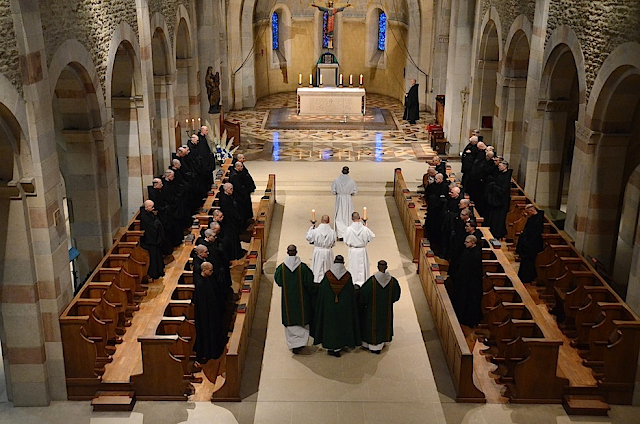
Latin Monastic Office for today from Le Barroux in France Texts also provided
The Reading of the Rule of Saint Benedict for June 4
From Chapter VII
Sextus humilitatis gradus est, si omni vilitate vel extremitate contentus sit monachus, et ad omnia quæ sibi iniunguntur velut operarium malum se iudicet et indignum, dicens sibi cum Propheta: Ad nihilum redactus sum et nescivi; ut iumentum factus sum apud te et ego semper tecum.
The sixth step of humility is that a monk is content with the lowest and most menial treatment, and regards himself as a poor and worthless workman in whatever task he is given, saying to himself with the Prophet: I am insignificant and ignorant, no better than a beast before you, yet I am with you always
Today's Celebration of the Mass
.jpg)
Saint Bartolomea Capitanio
Jesus XPI Passio sit semper in cordibus nostris
May the Passion of Jesus Christ be always in our hearts

Comments