Catholic devotions for 26th June
Scroll down for today's
Saint of the Day/ Feast
Reading of the Martyrology
Dedication of the Month
Dedication of the Day
Rosary
Five Wounds Rosary in Latin
Seven Sorrows Rosary in English
Latin Monastic Office
Reading of the Rule of Saint Benedict
Celebration of Mass
Reading from the School of Jesus Crucified

Feast of Saints John and Paul
The Basilica of Saints John and Paul sits atop the Caelian Hill, one of the seven hills of ancient Rome. The basilica is built over the home of Saints John and Paul, Roman military officers and blood brothers, who were martyred for the Catholic faith in their own home.

After a successful career of soldiering, Constantine the Great entrusted Saints John and Paul with the protection of his daughter, Constantia.
Upon the death of Constantine in 337 and his bequeathal of a formidable inheritance, Saints John and Paul retired to private life, built a house on the Caelian Hill, led exemplary Christian lives of charity and prayer, and prospered under the reign of Constantine II.
In A.D. 361, Julian the Apostate ascended to the imperial throne. From his youth, Julian had exhibited strong pagan tendencies, and during his reign, he reestablished many pagan practices, persecuted the Church, and challenged the authority of bishops throughout the empire.
In the summer of 362, he called Saints John and Paul back to military service in his court. Their acquiescence to Julian’s request would have meant a denial of their Catholic faith, since court officials were required to offer incense to false pagan gods.
Saints John and Paul recoiled at the thought of apostasy. Their refusal enraged Julian who accused them of impiety, a capital crime. Certain that Julian would order their deaths, Saints John and Paul charitably dispersed their earthly possessions to the poor of Rome.
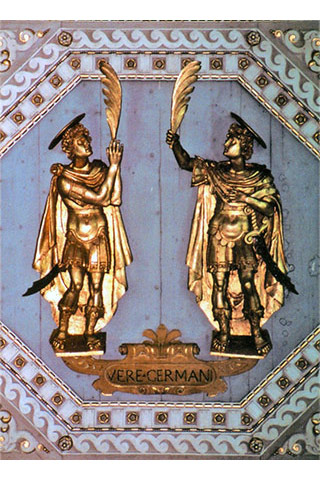
Julian sought to murder them, but he feared public outcry, for the Saints were extremely popular. Thus, the Emperor dispatched Terentianus, an officer of his court, with a murderous objective to their home. When he entered, he found Saints John and Paul at prayer.
When they rejected Terentianus’ order to offer sacrifice to Jupiter, he ordered them, on Julian’s prior instruction, beheaded on the night of June 26, 362 in their own home. Then Terentianus buried their bodies in the house and spread the rumor that Julian had sent Saints John and Paul into exile.
It did not take long for the truth to be known. A certain person, praying in the house, was granted a vision, wherein he saw, and loudly proclaimed, the details of the heinous crime.
Many were converted thereafter, including Terentianus himself. One year later to the day of the martyrdom of Saints John and Paul, on June 26, 363, Julian the Apostate, was felled by an arrow while campaigning in Mesopotamia. He died with the words “Vicisit Galilaee” (“Thou hast conquered, Galilean”).
Since the fifth century, the names of Saints John and Paul have been included in the Roman Canon of the Mass. Saints John and Paul’s feast day is celebrated on June 26, the date of their martyrdom.
The Reading from the Martyrology
This Day, the Twenty Sixth Day of June
At Rome, on Mount Coelius, the holy martyrs John and Paul, brothers. The former was steward, the other secretary of the virgin Constantia, daughter of the emperor Constantine. Afterwards, under Julian the Apostate, they received the palm of martyrdom by being beheaded.
At Trent, St. Vigilius, bishop, who, whilst he endeavored to root out the remains of idolatry, was overwhelmed with a shower of stones by cruel and barbarous men, and thus endured martyrdom for the name of Christ.
At Cordova, in Spain, under the Saracen king Abderahman, the birthday of St. Pelagius, a young man who gloriously consummated his martyrdom for the faith by having his flesh torn to pieces with iron pincers.
At Valenciennes, the holy martyrs Salvius, bishop of Angouleme, and Superius.
Also, the commemoration of St. Anthelmus, bishop of Belley.
In Poitou, St. Maxentius, priest and confessor, renowned for miracles.
At Thessalonica, St. David, hermit.
The same day, St. Perseveranda, virgin.
And elsewhere in divers places, many other holy martyrs, confessors, and holy virgins.
Omnes sancti Mártyres, oráte pro nobis.
("All ye Holy Martyrs, pray for us", from the Litaniae Sanctorum, the Litany of the Saints)
June is the Month of the Sacred Heart
.jpg)
Amen.
V. Heart of Jesus once in agony.
R. Pity the dying.
(300 days every time said. Plenary indulgence under the usual conditions if said thrice daily'but at three distinct times during the day'for a month)
(a) V. Praised be Jesus Christ.
R. Amen'or'Forever.
(b) V. Praised be Jesus and Mary.
R. Today and forever.
(c) V. Glory to the Sacred Heart of Jesus.
R. Glory to the immaculate heart of Mary.
(300 days every time any one of the foregoing is said as salutation and answer)*
Graciously grant, O Lord, peace in our times, that, aided by the help of Thy mercy, we may always be free from sin and secure from all disturbance. Through Christ Our Lord. Amen.
(3 years every time said)*
Burn, O Lord, our loins and our hearts with the fire of the Holy Ghost, that we may serve Thee with a chaste body and please Thee with a pure heart. Through Christ Our Lord. Amen.
(3 years every time said)*
Thursday is the Day dedicated to the Blessed Sacrament
The Pope at Corpus Christi
And at the wonderful Abbey of Heiligenkreuz
The Joyful Mysteries of the Rosary are prayed on Thursday
"I would like to remind you that the Rosary is a biblical prayer, all filled with the Holy Scriptures." It is a prayer from the heart, in which the repetition of the Ave Maria directs the thought and affection towards Christ, and thus is made a confident prayer to Him and our Mother. It is a prayer that helps to meditate on the Word of God and assimilate the Eucharistic Communion, on the model of Mary who kept in her heart everything Jesus did and said and even His Presence. " Pope Benedict XVI
The Rosary in Latin
Chaplet of the Five Holy Wounds of Christ in Latin
Chaplet of the Seven Sorrows of Our Lady in English
Latin Monastic Office for today from Le Barroux in France Texts also provided
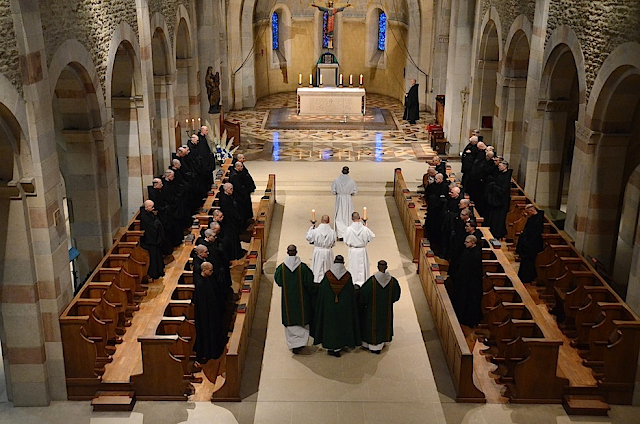
The Reading of the Rule of Saint Benedict for June 26
XIX DE DISCIPLINA PSALLENDI
1 Ubique credimus divinam esse praesentiam et oculos Domini in omni loco speculari bonos et malos,
2 maxime tamen hoc sine aliqua dubitatione credamus cum ad opus divinum assistimus.
3 Ideo semper memores simus quod ait propheta: Servite Domino in timore,
4 et iterum: Psallite sapienter,
5 et: In conspectu angelorum psallam tibi.
6 Ergo consideremus qualiter oporteat in conspectu divinitatis et angelorum eius esse,
7 et sic stemus ad psallendum ut mens nostra concordet voci nostrae.
CHAPTER 19: THE DISCIPLINE OF CHANTING PSALMS
1 We believe that the Divine Presence is everywhere, and the eyes of the Lord in every place look upon the good and the evil. (Prov 15:3).
2 We especially believe this without any doubt when we are assisting at the Work of God.
3 Therefore let us always remember what the prophet says: Serve the Lord in fear (Ps 2:11), and again,
4 Chant psalms wisely (Ps 46:8);
5 and, In the presence of the angels I will chant psalms to you (Ps 137:1).
6 Therefore let us consider how we ought to behave in the presence of the Holy One and His angels,
7 and thus stand to chant psalms in such a way that our mind and voice are in concord with each other.
Today's Celebration of the Mass

Feast of Blessed Marie-Madeleine Fontaine and Companions
Jesus XPI Passio sit semper in cordibus nostris
May the Passion of Jesus Christ be always in our hearts








.jpeg)

Comments