Catholic devotions for 14th June
Scroll down for today's
Basil of Caesarea, also called Saint Basil the Great (330 – 1 or 2 January 379) was an early Roman Christian prelate who served as Bishop of Caesarea in Cappadocia from 370 until his death in 379. He was an influential theologian who supported the Nicene Creed and opposed the heresies of the early Christian church such as Arianism and Apollinarianism.In addition to his work as a theologian, Basil was known for his care of the poor and underprivileged. Basil established guidelines for monastic life which focus on community life, liturgical prayer, and manual labor. Together with Pachomius, he is remembered as a father of communal monasticism in Eastern Christianity. He is considered a saint by the traditions of both Eastern and Western Christianity.
Basil, together with his brother Gregory of Nyssa and his friend Gregory of Nazianzus, are collectively referred to as the Cappadocian Fathers. The Eastern Orthodox Church and Eastern Catholic Churches have given him, together with Gregory of Nazianzus and John Chrysostom, the title of Great Hierarch. He is recognized as a Doctor of the Church in the Roman Catholic Church. He is sometimes referred to by the epithet Ouranophantor (Greek: Οὐρανοφάντωρ), "revealer of heavenly mysteries"
And elsewhere in divers places, many other holy martyrs, confessors, and holy virgins..
.jpg)
O most merciful Jesus, lover of souls, I beseech Thee, through the agony of Thy most holy Heart and through the sorrows of Thy Immaculate Mother, wash in Thy Blood the sinners of the whole world who are now in their agony and will die today.
Amen.
V. Heart of Jesus once in agony.
R. Pity the dying.
(300 days every time said. Plenary indulgence under the usual conditions if said thrice daily'but at three distinct times during the day'for a month)
(a) V. Praised be Jesus Christ.
R. Amen'or'Forever.
(b) V. Praised be Jesus and Mary.
R. Today and forever.
(c) V. Glory to the Sacred Heart of Jesus.
R. Glory to the immaculate heart of Mary.
(300 days every time any one of the foregoing is said as salutation and answer)*
Graciously grant, O Lord, peace in our times, that, aided by the help of Thy mercy, we may always be free from sin and secure from all disturbance. Through Christ Our Lord. Amen.
(3 years every time said)*
Burn, O Lord, our loins and our hearts with the fire of the Holy Ghost, that we may serve Thee with a chaste body and please Thee with a pure heart. Through Christ Our Lord. Amen.
(3 years every time said)*
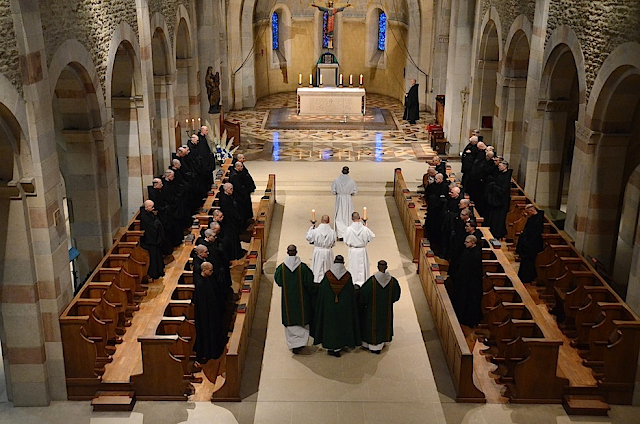
1 Dominico die temperius surgatur ad vigilias.


Saint of the Day/ Feast
Reading of the Martyrology
Dedication of the Month
Dedication of the Day
Rosary
Five Wounds Rosary in Latin
Seven Sorrows Rosary in English
Latin Monastic Office
Reading of the Rule of Saint Benedict
Celebration of Mass
Reading from the School of Jesus Crucified

Feast of Saint Basil the Great
Basil of Caesarea, also called Saint Basil the Great (330 – 1 or 2 January 379) was an early Roman Christian prelate who served as Bishop of Caesarea in Cappadocia from 370 until his death in 379. He was an influential theologian who supported the Nicene Creed and opposed the heresies of the early Christian church such as Arianism and Apollinarianism.In addition to his work as a theologian, Basil was known for his care of the poor and underprivileged. Basil established guidelines for monastic life which focus on community life, liturgical prayer, and manual labor. Together with Pachomius, he is remembered as a father of communal monasticism in Eastern Christianity. He is considered a saint by the traditions of both Eastern and Western Christianity.
Basil, together with his brother Gregory of Nyssa and his friend Gregory of Nazianzus, are collectively referred to as the Cappadocian Fathers. The Eastern Orthodox Church and Eastern Catholic Churches have given him, together with Gregory of Nazianzus and John Chrysostom, the title of Great Hierarch. He is recognized as a Doctor of the Church in the Roman Catholic Church. He is sometimes referred to by the epithet Ouranophantor (Greek: Οὐρανοφάντωρ), "revealer of heavenly mysteries"
The Reading from the Martyrology
This Day, the Fourteenth Day of June
At Caesarea, in Cappadocia, the consecration of St. Basil, bishop and Doctor of the Church, who was eminent for learning and wisdom in the time of the emperor Valens. Being adorned with every virtue, he was a great light in the Church, and defended her with admirable constancy against the Arians and Macedonians.
At Samaria, in Palestine, the holy prophet Eliseus, whose grave, says St. Jerome, makes the demons tremble. With him rests also the prophet Abdias.
At Syracuse, St. Marcian, bishop, who was made bishop by blessed Peter, and killed by the Jews after he had preached the Gospel.
At Soissons, the holy martyrs Valerius and Rufinus, who, after enduring many torments, were condemned to be beheaded by the governor Rictiovarus, in the persecution of Diocletian.
At Cordova, the holy martyrs Anastasius, priest, Felix, monk, and Digna, virgin.
At Constantinople, St. Methodius, bishop.
At Vienne, St. Aetherius, bishop.
At Rhodez, St. Quinctian, bishop.
Omnes sancti Mártyres, oráte pro nobis.
("All ye Holy Martyrs, pray for us", from the Litaniae Sanctorum, the Litany of the Saints)
June is the Month of the Sacred Heart
.jpg)
Amen.
V. Heart of Jesus once in agony.
R. Pity the dying.
(300 days every time said. Plenary indulgence under the usual conditions if said thrice daily'but at three distinct times during the day'for a month)
(a) V. Praised be Jesus Christ.
R. Amen'or'Forever.
(b) V. Praised be Jesus and Mary.
R. Today and forever.
(c) V. Glory to the Sacred Heart of Jesus.
R. Glory to the immaculate heart of Mary.
(300 days every time any one of the foregoing is said as salutation and answer)*
Graciously grant, O Lord, peace in our times, that, aided by the help of Thy mercy, we may always be free from sin and secure from all disturbance. Through Christ Our Lord. Amen.
(3 years every time said)*
Burn, O Lord, our loins and our hearts with the fire of the Holy Ghost, that we may serve Thee with a chaste body and please Thee with a pure heart. Through Christ Our Lord. Amen.
(3 years every time said)*
Saturday is the Day dedicated to The Blessed Virgin and her Immaculate Heart.
Saturdays are, traditionally, the days Catholics go to Confession in preparation for receiving the Eucharist on Sundays (some Catholics might make a habit of going to Confession on Saturdays; other might go before Mass on Sunday, and, of course, as always, whenever needed). Also on Saturdays, many Catholics make what is called the "First Saturdays Devotion" which entails going to Mass and receiving Communion on the first Saturday of the month for 5 consecutive months in reparation to the Immaculate Heart of Mary. See Devotion to the Immaculate Heart of Mary.
The Glorious Mysteries of the Rosary are prayed on Saturday
"I would like to remind you that the Rosary is a biblical prayer, all filled with the Holy Scriptures." It is a prayer from the heart, in which the repetition of the Ave Maria directs the thought and affection towards Christ, and thus is made a confident prayer to Him and our Mother. It is a prayer that helps to meditate on the Word of God and assimilate the Eucharistic Communion, on the model of Mary who kept in her heart everything Jesus did and said and even His Presence. " Pope Benedict XVI
The Rosary in Latin
Chaplet of the Five Holy Wounds of Christ in Latin
Chaplet of the Seven Sorrows of Our Lady in English
Latin Monastic Office for today from Le Barroux in France Texts also provided
The Reading of the Rule of Saint Benedict for June 14
XI. QUALITER DIEBIUS DOMINICIS VIGILIAE AGANTUR1 Dominico die temperius surgatur ad vigilias.
2 In quibus vigiliis teneatur mensura, id est, modulatis ut supra disposuimus sex psalmis et versu, residentibus cunctis disposite et per ordinem in subselliis, legantur in codice, ut supra diximus, quattuor lectiones cum responsoriis suis.
3 Ubi tantum in quarto responsorio dicatur a cantante gloria; quam dum incipit, mox omnes cum reverentia surgant.
4 Post quibus lectionibus sequantur ex ordine alii sex psalmi cum antiphonas sicut anteriores, et versu.
5 Post quibus iterum legantur aliae quattuor lectiones cum responsoriis suis, ordine quo supra.
6 Post quibus dicantur tria cantica de prophetarum, quas instituerit abbas; quae cantica cum alleluia psallantur.
7 Dicto etiam versu et benedicente abbate, legantur aliae quattuor lectiones de novo testamento, ordine quo supra.
8 Post quartum autem responsorium incipiat abbas hymnum Te Deum laudamus.
9 Quo perdicto, legat abbas lectionem de Evangelia, cum honore et timore stantibus omnibus.
10 Qua perlecta, respondeant omnes Amen, et subsequatur mox abbas hymnum Te decet laus, et data benedictione incipiant matutinos.
11 Qui ordo vigiliarum omni tempore tam aestatis quam hiemis aequaliter in die dominico teneatur.
12 Nisi forte - quod absit -tardius surgant: aliquid de lectionibus breviandum est, aut responsoriis.
13 Quod tamen omnino caveatur ne proveniat. Quod si contigerit, digne inde satisfaciat Deo in oratorio per cuius evenerit neglectum.
CHAPTER 11: HOW VIGILS ARE CELEBRATED ON SUNDAY
CHAPTER 11: HOW VIGILS ARE CELEBRATED ON SUNDAY
1 On Sundays the brothers are to arise earlier for Vigils.
2 At these Vigils they are to keep to the same measure: that is, as prescribed above, having sung six psalms and a versicle all are to be seated on benches in their proper order, and four lessons with their responsories are read from the book, as described above.
3 But only after the fourth responsory does the cantor intone a “Glory be”, all standing in reverence as he begins it.
4 After these lessons there follow according to the same pattern six more psalms with their refrains and versicles as above.
4 After these lessons there follow according to the same pattern six more psalms with their refrains and versicles as above.
5 After this there are again read four more lessons with their responsories, according to the pattern above.
6 After this, three canticles from the prophets are said, as the abbot directs, these canticles being sung with an “alleluia”.
7 After the versicle and the abbot’s blessing, four lessons from the New Testament are read as above.
8 But after the fourth responsory the abbot begins the hymn “We praise you, O God”.
9 That having been sung, the abbot reads the lesson from the Gospel while all stand in honor and fear. 10 This having been read, all respond “Amen”, following which the abbot immediately begins the hymn “To you be praise”; and after the blessing is given Lauds begins.
11 This order for Vigils should be kept on Sundays at all times, equally in summer and in winter,
11 This order for Vigils should be kept on Sundays at all times, equally in summer and in winter,
12 That is, unless (may it never happen!) they arise too late: in this case the readings or responsories may be somewhat shortened.
13 But all caution should be exercised so that this does not happen. However, if it does occur the one through whose neglect it has come to pass must make fitting satisfaction for it to God in the oratory.
Today's Celebration of the Mass
Jesus XPI Passio sit semper in cordibus nostris
May the Passion of Jesus Christ be always in our hearts








.jpeg)

Comments