Catholic devotions for 24th August
Scroll down for today's
Saint of the Day/ Feast
Reading of the Martyrology
Dedication of the Month
Dedication of the Day
Rosary
Five Wounds Rosary in Latin
Seven Sorrows Rosary in English
Latin Monastic Office
Reading of the Rule of Saint Benedict
Celebration of Mass
Reading from the School of Jesus Crucified

Feast of Saint Bartholomew
Saint Bartholomew, the apostle, went into India, which is in the end of the world. And therein he entered into a temple where an idol was which was named Astaroth, and he, as a pilgrim, abode there. In that idol dwelt a fiend that said that he could heal all manner sicknesses, but he lied, for he could not make them whole, but might better them but for a while.
And the temple was full of sick people, and could have no answer of that idol, wherefore they went in to another city whereas another idol was worshiped named Berith, and they demanded him wherefore Astaroth gave to them no answer. And Berith said: Your god is bound with chains of fire that he neither dare draw breath ne speak after that Bartholomew, the apostle of God, entered into the temple.
And they said to him: Who is that Bartholomew?
And the devil said: He is the friend of God Almighty, and he is come into this province for to avoid all the gods of India.
And then they said: Tell us some tokens and signs that we may know him and find him.
And the devil said to them: He hath his hairs black and crisp, his skin white, eyes great, his nostrils even and straight, his beard long and hoar a little, and of a straight and seemingly stature. He is clad in a white coat, and a white mantle, which in every corner hath gems of purple and precious stones therein. And it is sith twenty-six years that his clothes never waxed old ne foul. He prayeth and worshippeth God on his knees a hundred times a day, and a hundred times by night. The angels go with him, which never suffer him to be weary ne to be anhungered, he is always of like semblant, glad and joyous. He seeth all things before, he knoweth all things, he speaketh all manner languages, and understandeth them, and he knoweth well what I say to you. And when ye seek him, if he will he may show himself to you, and if he list not, not shall ye find him. And I pray you, when ye find him, that ye pray him that he come not hither, that his angels do not to me as they have done to my fellow.
Then they went and sought him diligently and busily for two days, and found him not.
On a day, one that was beset with a devil cried, and said: Apostle of God, Bartholomew, thy prayers burn me.
And the apostle said: Hold thou thy peace and come then.
And anon he was delivered. And when Polemius, king of that region, heard this thing, which had a daughter lunatic, he sent to the apostle, praying that he would come to him and heal his daughter. And when the apostle was come to him and saw that she was bound with chains, and bit all them that went to her, he commanded to unbind her. And the ministers Durst not go to her.
And he said: I hold the devil fast bound that was in her, and therefore be not afeard.
And then anon she was unbound and delivered. And then would have presented to the apostle camels charged with gold and silver and precious stones, but he could not be found in no manner. And on the morrow following, the apostle appeared to the king, alone in his chamber, and said to him: Wherefore soughtest thou me yesterday with gold and silver and precious stones?
Then St. Bartholomew began to say many things, and inform the king of our redemption, and among other things how Jesu Christ vanquished the devil by marvellous and convenable puissance, justice, and wisdom. For it was convenable that he that overcame the son made of the earth, that was Adam, while he was yet a virgin, should be overcome of the son of the virgin. He overcame him then mightily, when he threw him puissantly out of his lordship which had thrown out by force our forefather.
For it is right that he that vanquished man by eating, and held him, that he should be overcome by a man fasting, and hold man no longer. For it is rightful that he which by the art of the devil was despised, that by the art of Jesu Christ he should be vanquished. him by meat, and if he had no hunger, then knew he well without doubt that he was God. But he might not know him, for he had hunger, and consented nothing to him ne to his temptations.
Source and more
Semen est sanguis Christianorum
The blood of Christians is the seed of the Church
Tertullian, Apologeticum, 50
The Reading from the Martyrology
This Day, the Twenty-Fourth Day of August
The Apostle St. Bartholomew, who preached the Gospel of Christ in India. He passed thence into the Greater Armenia, where, after converting many to the faith, he was flayed alive by the barbarians, and beheaded by order of king Astyages, and thus he terminated his martyrdom. His sacred body was first carried to the island of Lipara, then to Benevento, and finally to Rome in the island of the Tiber, where it is venerated by the pious faithful.
At Carthage, three hundred holy martyrs, in the time of Valerian and Gallienus. Among other torments inflicted on them, a pit filled with burning lime was prepared by order of the governor, who, live coals with incense being brought to him, said to the confessors: "Choose one of these two things; to offer incense to Jupiter on these coals, or to cast yourselves into the lime." Armed with faith, and confessing Christ to be the Son of God, they quickly precipitated themselves into the pit, and amidst the vapors of the lime were reduced to dust. From this circumstance this blessed troop obtained the appellation of White Mass. [ Massae Candidae Carthigini ]
At Nepi, St. Ptolemy, bishop, disciple of the blessed Apostle Peter. Being sent by him to preach the Gospel in Tuscany, he died a glorious martyr of Christ in the city of Nepi.
In the same place, St. Eomanus, bishop of that city, who was the disciple of St. Ptolemy, and his companion in martyrdom.
At Ostia, St. Aurea, virgin and martyr, who was plunged into the sea with a stone tied to her neck. Her body, being cast on the shore, was buried by blessed Nonnus.
In Isauria, St. Tatio, martyr, who received the crown of martyrdom by being beheaded in the persecution of Domitian, under the governor Urbanus.
The same day, St. Eutychius, disciple of the blessed Evangelist John. He preached the Gospel in many countries, was subjected to imprisonment, to stripes and fire, and finally he rested in peace.
Also, St. George Limniota, monk. Because he reprehended the impious emperor Leo for breaking holy images and burning the relics of the saints, he had his hands cut off and his head burned by order of the tyrant, and went to our Lord to receive the recompense of a martyr.
At Rouen, St. Owen, bishop and confessor.
At Nevers, St. Patrick, abbot.
And elsewhere in divers places, many other holy martyrs, confessors, and holy virgins.
Omnes sancti Mártyres, oráte pro nobis.
("All ye Holy Martyrs, pray for us", from the Litaniae Sanctorum, the Litany of the Saints)
August is the Month of the Immaculate Heart of Mary

Composed by Saint John Henry Cardinal Newman, shortly after his reception into the One, True Fold of the Redeemer
Sunday is the Day dedicated to Resurrection & the Holy and Undivided Trinity
Prayers for Every Day of the Week
The Athanasian Creed in English
The Athanasian Creed in Latin
The Glorious Mysteries of the Rosary are prayed on Sunday
"I would like to remind you that the Rosary is a biblical prayer, all filled with the Holy Scriptures." It is a prayer from the heart, in which the repetition of the Ave Maria directs the thought and affection towards Christ, and thus is made a confident prayer to Him and our Mother. It is a prayer that helps to meditate on the Word of God and assimilate the Eucharistic Communion, on the model of Mary who kept in her heart everything Jesus did and said and even His Presence. " Pope Benedict XVI
The Rosary in Latin
Chaplet of the Five Holy Wounds of Christ in Latin
Chaplet of the Seven Sorrows of Our Lady in English
Latin Monastic Office for today from Le Barroux in France Texts also provided
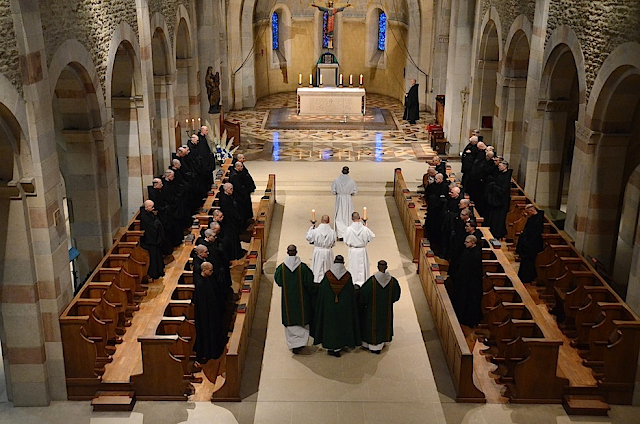
The Reading of the Rule of Saint Benedict for August 24
LXVI. DE OSTIARIIS MONASTERII
1 Ad portam monasterii ponatur senex sapiens, qui sciat accipere reponsum et reddere, et cuius maturitas eum non sinat vagari.
2 Qui portarius cellam debebit habere iuxta portam, ut venientes semper praesentem inveniant a quo responsum accipiant.
3 Et mox ut aliquis pulsaverit aut pauper clamaverit, Deo gratias respondeat aut Benedic,
4 et cum omni mansuetudine timoris Dei reddat responsum festinanter cum fervore caritatis.
5 Qui portarius si indiget solacio iuniorem fratrem accipiat.
6 Monasterium autem, si possit fieri, ita debet constitui ut omnia necessaria, id est aqua, molendinum, hortum, vel artes diversas intra monasterium exerceantur,
7 ut non sit necessitas monachis vagandi foris, quia omnino non expedit animabus eorum.
8 Hanc autem regulam saepius volumus in congregatione legi, ne quis fratrum se de ignorantia excuset.
CHAPTER 66: THE MONASTERY PORTERS
1 At the door of the monastery there should be placed a wise old man who knows how to take a message and give one, and whose maturity keeps him from wandering.
2 This porter ought to have his room near the door, so that those who arrive will always find someone present to take their message.
3 As soon as anyone knocks or a poor person calls out he should respond, Thanks be to God, or Please give your blessing;
4 and with all the gentleness of the fear of God, he is to respond quickly with the fervor of love.
5 If the porter requires help a younger brother should b given to him.
6 As regards the monastery: if possible it is to be so constituted that all necessities, such as water, mill, garden, and various crafts may be practiced within the monastery
7 so there will be no necessity for the monks to wander outside; for this is not at all good for their souls.
8 As regards this Rule: we wish it to be frequently read in the community, so that none of the brothers may excuse themselves on account of ignorance.
Today's celebration of Mass

The Suffering of
The Suffering of
Saint Bartholomew
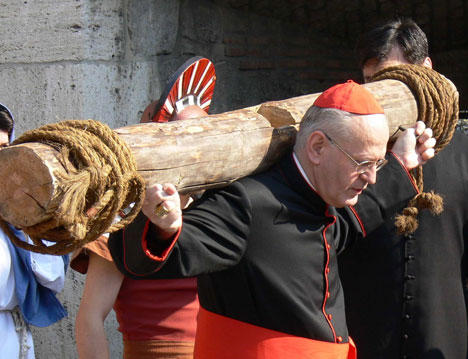
Jesus is nailed to the Cross

Jesus XPI Passio sit semper in cordibus nostris
May the Passion of Jesus Christ be always in our hearts

"The Cross is our trophy against the demons, our sword against sin, and the sword Christ used to pierce the serpent. The Cross is the Father's will, the glory of the Only-Begotten, the joy of the Spirit, the pride of the angels, the guarantee of the Church." -St. John Chrysostom








.jpeg)

Comments