Catholic devotions for 8th July
Scroll down for today's:
Saint of the Day/ Feast
Reading of the Martyrology
Dedication of the Month
Dedication of the Day
Rosary
Five Wounds Rosary in Latin
Seven Sorrows Rosary in English
Latin Monastic Office
Reading of the Rule of Saint Benedict
Celebration of Mass
Reading from the School of Jesus Crucified
Reading from the School of Jesus Crucified

Feast of St Elizabeth, Queen of Portugal
Queen (sometimes known as the PEACEMAKER); born in 1271; died in 1336. She was named after her great-aunt, the great Elizabeth of Hungary, but is known in Portuguese history by the Spanish form of that name, Isabel. The daughter of Pedro III, King of Aragon, and Constantia, grandchild of Emperor Frederick II, she was educated very piously, and led a life of strict regularity and self-denial from her childhood: she said the full Divine Office daily, fasted and did other penances, and gave up amusement. Elizabeth was married very early to Diniz (Denis), King of Portugal, a poet, and known as Rei Lavrador, or the working king, from his hard work in his country's service. His morals, however, were extremely bad, and the court to which his young wife was brought consequently most corrupt. Nevertheless, Elizabeth quietly pursued the regular religious practices of her maidenhood, whilst doing her best to win her husband's affections by gentleness and extraordinary forbearance. She was devoted to the poor and sick, and gave every moment she could spare to helping them, even pressing her court ladies into their service. Naturally, such a life was a reproach to many around her, and caused ill will in some quarters. A popular story is told of how her husband's jealousy was roused by an evil-speaking page; of how he condemned the queen's supposed guilty accomplice to a cruel death; and was finally convinced of her innocence by the strange accidental substitution of her accuser for the intended victim.
Diniz does not appear to have reformed in morals till late in life, when we are told that the saint won him to repentance by her prayers and unfailing sweetness. They had two children, a daughter Constantia and a son Affonso. The latter so greatly resented the favours shown to the king's illegitimate sons that he rebelled, and in 1323 war was declared between him and his father. St. Elizabeth, however, rode in person between the opposing armies, and so reconciled her husband and son. Diniz died in 1325, his son succeeding him as Affonso IV. St. Elizabeth then retired to a convent of Poor Clares which she had founded at Coimbra, where she took the Franciscan Tertiary habit, wishing to devote the rest of her life to the poor and sick in obscurity. But she was called forth to act once more as peacemaker. In 1336 Affonso IV marched his troops against the King of Castile, to whom he had married his daughter Maria, and who had neglected and ill-treated her. In spite of age and weakness, the holy queen dowager insisted on hurrying to Estremoz, where the two king's armies were drawn up. She again stopped the fighting and caused terms of peace to be arranged. But the exertion brought on her final illness; and as soon as her mission was fulfilled she died of a fever, full of heavenly joy, and exhorting her son to the love of holiness and peace. St. Elizabeth was buried at Coimbra, and miracles followed her death. She was canonized by Urban VIII in 1625, and her feast is kept on 8 July.
The Reading from the Martyrology
This Day, the Eighth Day of July
St. Elizabeth, widow, Queen of Portugal. Being renowned for virtues and miracles, she was numbered among the saints by Urban VIII.
In Asia Minor, the Saints Aquila and his wife Priscilla, of whom mention is made in the Acts of the Apostles.
At Porto, fifty holy soldiers, martyrs, who were led to the faith by the martyrdom of St. Bonosa, and baptized by the blessed Pope Felix. They were put to death in the persecution of Aurelian.
In Palestine, in the reign of Diocletian, St. Procopius, martyr, who was brought from Scythopolis to Caesarea, and upon his first resolute answer was beheaded by the judge Fabian.
At Constantinople, the holy Abrahamite monks, who resisted the emperor Theophilus by defending the worship of holy images, and suffered matryrdom.
At Wurtzburg, in Germany, St. Kilian, bishop, who was commissioned by the Roman Pontiff to preach the Gospel. After having converted many to Christ, he was put to death with his companions, Colman, a priest, and Totnan, a deacon.
At Rome, the blessed Eugenius II, Pope. Having gained a great reputation for sanctity and prudence in his government of the monastery of Saints Vincent and Anastasius, he was raised to the Sovereign Pontificate and ruled over the universal Church with much holiness. Pope Pius IX approved and confirmed the veneration paid to him.
At Treves, St. Auspicius, bishop and confessor.
At Spina Lamberti in Emília, Pope St. Adrian III, famous for his zeal in reconciling the Eastern to the Roman Church, and renowned for his miracles. His body was taken to the monastery of Nonantola and buried with honors in the Church of St. Sylvester.
Omnes sancti Mártyres, oráte pro nobis.
("All ye Holy Martyrs, pray for us", from the Litaniae Sanctorum, the Litany of the Saints)
July is the Month of the Most Precious Blood

Litaniae Pretiosissimi Sanguinis Domini Nostri Iesu Christi (Litany of the Most
Precious Blood of Our Lord Jesus Christ)
This Litany in honor of Jesus in His Most Precious Blood was drawn up by the Sacred
Congregation of Rites and promulgated by Pope John XXIII on February 24, 1960. The
devotion to Jesus in His most Precious Blood was first popularized by St. Gaspar del
Bufalo (1786-1837, feast Dec. 28) who founded the Missioners of the Most Precious
Blood. A partial indulgence is granted to the faithful who recite this litany.
Kyrie, eleison Kyrie, eleison.
Christe, eleison Christe, eleison.
Kyrie, eleison Kyrie, eleison.
Christe, audi nos Christe, audi nos.
Christe, exaudi nos. Christe, exaudi nos.
Pater de caelis, Deus, miserere nobis.
Fili, Redemptor mundi, Deus, miserere nobis.
Spiritus Sancte, Deus, miserere nobis.
Sancta Trinitas, unus Deus, miserere nobis.
Sanguis Christi, Unigeniti Patris aeterni, salva nos.
Sanguis Christi, Verbi Dei incarnati, salva nos.
Sanguis Christi, Novi et Aeterni Testamenti, salva nos.
Sanguis Christi, in agonia decurrens in terram, salva nos.
Sanguis Christi, in flagellatione profluens, salva nos.
Sanguis Christi, in coronatione spinarum emanans, salva nos.
Sanguis Christi, in Cruce effusus, salva nos.
Sanguis Christi, pretium nostrae salutis, salva nos.
Sanguis Christi, sine quo non fit remissio, salva nos.
Sanguis Christi, in Eucharistia potus et lavacrum animarum, salva nos.
Sanguis Christi, flumen misericordiae, salva nos.
Sanguis Christi, victor daemonum, salva nos.
Sanguis Christi, fortitudo martyrum, salva nos.
Sanguis Christi, virtus confessorum, salva nos.
Sanguis Christi, germinans virgines, salva nos.
Sanguis Christi, robur periclitantium, salva nos.
Sanguis Christi, levamen laborantium, salva nos.
Sanguis Christi, in fletu solatium, salva nos.
Sanguis Christi, spes poenitentium, salva nos.
Sanguis Christi, solamen morientium, salva nos.
Sanguis Christi, pax et dulcedo cordium, salva nos.
Sanguis Christi, pignus vitae aeternae, salva nos.
Sanguis Christi, animas liberans de lacu Purgatorii, salva nos.
Sanguis Christi, omni gloria et honore dignissimus, salva nos.
Agnus Dei, qui tollis peccata mundi, parce nobis, Domine.
Agnus Dei, qui tollis peccata mundi, exaudi nos, Domine.
Agnus Dei, qui tollis peccata mundi, miserere nobis, Domine.
V. redimisti nos, Domine, in sanguine tuo.
R. Et fecisti nos Deo nostro regnum.
Oremus;
Omnipotens sempiterne Deus, qui unigenitum Filium tuum mundi Redemptorem
constituisti, ac eius sanguine placari voluisti: concede, quaesumus, salutis nostrae
pretium ita venerari, atque a praesentis vitae malis eius virtute defendi in terris, ut
fructu perpetuo laetemur in caelis. Per eundem Christum Dominum nostrum. Amen.
Lord, have mercy. Lord, have mercy.
Christ, have mercy. Christ, have mercy.
Lord, have mercy. Lord, have mercy.
Christ, hear us. Christ, hear us.
Christ, graciously hear us. Christ, graciously hear us.
God the Father of Heaven, have mercy on us.
God the Son, Redeemer of the world, have mercy on us.
God, the Holy Spirit, have mercy on us.
Holy Trinity, One God, have mercy on us.
Blood of Christ, only-begotten Son of the eternal Father, save us.
Blood of Christ, Incarnate Word or God, save us.
Blood of Christ, of the New and Eternal Testament, save us.
Blood of Christ, falling upon the earth in Agony, save us.
Blood of Christ, shed profusely in the Scourging, save us.
Blood of Christ, flowing forth in the Crowning with Thorns, save us.
Blood of Christ, poured out on the Cross, save us.
Blood of Christ, price of our salvation, save us.
Blood of Christ, without which there is no forgiveness, save us.
Blood of Christ, Eucharistic drink and refreshment of souls, save us.
Blood of Christ, stream of mercy, save us.
Blood of Christ, victor over demons, save us.
Blood of Christ, courage of Martyrs, save us.
Blood of Christ, strength of Confessors, save us.
Blood of Christ, bringing forth Virgins, save us.
Blood of Christ, help of those in peril, save us.
Blood of Christ, relief of the burdened, save us.
Blood of Christ, solace in sorrow, save us.
Blood of Christ, hope of the penitent, save us.
Blood of Christ, consolation of the dying, save us.
Blood of Christ, peace and tenderness of hearts, save us.
Blood of Christ, pledge of eternal life, save us.
Blood of Christ, freeing souls from purgatory, save us.
Blood of Christ, most worthy of all glory and honor, save us.
Lamb of God, who taketh away the sins of the world, spare us, O Lord.
Lamb of God, who taketh away the sins of the world, graciously hear us, O Lord.
Lamb of God, who taketh away the sins of the world, have mercy on us, O Lord.
V. Thou hast redeemed us, O Lord, in Thy Blood.
R. And made us, for our God, a kingdom.
Let us pray;
Almighty and eternal God, Thou hast appointed Thine only-begotten Son the Redeemer
of the world and willed to be appeased by his blood. Grant, we beg of Thee, that we
may worthily adore this price of our salvation and through its power be safeguarded
from the evils of the present life so that we may rejoice in its fruits forever in heaven.
Through the same Christ our Lord. Amen.
Tuesday is the Day dedicated to the Holy Angels
Prayers for Every Day of the Week.
The Sorrowful Mysteries of the Rosary are prayed on Tuesday
"I would like to remind you that the Rosary is a biblical prayer, all filled with the Holy Scriptures." It is a prayer from the heart, in which the repetition of the Ave Maria directs the thought and affection towards Christ, and thus is made a confident prayer to Him and our Mother. It is a prayer that helps to meditate on the Word of God and assimilate the Eucharistic Communion, on the model of Mary who kept in her heart everything Jesus did and said and even His Presence. " Pope Benedict XVI
The Rosary in Latin
Chaplet of the Five Holy Wounds of Christ in Latin
Chaplet of the Seven Sorrows of Our Lady in English
Latin Monastic Office for today from Le Barroux in France Texts also provided
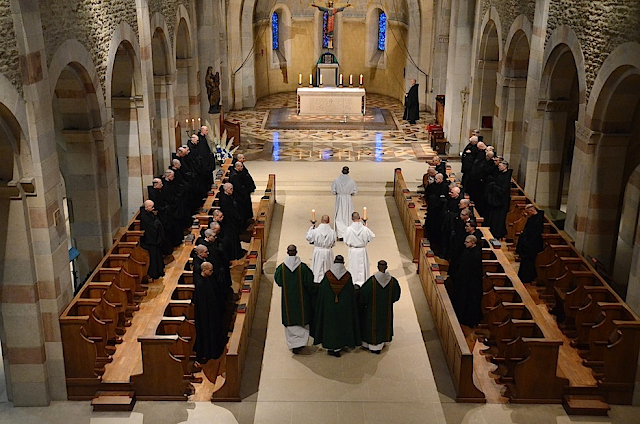
The Reading of the Rule of Saint Benedict for July 8
XXXI DE CELLARARIO MONASTERII, QUALIS SIT
1 Cellararius monasterii eligatur de congregatione, sapiens, maturis moribus, sobrius, non multum edax, non elatus, non turbulentus, non iniuriosus, non tardus, non prodigus,
2 sed timens Deum; qui omni congregationi sit sicut pater.
3 Curam gerat de omnibus;
4 sine iussione abbatis nihil faciat.
5 Quae iubentur custodiat;
6 fratres non contristet.
7 Si quis frater ab eo forte aliqua irrationabiliter postulat, non spernendo eum contristet, sed rationabiliter cum humilitate male petenti deneget.
8 Animam suam custodiat, memor semper illud apostolicum quia qui bene ministraverit gradum bonum sibi acquirit.
9 Infirmorum, infantum, hospitum pauperumque cum omni sollicitudine curam gerat, sciens sine dubio quia pro his omnibus in die iudicii rationem redditurus est.
10 Omnia vasa monasterii cunctamque substantiam ac si altaris vasa sacrata conspiciat.
11 Nihil ducat neglegendum.
12 Neque avaritiae studeat, neque prodigus sit et stirpator substantiae monasterii, sed omnia mensurate faciat et secundum iussionem abbatis.
CHAPTER 31: THE QUALITIES OF THE MONASTERY CELLARER
1 As monastery cellerar there should be chosen from the community one who is wise, of mature character, temperate, not an excessive eater, not haughty, not turbulent, not harmful, not sluggish, not wasteful,
2 but God-fearing; one who can act as a father to the whole community.
3 He is to have charge of everything;
4 he is to do nothing without an order from the abbot.
5 He is to keep custody over his orders;
6 he is not to sadden the brothers.
7 If one of the brothers happens to request something unreasonably, he is not to treat him with disdain and thus sadden him, rather he must reasonably and with humility deny the bad request.
8 He is to keep custody over his own soul, remembering always that apostolic saying: he who has ministered well acquires a good standing for himself (1 Tim 3:13).
9 He is to care for the sick, for children, for guests, and for the poor with all solicitude, knowing without doubt that for all these he will have to give an account on the Day of Judgment (cf .Luke 16:2).
10 He is to look upon all the vessels and goods of the monastery as though they were the sacred vessels of the altar.
11 He is not to neglect anything.
2 He is not to be avaritious, not wasteful, not be a squanderer of the monastery’s resources; rather he is to do everything in proper measure and according to the order of his abbot.
Today's Celebration of the Mass

Saint Eliabeth
Jesus receives a blow

Jesus XPI Passio sit semper in cordibus nostris
May the Passion of Jesus Christ be always in our hearts







.jpeg)

Comments