Catholic devotions for 14th July
Scroll down for today's
Saint of the Day/ Feast
Reading of the Martyrology
Dedication of the Month
Dedication of the Day
Rosary
Five Wounds Rosary in Latin
Seven Sorrows Rosary in English
Latin Monastic Office
Reading of the Rule of Saint Benedict
Celebration of Mass
Reading from the School of Jesus Crucified

Feast of St Bonaventure, Franciscan.
Here telling St Thomas Aquinas, "This is my library" referring to the Cross
Nothing is known of Bonaventure's parents save their names: Giovanni di Fidanza and Maria Ritella. How his baptismal name of John came to be changed to that of Bonaventure is not clear. An attempt has been made to trace the latter name to the exclamation of St. Francis, O buona ventura, when Bonaventure was brought as an infant to him to be cured of a dangerous illness. This derivation is highly improbable; it seems based on a late fifteenth-century legend. Bonaventure himself tells us (Legenda S. Francisci Prolog.) that while yet a child he was preserved from death through the intercession of St. Francis, but there is no evidence that this cure took place during the lifetime of St. Francis or that the name Bonaventure originated in any prophetical words of St. Francis. It was certainly borne by others before the Seraphic Doctor. No details of Bonaventure's youth have been preserved. He entered the Order of Friars Minor in 1238 or 1243; the exact year is uncertain. Wadding and the Bollandists bold for the later date, but the earlier one is supported by Sbaradea, Bonelli, Panfilo da Magliano, and Jeiler, and appears more probable. It is certain that Bonaventure was sent from the Roman Province, to which he belonged, to complete his studies at the University of Paris under Alexander of Hales, the great founder of the Franciscan School. The latter died in 1246, according to the opinion generally received, though not yet definitely established, and Bonaventure seems to have become his pupil about 1242. Be this as it may, Bonaventure received in 1248 the "licentiate" which gave him the right to teach publicly as Magister regens, and he continued to lecture at the university with great success until 1256, when he was compelled to discontinue, owing to the then violent outburst of opposition to the Mendicant orders on the part of the secular professors at the university. The latter, jealous, as it seems, of the academic successes of the Dominicans and Franciscans, sought to exclude them from teaching publicly. The smouldering elements of discord had been fanned into a flame in 1256, when Guillaume de Saint-Amour published a work entitled "The Perils of the Last Times", in which he attacked the Friars with great bitterness. It was in connexion with this dispute that Bonaventure wrote his treatise, "De paupertate Christi". It was not, however, Bonaventure, as some have erroneously stated, but Blessed John of Parma, who appeared before Alexander IV at Anagni to defend the Franciscans against their adversary. The Holy See having, as is well known, re-established the Mendicants in all their privileges, and Saint-Amour's book having been formally condemned, the degree of Doctor was solemnly bestowed on St. Bonaventure and St. Thomas Aquinas at the university, 23 October, 1257.
In the meantime Bonaventure, though not yet thirty-six years old, had on 2 February, 1257, been elected Minister General of the Friars Minor — an office of peculiar difficulty, owing to the fact that the order was distracted by internal dissensions between the two factions among the Friars designated respectively the Spirituales and the Relaxati. The former insisted upon the literal observance of the original Rule, especially in regard to poverty, while the latter wished to introduce innovations and mitigations. This lamentable controversy. had moreover been aggravated by the enthusiasm with which many of the "Spiritual" Friars had adopted the doctrines connected with the name of Abbot Joachim of Floris and set forth in the so-called "Evangelium aeternum". The introduction to this pernicious book, which proclaimed the approaching dispensation of the Spirit that was to replace the Law of Christ, was falsely attributed to Bl. John of Parma, who in 1267 on the other hand, Bonaventure had, in an encyclical letter issued immediately after his election, outlined a program for the reformation of the Relaxati. These reforms he sought to enforce three years later at the General Chapter of Narbonne when the constitutions of the order which he had revised were promulgated anew. These so-called "Constitutiones Narbonenses" are distributed under twelve heads, corresponding to the twelve chapters of the Rule, of which they form an enlightened and prudent exposition, and are of capital importance in the history of Franciscan legislation. The chapter which issued this code of laws requested Bonaventure to write a "legend" or life of St. Francis which should supersede those then in circulation. Pisa at which his newly composed life of St. Francis was officially approved as the standard biography of the saint to the exclusion of all others. At this chapter of 1263, Bonaventure fixed the limits of the different provinces of the order and, among other ordinances, prescribed that at nightfall a bell should be rung in honor of the Annunciation, a pious practice from which the Angelus seems to have originated. There are no grounds, however, for the assertion that Bonaventure in this chapter prescribed the celebration of the feast of the Immaculate Conception in the order. In 1264, at the earnest request of Cardinal Cajetan, Bonaventure consented to resume the direction of the Poor Clares which the Chapter of Pisa had entirely renounced the year before. He required the Clares, however, to acknowledge occasionally in writing that the favors tendered them by the Friars were voluntary acts of charity not arising from any obligation whatsoever. It is said that Pope Urban IV acted at Bonaventure's suggestion in attempting to establish uniformity of observance throughout all the monasteries of Clares. About this time (1264) Bonaventure founded at Rome the Society of the Gonfalone in honor of the Blessed Virgin which, if not the first confraternity instituted in the Church, as some have claimed, was certainly one of the earliest. In 1265 Clement IV, by a Bull dated 23 November, nominated Bonaventure to the vacant Archbishopric of York, but the saint, in keeping with his singular humility, steadily refused this honor and the pope yielded.
In 1266 Bonaventure convened a general chapter in Paris at which, besides other enactments, it was decreed that all the "legends" of St. Francis written before that of Bonaventure should be forthwith destroyed, just as the Chapter of Narbonne had in 1260 ordered the destruction of all constitutions before those then enacted. This decree has excited much hostile criticism. Some would fain see in it a deliberate attempt on Bonaventure's part to close the primitive sources of Franciscan history, to suppress the real Francis, and substitute a counterfeit in his stead. Others, however, regard the decree in question as a purely liturgical ordinance intended to secure uniformity in the choir "legends". Between these two conflicting opinions the truth seems to be that this edict was nothing more than another heroic attempt to wipe out the old quarrels and start afresh. One cannot but regret the circumstances of this decree, but when it is recalled that the appeal of the contending parties was ever to the words and actions of St. Francis as recorded in the earlier "legends", it would be unjust to accuse the chapter of "literary vandalism" in seeking to proscribe the latter. We have no details of Bonaventure's life between 1266 and 1269. In the latter year he convoked his fourth general chapter at Assisi, in which it was enacted that a Mass be sung every Saturday throughout the order in honor of the Blessed Virgin, not, However, in honor of her Immaculate Conception as Wadding among others has erroneously stated. It was probably soon after this chapter that Bonaventure composed his "Apologia pauperum", in which he silences Gerard of Abbeville who by means of an anonymous libel had revived the old university feud against the Friars. Two years later, Bonaventure was mainly instrumental in reconciling the differences among the cardinals assembled at Viterbo to elect a successor to Clement IV, who had died nearly three years before; it was on Bonaventure's advice that, 1 September, 1271, they unanimously chose Theobald Visconti of Piacenza who took the title of Gregory 1272 Bonaventure for the second time convened a general chapter at Pisa in which, apart from general enactments to further regular observances new decrees were issued respecting the direction of the Poor Clares, and a solemn anniversary was instituted on 25 August in memory of St. Louis. This was the first step towards the canonization of the holy king, who had been a special friend of Bonaventure, and at whose request Bonaventure composed his "Office of the Passion". On 23 June, 1273, Bonaventure, much against his will, was created Cardinal-Bishop of Albano, by Gregory Jerome of Ascoli, subsequently Nicholas IV, was elected to succeed him. Meanwhile Bonaventure had been charged by Gregory X to prepare the questions to be discussed at the Fourteenth Oecumenical Council, which opened at Lyons 7 May, 1274.
The pope himself presided at the council, but he confided the direction of its deliberations to Bonaventure, especially charging him to confer with the Greeks on the points relating to the abjuration of their schism. It was largely due to Bonaventure's efforts and to those of the Friars whom he had sent to Constantinople, that the Greeks accepted the union effected 6 July, 1274. Bonaventure twice addressed the assembled Fathers, on 18 May, during a session of the Council, when he preached on Baruch 5:5, and on 29 June, during pontifical Mass celebrated by the pope. While the council was still in session, Bonaventure died, Sunday, 15 July, 1274. The exact cause of his death is unknown, but if we may credit the chronicle of Peregrinus of Bologna, Bonaventure's secretary, which has recently (1905) been recovered and edited, the saint was poisoned. He was buried on the evening following his death in the church of the Friars Minor at Lyons, being honored with a splendid funeral which was attended by the pope, the King of Aragon, the cardinals, and the other members of the council. The funeral oration was delivered by Pietro di Tarantasia, O.P., Cardinal-Bishop of Ostia, afterwards Innocent V, and on the following day during the fifth session of the council, Gregory X spoke of the irreparable loss the Church had sustained by the death of Bonaventure, and commanded all prelates and priests throughout the whole world to celebrate Mass for the repose of his soul.
Semen est sanguis Christianorum
The blood of Christians is the seed of the Church
Tertullian, Apologeticum, 50
The Reading from the Martyrology
This Day, the Fourteenth Day of July
At Lyons, the demise of St. Bonaventure, Cardinal and bishop of Albano, confessor and doctor of the Order of Friars Minor, most celebrated for his learning and holiness of life.
At Rome, St. Justus, soldier under the tribune Claudius. A miraculous cross appearing to him, he believed in Christ, was baptized, and bestowed his goods on the poor. Arrested afterwards by the prefect Magnetius, he was scourged, had a heated helmet put on his head, and was thrown into the fire, but without injury even to a hair of his head, Finally, he yielded up his soul in the confession of the Lord.
At Sinope, in Pontus, the martyr St. Phocas, bishop of that city. Under the emperor Trajan, after having been imprisoned, bound, struck with the sword and exposed to the fire for Christ, he took his flight to Heaven. His remains were brought to Vienne, in France, and deposited in the Church of the Holy Apostles.
At Alexandria, St. Heraclas, bishop, whose fame was so great that the historian Africanus repaired to Alexandria to see him, as he himself testifies.
At Carthage, St. Cyrus, bishop, on whose festival St. Augustine spoke of him to his people.
At Como, St. Felix, first bishop of that city. At Brescia, St. Optatian, bishop.
At Deventer, in Belgium, St. Marcellin, priest and confessor.
At Rome, St. Camillus de Lellis, confessor, founder of the Clerks Regular who minister to the sick. Renowned for virtues and miracles, he was numbered among the saints by the Sovereign Pontiff, Benedict XIV.
At Lima in Peru, St. Francis Solano, a priest and confessor of the Order of Friars Minor. He passed to the Lord in the West Indies, renowned for his preaching, miracles and virtues. Pope Benedict XIII placed him on the canon of the saints.
And elsewhere in divers places, many other holy martyrs, confessors, and holy virgins.
Omnes sancti Mártyres, oráte pro nobis.
("All ye Holy Martyrs, pray for us", from the Litaniae Sanctorum, the Litany of the Saints)
July is the Month of the Most Precious Blood

Litaniae Pretiosissimi Sanguinis Domini Nostri Iesu Christi (Litany of the Most
Precious Blood of Our Lord Jesus Christ)
This Litany in honor of Jesus in His Most Precious Blood was drawn up by the Sacred
Congregation of Rites and promulgated by Pope John XXIII on February 24, 1960. The
devotion to Jesus in His most Precious Blood was first popularized by St. Gaspar del
Bufalo (1786-1837, feast Dec. 28) who founded the Missioners of the Most Precious
Blood. A partial indulgence is granted to the faithful who recite this litany.
Kyrie, eleison Kyrie, eleison.
Christe, eleison Christe, eleison.
Kyrie, eleison Kyrie, eleison.
Christe, audi nos Christe, audi nos.
Christe, exaudi nos. Christe, exaudi nos.
Pater de caelis, Deus, miserere nobis.
Fili, Redemptor mundi, Deus, miserere nobis.
Spiritus Sancte, Deus, miserere nobis.
Sancta Trinitas, unus Deus, miserere nobis.
Sanguis Christi, Unigeniti Patris aeterni, salva nos.
Sanguis Christi, Verbi Dei incarnati, salva nos.
Sanguis Christi, Novi et Aeterni Testamenti, salva nos.
Sanguis Christi, in agonia decurrens in terram, salva nos.
Sanguis Christi, in flagellatione profluens, salva nos.
Sanguis Christi, in coronatione spinarum emanans, salva nos.
Sanguis Christi, in Cruce effusus, salva nos.
Sanguis Christi, pretium nostrae salutis, salva nos.
Sanguis Christi, sine quo non fit remissio, salva nos.
Sanguis Christi, in Eucharistia potus et lavacrum animarum, salva nos.
Sanguis Christi, flumen misericordiae, salva nos.
Sanguis Christi, victor daemonum, salva nos.
Sanguis Christi, fortitudo martyrum, salva nos.
Sanguis Christi, virtus confessorum, salva nos.
Sanguis Christi, germinans virgines, salva nos.
Sanguis Christi, robur periclitantium, salva nos.
Sanguis Christi, levamen laborantium, salva nos.
Sanguis Christi, in fletu solatium, salva nos.
Sanguis Christi, spes poenitentium, salva nos.
Sanguis Christi, solamen morientium, salva nos.
Sanguis Christi, pax et dulcedo cordium, salva nos.
Sanguis Christi, pignus vitae aeternae, salva nos.
Sanguis Christi, animas liberans de lacu Purgatorii, salva nos.
Sanguis Christi, omni gloria et honore dignissimus, salva nos.
Agnus Dei, qui tollis peccata mundi, parce nobis, Domine.
Agnus Dei, qui tollis peccata mundi, exaudi nos, Domine.
Agnus Dei, qui tollis peccata mundi, miserere nobis, Domine.
V. redimisti nos, Domine, in sanguine tuo.
R. Et fecisti nos Deo nostro regnum.
Oremus;
Omnipotens sempiterne Deus, qui unigenitum Filium tuum mundi Redemptorem
constituisti, ac eius sanguine placari voluisti: concede, quaesumus, salutis nostrae
pretium ita venerari, atque a praesentis vitae malis eius virtute defendi in terris, ut
fructu perpetuo laetemur in caelis. Per eundem Christum Dominum nostrum. Amen.
Lord, have mercy. Lord, have mercy.
Christ, have mercy. Christ, have mercy.
Lord, have mercy. Lord, have mercy.
Christ, hear us. Christ, hear us.
Christ, graciously hear us. Christ, graciously hear us.
God the Father of Heaven, have mercy on us.
God the Son, Redeemer of the world, have mercy on us.
God, the Holy Spirit, have mercy on us.
Holy Trinity, One God, have mercy on us.
Blood of Christ, only-begotten Son of the eternal Father, save us.
Blood of Christ, Incarnate Word or God, save us.
Blood of Christ, of the New and Eternal Testament, save us.
Blood of Christ, falling upon the earth in Agony, save us.
Blood of Christ, shed profusely in the Scourging, save us.
Blood of Christ, flowing forth in the Crowning with Thorns, save us.
Blood of Christ, poured out on the Cross, save us.
Blood of Christ, price of our salvation, save us.
Blood of Christ, without which there is no forgiveness, save us.
Blood of Christ, Eucharistic drink and refreshment of souls, save us.
Blood of Christ, stream of mercy, save us.
Blood of Christ, victor over demons, save us.
Blood of Christ, courage of Martyrs, save us.
Blood of Christ, strength of Confessors, save us.
Blood of Christ, bringing forth Virgins, save us.
Blood of Christ, help of those in peril, save us.
Blood of Christ, relief of the burdened, save us.
Blood of Christ, solace in sorrow, save us.
Blood of Christ, hope of the penitent, save us.
Blood of Christ, consolation of the dying, save us.
Blood of Christ, peace and tenderness of hearts, save us.
Blood of Christ, pledge of eternal life, save us.
Blood of Christ, freeing souls from purgatory, save us.
Blood of Christ, most worthy of all glory and honor, save us.
Lamb of God, who taketh away the sins of the world, spare us, O Lord.
Lamb of God, who taketh away the sins of the world, graciously hear us, O Lord.
Lamb of God, who taketh away the sins of the world, have mercy on us, O Lord.
V. Thou hast redeemed us, O Lord, in Thy Blood.
R. And made us, for our God, a kingdom.
Let us pray;
Almighty and eternal God, Thou hast appointed Thine only-begotten Son the Redeemer
of the world and willed to be appeased by his blood. Grant, we beg of Thee, that we
may worthily adore this price of our salvation and through its power be safeguarded
from the evils of the present life so that we may rejoice in its fruits forever in heaven.
Through the same Christ our Lord. Amen.
Prayers for Every Day of the Week
The Joyful Mysteries of the Rosary are prayed on Monday
"I would like to remind you that the Rosary is a biblical prayer, all filled with the Holy Scriptures." It is a prayer from the heart, in which the repetition of the Ave Maria directs the thought and affection towards Christ, and thus is made a confident prayer to Him and our Mother. It is a prayer that helps to meditate on the Word of God and assimilate the Eucharistic Communion, on the model of Mary who kept in her heart everything Jesus did and said and even His Presence. " Pope Benedict XVI
The Rosary in Latin
Chaplet of the Five Holy Wounds of Christ in Latin
Chaplet of the Seven Sorrows of Our Lady in English
Latin Monastic Office for today from Le Barroux in France Texts also provided
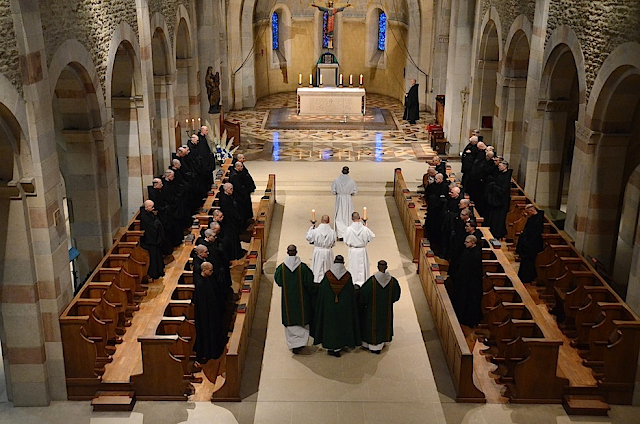
The Reading of the Rule of Saint Benedict for July 14
XXXV DE SEPTIMANARIIS COQUINAE
12 Septimanarii autem ante unam horam refectionis accipiant super statutam annonam singulas biberes et panem,
13 ut hora refectionis sine murmuratione et gravi labore serviant fratribus suis.
14 In diebus tamen sollemnibus usque ad missas sustineant.
15 Intrantes et exeuntes hebdomadarii in oratorio mox matutinis finitis dominica omnibus genibus provolvantur postulantes pro se orari.
16 Egrediens autem de septimana dicat hunc versum: Benedictus es, Domine Deus, qui adiuvasti me et consolatus es me;
17 quo dicto tertio accepta benedictione egrediens, subsequatur ingrediens et dicat: Deus in adiutorium meum intende, Domine ad adiuvandum me festina,
18 et hoc idem tertio repetatur ab omnibus et accepta benedictione ingrediatur.
CHAPTER 35: THE WEEKLY KITCHEN SERVERS
12 An hour before the meal the weekly servers are to receive, over and above the usual allowance, a drink and a piece of bread,
13 so that at meal time they may serve the brothers without murmuring or oppressive exertion.
14 On solemn days, however, they are to wait until after the dismissal.
15 On Sunday as soon as Lauds has ended, both those beginning and those completing their week shall bow before the knees of all, asking for their prayers.
16 The one ending his week is to say this verse: Blessed are you, Lord God, who have helped me and consoled me (Dan 3:52; Ps 86:17);
17 and having said this three times, the one ending his service is to receive the blessing. The one beginning his service then continues, saying: O God, come to my assistance; O Lord, make haste to help me (Ps 70:2),
18 and when this has been repeated three times by all, and having then received the blessing, he is to begin his service.
Today's Celebration of the Mass

Saint Camillus

Jesus is presented before Herod

Jesus XPI Passio sit semper in cordibus nostris
May the Passion of Jesus Christ be always in our hearts

"The Cross is our trophy against the demons, our sword against sin, and the sword Christ used to pierce the serpent. The Cross is the Father's will, the glory of the Only-Begotten, the joy of the Spirit, the pride of the angels, the guarantee of the Church." -St. John Chrysostom








.jpeg)

Comments