Synodal Path causes chaos in German Catholic scout movement
After a fiasco last year when an ardent synodalist was rejected by the Bishops (see background), German scouting now has a new leader.
Maximilian Strozyk becomes the new Federal Curate of the DPSG
Maximilian Strozyk, pastor at the Duisburg youth church Tabgha, has a new nationwide role: The priest of the Diocese of Essen, originally from Bochum and living in Mülheim, is now also involved at the federal level as a pastor for the German Scout Association St. George.

In the end, it was a close race: At the 93rd Federal Assembly of the German Scout Association St. George (DPSG) in Garmisch-Partenkirchen, Bavaria, on Saturday, May 31, 2025, Max Strozyk prevailed in the third round of voting with 40 votes, beating the Bamberg canon lawyer Friedolf Lappen by just one vote. The third candidate, Rebecca Löger da Silva – most recently Diocesan curate of the DPSG in the Diocese of Osnabrück – withdrew her candidacy after the second round of voting. See below: Young, devout, queer.
Strozyk, originally from Bochum and now living in Mülheim, is a youth pastor at the Duisburg youth church Tabgha in the Diocese of Essen and will continue to do so. At the same time, after six years as a curate of the DPSG in the Diocese of Essen, he is now looking forward to strengthening the DPSG board at the federal level as a pastor.
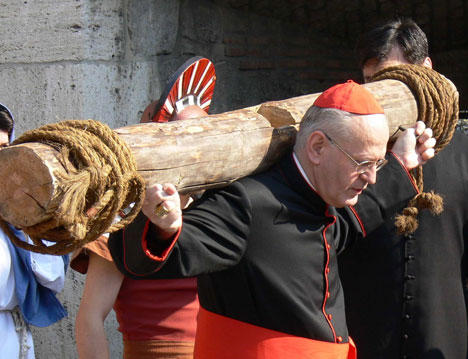
Tabgha- where they split the Cross in two
(They are clearly preparing the schismatics of the future!)
At the current federal assembly, Strozyk advocated, among other things, for further raising the profile of the training of curates in the individual DPSG branches and raising awareness of issues such as spiritual abuse of power. He also wants to support the children, adolescents, and young adults in the Catholic youth association, which has around 95,000 members nationwide, in developing their own spirituality. For joint engagement with the DPSG curates and other interested individuals, he proposes a "Spiritualism Working Group" for the youth association.
In his application, Strozyk also referred to one of the DPSG's images of church: community around the campfire. "This is how I want to experience the association: as a group that gathers around a center that provides warmth, is open to others, and offers space for daydreaming, discussion, and, above all, humanity," Strozyk said. In the coming weeks, the new DSPG federal curate will likely reflect on this image from his application at one or two DPSG group campfires between Flensburg and Oberstdorf.
Background
German bishops surprisingly reject highly qualified applicant: "The last shred of trust has been shattered"
Viola Kohlberger from Augsburg applied for a high-ranking position in the Scouting community; her suitability seemed clear. But then the Permanent Council of German Catholics turned against her. In an interview, Kohlberger spoke with editor Larissa Launhardt about the decision, which no one seems to quite understand.
Viola Kohlberger is 32 years old and is not allowed to take on her dream job because the majority of the 27 most powerful Catholic bishops in Germany opposed her – even though the Augsburg native is apparently highly qualified.
"I feel so powerless," Kohlberger said a few days later in a telephone conversation with editor Larissa Launhardt.
Election of Viola Kohlberger as Federal Curator
In January 2025, the Augsburg native wanted to take over the position of Federal Curator of the German Scout Association Saint George (dpsg), which would have made her the chairwoman, spiritual leader, and thus the face of Germany's largest Scout association with around 85,000 members. She wanted to officially stand for election at the dpsg's Federal Assembly in May as the final step in a long application process. However, the Permanent Council, one of the most important and powerful bodies of the German Bishops' Conference within the Catholic Church, surprisingly voted against the 32-year-old a few days earlier.
The Permanent Council has a say, as the dpsg is a Catholic youth organization and the position is funded by the Catholic Church. However, the approval of the bishops is usually a formality.
Working for the Catholic Church
"I first considered whether this was a position for me last spring, then went through a lot of interviews, and finally decided to run in September 2023," Kohlberger said. He continued:
"I thought long and hard about whether I would serve the Catholic Church. Can I take on the supreme spiritual leadership when I have so much criticism of the church, when I feel so uncomfortable in some church contexts, and when I also know how unfair many things are?"
Despite her reservations, the theologian decided to take on the position, wanting to actively shape things and give her church another chance. In December, she officially began her application, submitted letters of recommendation, had her documents reviewed by the relevant offices, including with regard to her theological suitability. In February 2024, she successfully interviewed the relevant Bishop, Michael Gerber, and subsequently even introduced herself to the relevant committees of the association. A months-long process that cost not only time but also nerves.
Professional Qualifications
On paper, there's nothing wrong with the 32-year-old. She's currently pursuing a doctorate in Catholic Church history, works as a diocesan curate in the Diocese of Augsburg, so she already has experience in spiritual leadership, and has been a "wholehearted" member of the German Catholic Youth (DPSG) for around 25 years. The outcry that followed the Permanent Council's decision against Viola Kohlberger also speaks for itself.
"The Permanent Council's decision is incomprehensible to us in any way. We know Viola as a committed youth organization member, among other things, from our joint work on the Synodal Path, and we appreciate her commitment and enthusiasm. Viola offers our full solidarity!", the Federal Association of the Federation of German Catholic Youth announced.
The Central Committee of German Catholics also wrote on X: "The Presidium of the Central Committee of German Catholics is irritated by the news that Viola Kohlberger has not received the necessary approval (...)." She represents the next generation of Catholics, who are ready to "make our church fit for the future." The decision is incomprehensible.
And, of course, the German Catholic Church (DPSG) also expressed its views, writing on Instagram: "Disappointment, incomprehension, anger... The past week was also marked by a variety of emotions for us as the Federal Executive Board." The association now wants to explore possible next steps together with Kohlberger and discuss the issue with all members at the Federal Assembly. "We hope that together we can find the best possible way to deal with this difficult situation into which the decision of the Permanent Council has placed Viola and our association," the DPSG continued. Numerous others expressed solidarity with Kohlberger via social media, expressing both incomprehension and bewilderment.
Confusion over the bishops' decision
Confusion is also her prevailing feeling at the moment, Kohlberger continued on the phone. "Normally, when the responsible bishop speaks out in favor of a person, the rest of the committee agrees. It's clear that someone might be rejected for formal reasons, but at least in the youth sector, in recent years, no one has been rejected because the person wasn't a good fit and there were personal reasons, so to speak."
The 32-year-old will probably never know the exact reasons, as the permanent council isn't obligated to share arguments for its decision. "That's the typical strategy: they wait it out. And then everyone calms down, everyone has expressed their anger, and then it's back to normal business," Kohlberger said, frustrated. The bishops also specifically requested a secret ballot, so it's not even clear who the men who voted against her were.
Possible Reasons for the Rejection
It seems obvious that the Permanent Council did not want Viola Kohlberger in such a prestigious and influential position. She also appears to be uncomfortable for some bishops. The 32-year-old frequently comments publicly on church politics on Instagram and actively participated in the Catholic reform process, the Synodal Path.
She herself suspects that this has now become her downfall:
"I think it's also about the fact that I have repeatedly publicly criticized individual bishops and, of course, the Bishops' Conference as a whole. Especially bishops who abuse their power, including against me. And I think that especially those men who can no longer separate their office from themselves naturally always see criticism of their office or their conduct as criticism of themselves. And that's extremely difficult."
Kohlberger was always aware of the consequences: "It was completely clear to me when I joined the Synodal Path, and I also deliberately set my Instagram profile to public. I knew I could face consequences, so I didn't go into it so naively."
The Consequences
The fact that such a massive barrier has now been put in place still shocks Kohlberger. "I don't know what to do right now," she says. "I really have to see if I still want to work for the Catholic Church. That was the last piece of trust that's being shattered." A friend of hers left the church in response, and others in her circle of acquaintances are considering doing so.
The DPSG is now without a federal curator; Viola Kohlberger was the only candidate. The permanent council also only meets every few months. A spokesperson for the council explained in response to our editorial team that they generally do not comment on personnel decisions. Therefore, no statement is planned.
The main demands that the 32-year-old from Augsburg always advocates so passionately are: more power sharing, greater gender equality, and access to all offices for all. Issues that probably seem too radical for the majority of German local bishops.
Young, devout, queer
"I won't let them take the Church away from me"
Rebecca Lögers da Silva is 24 years old, a devout Catholic, queer, and she wants to become a pastoral assistant. Despite all the criticism of its structures, the church is her spiritual home. This commitment is also connected to the Boy Scouts.
Enthusiastic Girl Scout: Rebecca Lögers da Silva is a spiritual director of the St. George Scout Association in the Diocese of Osnabrück.
"How am I supposed to live without it? I need it... I cling to it. I allow myself to be humiliated, broken, discriminated against. But I still love it, this church of mine. I can't understand it myself." These lines are just an excerpt from a touchingly tender text that Rebecca Lögers da Silva wrote for her publicly accessible Instagram channel – and it almost seems like a desperate love poem.
There are moments when the 24-year-old is torn: between her "spiritual home" and her doubts about this very church, with its rigid structures and outdated attitudes. She asks herself whether this is (still) the right place for her. For her – a young woman with a feminist background, a critical theology student, and avowedly queer – who refuses to commit to a fixed sexual orientation. And Lögers da Silva knows that this could be precisely the reason why "her" church might reject her and not let her work in "my dream job" as a pastoral assistant. "But leaving would be much more difficult for me than staying," she says.
This has much to do with her commitment to the Girl Scouts and Boy Scouts – this work is both a source of inspiration for Rebecca Lögers da Silva. This calls her to help shape the world and the church – "to talk about God and to live according to what I have understood about her and him." Since summer 2021, she has been a volunteer curator, i.e., spiritual director, of the German Scout Association St. George (DPSG) in the Diocese of Osnabrück: a first, as previously this role had always been held by men with a full-time background. What does she do? Prepare services, offer input for meetings, organize training courses, and collaborate on nationwide projects. And through her office and presence, she demonstrates that this Christian profile is important to the DPSG. Vespers, celebrations of the Word of God, prayers, and daily introductions can look different from the usual liturgical style. "We sometimes try out crazy things," she says with a grin.
"I didn't want to pretend anymore."
The roots of this commitment lie in her hometown of Nordhorn. Influenced by her parents' active involvement in the Catholic parish of St. Mary's and her natural approach to faith, she first joined the camp team as a teenager and then joined the Girl Scout troop there in 2013 – the only DPSG group in the county of Bentheim. And she quickly learned that Girl Scouts do much more than just find the right tree for the right leaf. Climate justice, ecology, sustainability, peace work, gender equality, spirituality, and faith: These are at the top of the association's agenda.
But there are other things that Lögers da Silva appreciates as well. That the association creates a valuable place for young people within the church, "free from performance and where it's not about winning." That it brings children and young people from different backgrounds together, and "they can simply be who they are." That it's simply fun to sit around a campfire in the forest, chatting together, and eating pudding. When she talks about such activities, you can hear her great enthusiasm for the "Scouts" – to whom she eventually no longer wants to deny her bisexuality. "I didn't want to pretend anymore," she says. "After all, I want to be a role model for the children and young people and stand up for what is part of my identity." Even before she joined the nationwide "OutinChurch" initiative at the beginning of this year, she told the group about her sexual orientation and received a lot of support and encouragement afterward.
Ultimately, volunteering for the Scouts also laid the foundation for her future career aspirations to work full-time in the church. "I imagine it would be so incredibly wonderful to be able to accompany people through existential phases of life and in their faith." The Nordhorn native first studied religious studies and English, then switched to a full-time master's degree in theology in Münster. She'll be finished in about two years—then she'd like to enter the diocese and, after her assistantship, work as a pastoral assistant in a parish. "Perhaps in combination with an institution or association," she considers.
"I am loved by God."
The young woman knows that with her stance and her commitment to an open church that truly accepts everyone without prejudice, she might encounter limitations here and there. "I see so many people struggling. Wearing themselves out – maybe even giving up to some extent. I see the walls of the structures. I see people punching holes with little hammers on one side – and then starting to mix filler on the other." But she herself doesn't want to give up; she wants to loudly and visibly contribute to the church project and tear some of the bricks out of this wall. "I won't let them take my church away from me," says Lögers da Silva, sounding almost defiant. "I'm not giving up my passport just because I don't agree with everything in Germany. Instead, I'm trying to make a difference with others."
Then she repeats the phrase about a spiritual home. Where exactly does she find that in the Catholic Church? The student admits that this is, "of course, primarily a vague feeling." But she can certainly pin it down to certain things. When she's celebrating church services with other Girl Scouts and Boy Scouts in Osnabrück, sitting around a campfire, hiking through the forest, planning the next creative activity as a team. When she's connected with the university community in Münster in thanksgiving and intercession. When she's watching a sunset on a beach. When she's dancing through her apartment, laughing as she says a prayer. Then she feels a sense of belonging to a large community, then she experiences God with her and within her. And the more Rebecca Lögers da Silva talks, the more it becomes clear to her: "I am loved by God."





.jpeg)

Comments