Catholic devotions for the 2nd June
Scroll down for today's
Saint of the Day/ Feast
Reading of the Martyrology
Dedication of the Month
Dedication of the Day
Rosary
Five Wounds Rosary in Latin
Seven Sorrows Rosary in English
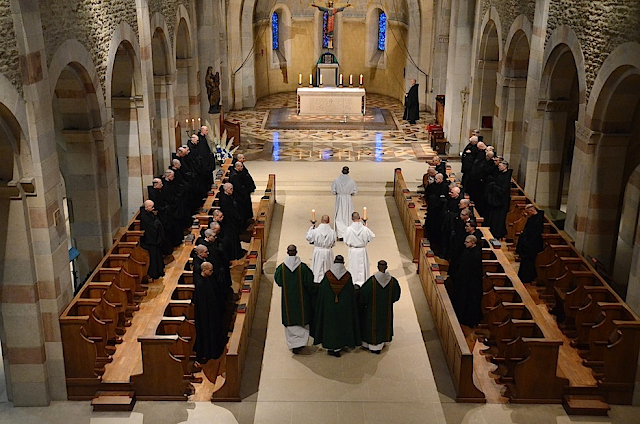
Latin Monastic Office
Reading of the Rule of Saint Benedict
Celebration of Mass
Reading from the School of Jesus Crucified

Nicholas was born at Steiri in Boeotia, Greece, where his solitary life as a shepherd led him to contemplative spirituality, as part of which he developed the constant repetition of the phrase Kyrie Eleison.This brought him conflict and aggression in populated places, and he suffered much oppression.His mother, believing that he was possessed by demons, sent him to live at the Hosios Loukas monastery but the monks became annoyed with his almost insane behaviour, such as the constant exclamation of the Kyrie Eleison, and expelled him.Nicholas then continued to live some life until he was nineteen when he decided to go on a pilgrimage to Rome. In Naupaktos he embarked on a ship to Otranto and spent some time in the Greek-populated regions in Apulia before dying in Trani Veneration[edit] Three years after Nicholas' death, archbishop Bisantius of Trani commissioned the building of a new cathedral dedicated to Nicholas and asked in 1098/99 while participating in the Lateran council Pope Urban II for his permission for the sanctification of Nicholas. Trani Cathedral is dedicated to him, and he is the patron saint of the city.
Source
The Reading from the Martyrology
This Day, the Second Day of June
At Rome, the birthday of the holy martyr Marcellinus, priest, and Peter, exorcist, who instructed in the faith many persons detained in prison. Under Diocletian, they were loaded with chains, and, after enduring many torments, were beheaded by the judge Serenus, in a place which was then called the Black Forest, but which was in their honor afterwards known as the White Forest. Their bodies were buried in a crypt near St. Tiburtius, and Pope St. Damasus composed for their tomb an epitaph in verse.
In Campania, during the reign of Decius, St. Erasmus, bishop and martyr, who was first scourged with leaded whips and then severely beaten with rods; he had also rosin, brimstone, lead, pitch, wax, and oil poured over him, without receiving any injury. Afterwards, under Maximian, he was again subjected to various most horrible tortures at Mola, but was still preserved from death by the power of God for the strengthening of others in the faith. Finally, celebrated for his sufferings, and called by God, he closed his life by a peaceful and holy end. His body was afterwards transferred to Gaeta.
At Lyons, many holy martyrs (Photinus, bishop, Sanctus, deacon, Vetius, Epagathus, Maturus, Ponticus, Biblis, Attalus, Alexander and Blandina, with many others), whose many valiant combats, in the time of Marcus Aurelius Antoninus and Lucius Verus, are recorded in a letter from the church at Lyons to the churches of Asia and Phrygia. St. Blandina, one of these martyrs, though weaker on account of her sex and frame, and of her lower condition in life, encountered longer and more terrible trials. But remaining unshaken, she was put to the sword, and followed those whom she had exhorted to win the palm of martyrdom.
At Rome, St. Eugenius, Pope and confessor.
At Tarni, in Terra-di-Bari, St. Nicholas Peregrinus, confessor, whose miracles were related in the Roman Council, under Urban II.
And elsewhere in divers places, many other holy martyrs, confessors, and holy virgins.
In Campania, during the reign of Decius, St. Erasmus, bishop and martyr, who was first scourged with leaded whips and then severely beaten with rods; he had also rosin, brimstone, lead, pitch, wax, and oil poured over him, without receiving any injury. Afterwards, under Maximian, he was again subjected to various most horrible tortures at Mola, but was still preserved from death by the power of God for the strengthening of others in the faith. Finally, celebrated for his sufferings, and called by God, he closed his life by a peaceful and holy end. His body was afterwards transferred to Gaeta.
At Lyons, many holy martyrs (Photinus, bishop, Sanctus, deacon, Vetius, Epagathus, Maturus, Ponticus, Biblis, Attalus, Alexander and Blandina, with many others), whose many valiant combats, in the time of Marcus Aurelius Antoninus and Lucius Verus, are recorded in a letter from the church at Lyons to the churches of Asia and Phrygia. St. Blandina, one of these martyrs, though weaker on account of her sex and frame, and of her lower condition in life, encountered longer and more terrible trials. But remaining unshaken, she was put to the sword, and followed those whom she had exhorted to win the palm of martyrdom.
At Rome, St. Eugenius, Pope and confessor.
At Tarni, in Terra-di-Bari, St. Nicholas Peregrinus, confessor, whose miracles were related in the Roman Council, under Urban II.
And elsewhere in divers places, many other holy martyrs, confessors, and holy virgins.
Omnes sancti Mártyres, oráte pro nobis.
("All ye Holy Martyrs, pray for us", from the Litaniae Sanctorum, the Litany of the Saints)
June is the Month of the Sacred Heart
.jpg)
Amen.
V. Heart of Jesus once in agony.
R. Pity the dying.
(300 days every time said. Plenary indulgence under the usual conditions if said thrice daily'but at three distinct times during the day'for a month)
(a) V. Praised be Jesus Christ.
R. Amen'or'Forever.
(b) V. Praised be Jesus and Mary.
R. Today and forever.
(c) V. Glory to the Sacred Heart of Jesus.
R. Glory to the immaculate heart of Mary.
(300 days every time any one of the foregoing is said as salutation and answer)*
Graciously grant, O Lord, peace in our times, that, aided by the help of Thy mercy, we may always be free from sin and secure from all disturbance. Through Christ Our Lord. Amen.
(3 years every time said)*
Burn, O Lord, our loins and our hearts with the fire of the Holy Ghost, that we may serve Thee with a chaste body and please Thee with a pure heart. Through Christ Our Lord. Amen.
(3 years every time said)*
The Joyful Mysteries of the Rosary are prayed on Monday
"I would like to remind you that the Rosary is a biblical prayer, all filled with the Holy Scriptures." It is a prayer from the heart, in which the repetition of the Ave Maria directs the thought and affection towards Christ, and thus is made a confident prayer to Him and our Mother. It is a prayer that helps to meditate on the Word of God and assimilate the Eucharistic Communion, on the model of Mary who kept in her heart everything Jesus did and said and even His Presence. " Pope Benedict XVI
The Rosary in Latin
Chaplet of the Five Holy Wounds of Christ in Latin
Chaplet of the Seven Sorrows of Our Lady in English
Latin Monastic Office for today from Le Barroux in France Texts also provided
The Reading of the Rule of Saint Benedict for June 2
From Chapter VII
Quartus humulitatis gradus est, si in ipsa oboedientia duris et contrariis rebus vel etiam quibuslibet inrogatis iniuriis, tacite conscientia patientiam amplectatur et sustinens non lassescat vel discedat, dicente Scriptura: Qui perseveraverit usque in finem, hic salvus erit. Item: Confortetur cor tuum et sustine Dominum. Et ostendens fidelem pro Domino universa etiam contraria sustinere debere, dicit ex persona sufferentium: Propter te morte adficimur tota die, æstimati sumus ut oves occisionis. Et securi de spe retributionis divinæ subsecuntur gaudentes et dicentes: Sed in his omnibus superamus propter eum qui dilexit nos. Et item alio loco Scriptura: Probasti nos, Deus, igne nos examinasti sicut igne examinatur argentum; induxisti nos in laqueum; posuisti tribulationes in dorso nostro. Et ut ostendat sub priore debere nos esse, subsequitur dicens: Inposuisti homines super capita nostra. Sed et præceptum Domini in adversis et iniuriis per patientiam adimplentes, qui percussi in maxillam præbent et aliam, auferenti tunicam dimittunt et pallium, angarizati militario vadunt duo, cum Paulo apostolo falsos fratres sustinent et persecutionem sustinent, et maledicentes se benedicent.
The fourth step in humility is if in that same obedience, though things hard and contrary and
even injuries, no matter of what kind, have been inflicted, he keep patience with a quiet conscience
and enduring grows not weary nor gives in, for Scripture says: “He who perseveres to the end, the
same shall be saved.” And again: “Let thy heart be comforted and wait for the Lord.” And showing
that the faithful man ought for the Lord’s sake to wait patiently, seem all things never so contrary, it
says in the name of the suffering: “For Thy sake we are afflicted all the day; we are accounted as
sheep for the slaughter.”
And they, secure in their hope of divine retribution, gladly follow on and say: “But in all
these things we overcome by Him Who loved us.”
And again in another place: “Thou, O God, hast tested us,” says Scripture, “Thou hast
examined us with fire, as silver is examined with fire. Thou hast led us into the snare, Thou hast
placed troubles upon our back.” And to show that we ought to be under a superior, it follows on,
saying: “Thou hast placed men over our heads.” Moreover, fulfilling the Lord’s command by
patience amid adversities and injuries those struck on the cheek offer the other also; with him who
deprives them of their tunic they leave their cloak in addition; constrained to go a thousand paces,
they go two thousand; with Paul the Apostle, they endure false brethren and bless those that curse
them.
Today's Celebration of the Mass

Blessed Sadoc and Companions from the Martyrology
Jesus XPI Passio sit semper in cordibus nostris
May the Passion of Jesus Christ be always in our hearts






.jpeg)

Comments