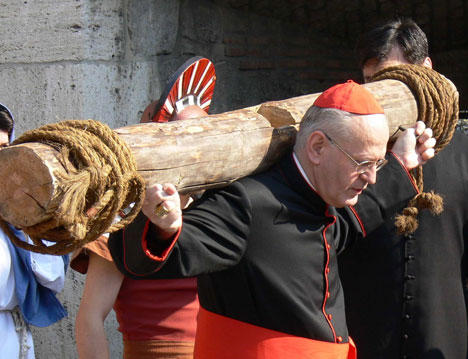
Cardinal Schönborn, Papal delegate to 350th Anniversary of the Black Madonna of Cologne. The Madonna was saved, many would say miraculously, from Allied bombing in 1942.
The Chapel of Mary in Kupfergasse is a center of popular piety in Cologne. The "Black Madonna" there has survived crises and wars. It will soon celebrate its anniversary, and the Pope is sending a Cardinal.

Pope Leo XIV has appointed Viennese Cardinal Christoph Schönborn (80) as his special envoy for the anniversary celebrations of Cologne's Chapel of Grace, "Mary in Kupfergasse." The Vatican Press Office announced this on Saturday. The church, with its "Black Madonna," venerated in Cologne and far beyond, will celebrate the 350th anniversary of its consecration on September 14.
As the "Mother of Mercy," the statue of the Virgin Mary, which survived the heavy bombings of World War II unscathed, has long played a central role in Rhineland popular piety – even beyond the Catholic Church.
Marian Festival Week of the Black Mother of God 2020
(NB. This is the new Rite but in Latin. The English subtitles work for the Sermon in German but go crazy when it comes to the Canon of the Mass in Latin)
Some history
The veneration of the Black Madonna in Kupfergasse has a long tradition in Cologne. At any time of year and day, and for all kinds of needs, many people light a candle and recite a prayer, trusting in its help.
How did it come about - a look into history
Even in Roman times, the area belonged to the City of Cologne. During the turmoil of the Thirty Years' War, from which Cologne was largely spared, devout Catholics left neighboring areas and fled to Cologne, which had preserved the Catholic faith and where they were safe.
Thus, in the early 1630s, five daughters of Saint Teresa of Avila, so-called Discalced Carmelites, came here from Holland. In 1635, they acquired the Neuenahrer Hof in Kupfergasse, which was formerly owned by Protestants, as Cologne was also a nucleus of Protestantism.
More sisters continually joined, and eventually they dedicated their convent, built in 1660, to the Blessed Virgin Mary, Saint Joseph, and Saint Teresa of Avila (hence the figure in the gable façade).
From 1673 to 1675, a Loreto Chapel was built there to venerate the Mother of God and was consecrated on September 8, 1675.
The chapel was built according to the original dimensions of the House of the Holy Family in Loreto and offered believers who could not travel to Italy the opportunity to make a pilgrimage to their homeland and venerate the Holy Family there.
Since 1675, the Black Madonna has been continuously publicly venerated here in the Loreto Chapel. The miraculous image (Image 2) has a rich history, but its origin and age cannot be determined with certainty. It is carved from dark linden wood or has darkened over time. The exact details are unknown, but many interpretations are possible. What is certain is that she has been publicly venerated at this location since 1675, and since then, an eight-day festival has been held annually, beginning on September 8th.
Since then, pilgrims have come from near and far to pray to the "Mother of Mercy" at this spot—the title by which she is venerated—in times of great need and sorrow, and to light a candle in their prayers.
It has also become a tradition for the Cologne Triumvirate to visit the Black Madonna every year on Carnival Sunday to request her blessing for the Rose Monday procession.
Thus, their veneration has been an integral part of Cologne's religious traditions for almost 350 years, regardless of denomination.
It was only later, between 1705 and 1715, that a Church in honor of Saint Joseph was built on this site (the statue of Joseph in the side aisle commemorates this) and was again consecrated on September 8th.
Unrestful times began in Cologne under French rule. Cologne was incorporated into the French Republic in 1797, the Archdiocese of Cologne ceased to exist, and like many others, the Carmelite convent in Kupfergasse, including the Chapel of Grace, was dissolved in 1801. The church, chapel, and convent were closed and no longer accessible. Today, only the resting place of the Carmelites in the cloister of the church remains as a reminder of the monastic era.
In 1803, the Church was granted the status of an independent parish.
The first years of the new parish of St. Mary in Kupfergasse were characterized by such a boom in religious life that countless Holy Masses were celebrated daily at the altar of the miraculous image and at the other altars of the church.
In 1828, the Cellite Sisters of St. Augustine were able to take over the monastery, which had been dissolved in 1802. There was even a replica of the Black Madonna, which could be borrowed from the Cellite Sisters as the so-called Madonna of the Sick, to be placed in the sickroom in cases of serious illness.
In 1853, Adolph Kolping, a fervent devotee of the Black Madonna and a frequent worshipper in the chapel, founded the first journeymen's house on Breite Straße. Kolping received significant support from the parish clergy of St. Mary in Kupfergasse.
Since the construction of residential buildings led to a huge increase in the number of parishioners, a school was also built in Schwalbengasse that year; there had already been one previously.
In 1873, the Church was given a side aisle to accommodate the large number of churchgoers.
In 1925, during the Holy Year, the Black Madonna was crowned with a miniature of the papal crown on the occasion of the 250th anniversary of the Chapel of Grace by order of Pius XI. (The Black Madonna still wears this crown today, alternating with a Baroque-style crown.) The ceremony took place in Cologne Cathedral, which could barely accommodate the crowds.
During World War II, people turned their attention back to God, and the ever-growing number of churchgoers brought their prayers to the "Mother of Mercy" during the evening Marian devotions, which still take place today.
In the terrible "Night of the 1,000 Bombers" on May 30/31, 1942, a third of the houses, as well as the church, the monastery, and the associated buildings, were destroyed (Image 5). At the last second, the miraculous image was saved by Sister Marzella Schui. It was not until 1948 that the Black Madonna returned to the partially restored chapel.
She wrote a book about the saving of the Black Madonna

Cellite Sisters
In 1630, the miraculous image of Saint Teresa of Avila was brought to Cologne by five sisters fleeing Holland. Here, they – now a group of 20 sisters – acquired the property on Kupfergasse (today Schwalbengasse), where they began construction of the convent in 1660. In 1675, the Chapel of Grace was completed, where the miraculous image has been located and continuously venerated since September 8 of that year. In the wake of the French Revolution, the Carmelites were finally forced to flee Cologne in 1798. In 1802, the monastery church of St. Mary in Kupfergasse was separated from the parish of St. Columba and established as the parish church of a new auxiliary parish.
On November 26, 1828 – according to the parish chronicle – the Cellit Sisters of St. Augustine (12 sisters) of the suppressed monasteries "To the Holy Trinity" and "To the Cell," the monastery suppressed by the French in 1802. The motherhouse of the order was located here until 1943. Early on, the sisters increasingly devoted themselves to charitable work. In 1861, they built a hospital ward where 12 poor and helpless women could receive free care. In the following years, branches were founded in Krefeld, Bad Münstereifel, and Uerdingen. In total, the Cellites established 51 branches between 1865 and 1928. During the Austro-Prussian War (1866) and the Franco-Prussian War (1870/71), they cared for the wounded and dying. In the parishes where they are located, they provide outpatient nursing care, care for the elderly and the infirm, childcare for children not yet of school age, and work in nursing, household management, and administration in hospitals, children's homes, etc.
The work of Sister Marzella Schui should not go unforgotten or unmentioned. On May 30, 1942, the penultimate day of the month of Mary, Cologne experienced the greatest fire disaster of the Second World War due to enemy air raids. The hail of bombs never ceased, and soon the reports came: the church and rectory – as well as the houses on the opposite side of Schwalbengasse – were in flames. After Chaplain Hambüchen and the sexton managed to save the Blessed Sacrament and some vestments, Sister Marzella climbed onto the altar, on which the miraculous image of the Black Madonna stood, opened the glass shrine, shouldered the Madonna of Grace, and carried her out of the burning church. That night, the church was completely destroyed, and without the sister's rescue, the miraculous image would have been destroyed by the flames and irretrievably lost. The motherhouse also partially fell victim to the flames, and only a few items could be saved. The sisters had to be accommodated in other houses for a while, returning later for a short time until the motherhouse was finally completely destroyed on May 29, 1943. Many sisters, along with parishioners and other Cologne residents, helped rebuild the church, the Chapel of Grace, and the convent. As early as 1948, the sisters moved back into a small, temporary settlement in the ruins of Schwalbengasse. Initial plans called for the motherhouse to move back here as well, but it was relocated to Fischenich from 1943 to 1959, but these plans soon fell apart. Instead, a building was constructed that now houses cells for some of the sisters, and from 1952 onward, a senior citizens' home.
In 2019, the last three active Cellite sisters will leave the retirement home and return to their mother house in Cologne-Longerich. Some of the Cellite sisters will remain here until 2020 as residents of the nursing wards, before eventually returning to the mother house.
The Community are Augustinians and a restoration of the Beguine movement. They live on but much reduced in numbers. The full history here ; their growth was stopped by the Council in 1964, as it says.
The great late Cardinal Stickler celebrating a Latin Mass in Cologne, but not in this Church.








.jpeg)

Comments