Catholic devotions for 16th August
Scroll down for today's
Saint of the Day/ Feast
Reading of the Martyrology
Dedication of the Month
Dedication of the Day
Rosary
Five Wounds Rosary in Latin
Seven Sorrows Rosary in English
Latin Monastic Office
Reading of the Rule of Saint Benedict
Celebration of Mass
Reading from the School of Jesus Crucified

Feast of Saint Joachim, Father of Our Lord's Mother
The story of Joachim, his wife Anne (or Anna), and the miraculous birth of their child Mary, the mother of Jesus, was told for the first time in the 2nd-century apocryphal infancy-gospel the Gospel of James (also called the Protoevangelium of James). Joachim was a rich and pious man, who regularly gave to the poor; however, Charles Souvay, writing in the Catholic Encyclopedia, says that the idea that Joachim possessed large herds and flocks is doubtful. At the temple, Joachim's sacrifice was rejected, as the couple's childlessness was interpreted as a sign of divine displeasure. Joachim consequently withdrew to the desert, where he fasted and did penance for 40 days. Angels then appeared to both Joachim and Anne to promise them a child.
Joachim later returned to Jerusalem and embraced Anne at the city gate, located in the Walls of Jerusalem. An ancient belief held that a child born of an elderly mother who had given up hope of having offspring was destined for great things. Parallels occur in the Hebrew Bible in the case of Sarah, the wife of Abraham and mother of Isaac; Hannah, the mother of Samuel; and in the New Testament in the case of the parents of John the Baptist. The cycle of legends concerning Joachim and Anne was included in the Golden Legend (around 1260) by Jacobus de Voragine. This cycle remained popular in Christian art until the Council of Trent (1545–1563) restricted the depiction of apocryphal events.
No liturgical celebration of Saint Joachim was included in the Tridentine calendar. It was added to the General Roman Calendar in 1584, for celebration on 20 March, the day after the feast day of Saint Joseph. In 1738, it was transferred to the Sunday within the Octave of the Assumption of Mary. As part of his effort to allow the liturgy of Sundays to be celebrated, Pope Pius X (term 1903–1914) transferred it to 16 August, the day after the Assumption, so Joachim may be remembered in the celebration of Mary's triumph.
On May 28, 1906, Pope Saint Pius X introduced the indulgence of 300 days, that can be obtained once a day, for each invocation of "Saint Joachim, spouse of Saint Anne and father of the Blessed Virgin".
The feast was then celebrated as a Double of the Second Class, a rank that was changed in 1960 to that of Second Class Feast. The Eastern Catholic Churches commemorate Joachim on 9 September, the Synaxis of Joachim and Anne, the day after the Nativity of Mary.
Semen est sanguis Christianorum
The blood of Christians is the seed of the Church
Tertullian, Apologeticum, 50
The Reading from the Martyrology
This Day, the Sixteenth Day of August
St. Joachim, father of the Most Blessed Virgin Mary, whose birthday is the 20th of March.
At Rome, St. Titus, deacon, who, when the city was taken by the Goths, was put to death by a barbarous tribune, whilst distributing money to the poor.
At Nicaea, in Bithynia, St. Diomedes, physician, who underwent martyrdom for the faith of Christ by being beheaded, during the persecution of Diocletian.
Also, thirty-three holy martyrs.
At Ferentino, in Campania, St. Ambrose, centurion. In the persecution of Diocletian, he was subjected to different kinds of tortures, and finally passing through fire without injury, was cast into the water, and thus reached the place of eternal rest.
At Milan, the demise of St. Simplician, bishop, renowned by the testimony given of him by St. Ambrose and St. Augustine.
At Auxerre, St. Eleutherius, bishop.
At Nicomedia, St. Arsacius, confessor. Under the persecutor Licinius, he left the military service, and leading a solitary life, became so famous for working miracles, that we read of his expelling the demons and killing a huge dragon by his prayers. Finally he foretold the destruction of the city, and gave up his soul to God in prayer.
In France, near Montpelier, the demise of blessed Roch, confessor, who by the Sign of the Cross, delivered many cities of Italy from an epidemic. His body was afterwards transferred to Venice, and deposited with the greatest honors in the church dedicated under his invocation.
At Rome, St. Serena, who had been the wife of the emperor Diocletian.
And elsewhere in divers places, many other holy martyrs, confessors, and holy virgins..
Omnes sancti Mártyres, oráte pro nobis.
("All ye Holy Martyrs, pray for us", from the Litaniae Sanctorum, the Litany of the Saints)
August is the Month of the Immaculate Heart of Mary

Composed by Saint John Henry Cardinal Newman, shortly after his reception into the One, True Fold of the Redeemer
Saturday is the Day dedicated to The Blessed Virgin and her Immaculate Heart.
Saturdays are, traditionally, the days Catholics go to Confession in preparation for receiving the Eucharist on Sundays (some Catholics might make a habit of going to Confession on Saturdays; other might go before Mass on Sunday, and, of course, as always, whenever needed). Also on Saturdays, many Catholics make what is called the "First Saturdays Devotion" which entails going to Mass and receiving Communion on the first Saturday of the month for 5 consecutive months in reparation to the Immaculate Heart of Mary. See Devotion to the Immaculate Heart of Mary.
The Glorious Mysteries of the Rosary are prayed on Saturday
"I would like to remind you that the Rosary is a biblical prayer, all filled with the Holy Scriptures." It is a prayer from the heart, in which the repetition of the Ave Maria directs the thought and affection towards Christ, and thus is made a confident prayer to Him and our Mother. It is a prayer that helps to meditate on the Word of God and assimilate the Eucharistic Communion, on the model of Mary who kept in her heart everything Jesus did and said and even His Presence. " Pope Benedict XVI
The Rosary in Latin
Chaplet of the Five Holy Wounds of Christ in Latin
Chaplet of the Seven Sorrows of Our Lady in English
Latin Monastic Office for today from Le Barroux in France Texts also provided
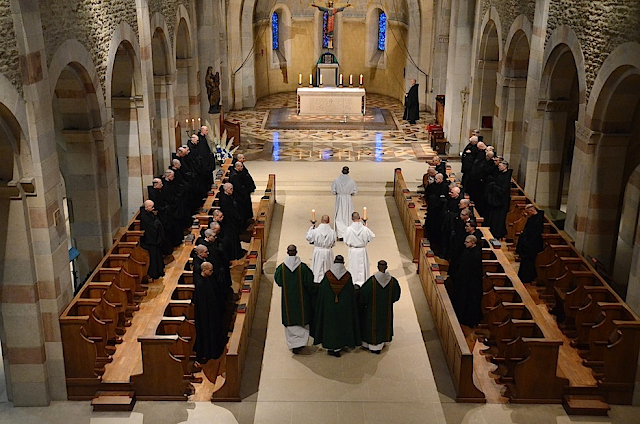
The Reading of the Rule of Saint Benedict for August 16
LXI DE MONACHIS PEREGRINIS, QUALITER SUSCIPIANTUR
6 Quod si superfluus aut vitiosus inventus fuerit tempore hospitalitatis, non solum non debet sociari corpori monasterii,
7 verum etiam dicatur ei honeste ut discedat, ne eius miseria etiam alii vitientur.
8 Quod si non fuerit talis qui mereatur proici, non solum si petierit suscipiatur congregationi sociandus, 9 verum etiam suadeatur ut stet, ut eius exemplo alii erudiantur,
10 et quia in omni loco uni Domino servitur, uni regi militatur.
11 Quem si etiam talem esse perspexerit abbas, liceat eum in superiori aliquantum constituere loco.
12 Non solum autem monachum, sed etiam de suprascriptis gradibus sacerdotum vel clericorum stabilire potest abbas in maiori quam ingrediuntur loco, si eorum talem perspexerit esse vitam.
13 Caveat autem abbas ne aliquando de alio noto monasterio monachum ad habitandum suscipiat sine consensu abbatis eius aut litteras commendaticias,
14 quia scriptum est: Quod tibi non vis fieri, alio ne feceris.
CHAPTER 61: HOW VISITING MONKS ARE RECEIVED
6 But if during that time he was found to be fussy or prone to vice, not only should he be refused membership in the community,
7 but he should also be courteously told to depart, lest others be corrupted by his misery.
8 If, however, he is not the sort who deserves to be sent away, he should not only be received at his request into membership with the community;
9 he should, rather, be persuaded to stay so that by his example others may be taught,
10 because in every place we serve one Lord and fight under one King.
11 And if the abbot perceives that he is of this kind, he may put him in a somewhat higher place.
12 Not only a monk, but also one from the aforementioned grades of priests or clerics may be established by the abbot in a higher place than that of their time of entrance, if he perceives that their life merits it.
13 But the abbot must be careful never to receive permanently a monk from another known monastery without the consent of his abbot or letters of recommendation,
14 for it is written: What you do not want done to yourself, do not do to another (Tob 4:16).
Today's Celebration of the Mass
Also today
.jpg)


.jpg)
.jpg)


Saint Roche
(See Scuola Grande di San Rocco, in the heart of Venice)
and
.jpg)
Blessed Angelus Agostini Mazzinghi
Jesus is scourged at the pillar

Jesus XPI Passio sit semper in cordibus nostris
May the Passion of Jesus Christ be always in our hearts

"The Cross is our trophy against the demons, our sword against sin, and the sword Christ used to pierce the serpent. The Cross is the Father's will, the glory of the Only-Begotten, the joy of the Spirit, the pride of the angels, the guarantee of the Church." -St. John Chrysostom






.jpeg)

Comments