Catholic devotions for 22nd June
Scroll down for today's
Saint of the Day/ Feast
Reading of the Martyrology
Dedication of the Month
Dedication of the Day
Rosary
Five Wounds Rosary in Latin
Seven Sorrows Rosary in English
Latin Monastic Office
Reading of the Rule of Saint Benedict
Celebration of Mass
Reading from the School of Jesus Crucified

Feast of Saint Paulinus of Nola
Paulinus of Nola (/pɔːˈlaɪnəs/; Latin: Paulinus Nolanus; also anglicized as Pauline of Nola;[2] c. 354 – 22 June 431) born Pontius Meropius Anicius Paulinus, was a Roman poet, writer, and senator who attained the ranks of suffect consul (c. 377) and governor of Campania (c. 380 – c. 381) but—following the assassination of the emperor Gratian and under the influence of his Hispanic wife Therasia of Nola—abandoned his career, was baptized as a Christian, and probably after Therasia's death became bishop of Nola in Campania. While there, he wrote poems in honor of his predecessor Saint Felix and corresponded with other Christian leaders throughout the empire. He is credited with the introduction of bells to Christian worship and helped resolve the disputed election of Pope Boniface I. His renunciation of his wealth and station in favor of an ascetic and philanthropic life was held up as an example by many of his contemporaries—including Augustine, Jerome, Martin, and Ambrose—and he was subsequently venerated as a saint. His relics became a focus of pilgrimage, but were removed from Nola sometime between the 11th and 20th centuries. His feast day is observed on 22 June in both the Roman Catholic and Eastern Orthodox Churches. In Nola, the entire week around his feast day is celebrated as the Festival of the Lilies.
The Reading from the Martyrology
This Day, the Twenty Second Day of June
At Nola, in Campania, the birthday of blessed Paulinus, bishop and confessor, who, although a most noble and wealthy man, made himself poor and humble for Christ; and what is still more admirable, became a slave to liberate a widow's son, who had been carried to Africa by the Vandals, when they devastated Campania. He was celebrated, not only for his learning and exceptional holiness of life, but also for his power over the demons. His great merit has been extolled by Saints Ambrose, Jerome, Augustine and Gregory, in their writings. His body, at first transferred to Benevento, and thence to Rome, was restored to Nola by order of Pius X.
At Rome, blessed Innocent V, Pope, who labored with mildness and prudence to maintain liberty for the Church and harmony among Christians. The veneration paid to him, Pope Leo XIII approved and confirmed.
On Mount Ararat, the martyrdom of ten thousand holy martyrs, who were crucified.
At Verulam, in England, in the time of Diocletian, St. Alban, martyr, who gave himself up to save a cleric whom he had harbored. After being scourged and subjected to bitter torments, he was sentenced to capital punishment. With him suffered also one of the soldiers that led him to execution, who was converted to Christ on the way, and merited to be baptized, in his own blood.
At Samaria, fourteen hundred and eighty holy martyrs, under Chosroes, king of Persia.
At Rome, the translation of St. Flavius Clemens, ex-consul and martyr, who was put to death for the faith of Christ by the emperor Domitian. His body was found in the basilica of Pope St. Clement, and buried there with great pomp.
The same day, St. Nicaeas, bishop of the town of Bomatia, celebrated for his learning and holy life.
At Naples, in Campania, St. John, bishop, who was called to the kingdom of Heaven by blessed Paulinus, bishop of Nola.
In the monastery of Cluny, St. Consortia, virgin.
At London in England, on Tower Hill, St. John Fisher, bishop of Rochester and cardinal of the Holy Roman Church. For the defense of the Catholic faith and the primacy of the Roman Pontiff he was beheaded by order of King Henry VIII.

And elsewhere in divers places, many other holy martyrs, confessors, and holy virgins.
Omnes sancti Mártyres, oráte pro nobis.
("All ye Holy Martyrs, pray for us", from the Litaniae Sanctorum, the Litany of the Saints)
June is the Month of the Sacred Heart
.jpg)
Amen.
V. Heart of Jesus once in agony.
R. Pity the dying.
(300 days every time said. Plenary indulgence under the usual conditions if said thrice daily'but at three distinct times during the day'for a month)
(a) V. Praised be Jesus Christ.
R. Amen'or'Forever.
(b) V. Praised be Jesus and Mary.
R. Today and forever.
(c) V. Glory to the Sacred Heart of Jesus.
R. Glory to the immaculate heart of Mary.
(300 days every time any one of the foregoing is said as salutation and answer)*
Graciously grant, O Lord, peace in our times, that, aided by the help of Thy mercy, we may always be free from sin and secure from all disturbance. Through Christ Our Lord. Amen.
(3 years every time said)*
Burn, O Lord, our loins and our hearts with the fire of the Holy Ghost, that we may serve Thee with a chaste body and please Thee with a pure heart. Through Christ Our Lord. Amen.
(3 years every time said)*
Sunday is the Day dedicated to Resurrection & the Holy and Undivided Trinity
Prayers for Every Day of the Week
The Athanasian Creed in English
The Athanasian Creed in Latin
The Glorious Mysteries of the Rosary are prayed on Sunday
"I would like to remind you that the Rosary is a biblical prayer, all filled with the Holy Scriptures." It is a prayer from the heart, in which the repetition of the Ave Maria directs the thought and affection towards Christ, and thus is made a confident prayer to Him and our Mother. It is a prayer that helps to meditate on the Word of God and assimilate the Eucharistic Communion, on the model of Mary who kept in her heart everything Jesus did and said and even His Presence. " Pope Benedict XVI
The Rosary in Latin
Chaplet of the Five Holy Wounds of Christ in Latin
Chaplet of the Seven Sorrows of Our Lady in English
Latin Monastic Office for today from Le Barroux in France Texts also provided
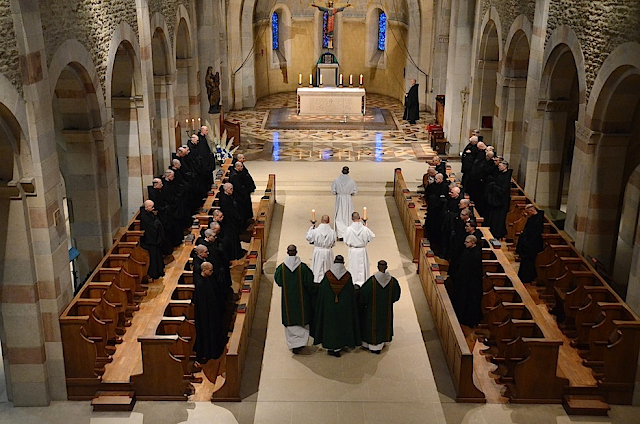
The Reading of the Rule of Saint Benedict for June 22
XVIII QUO ORDINE IPSI PSALMI DICENDI SUNT
1 In primis dicatur versu Deus in adiutorium meum intende, Domine ad adiuvandum me festina, gloria, inde hymnum uniuscuiusque horae.
2 Deinde, prima hora dominica, dicenda quattuor capitula psalmi centesimi octavi decimi;
3 reliquis vero horis, id est tertia, sexta vel nona, terna capitula suprascripti psalmi centesimi octavi decimi dicantur.
4 Ad primam autem secundae feriae, dicantur tres psalmi, id est primus, secundus et sextus;
5 et ita per singulos dies ad primam usque dominica dicantur per ordinem terni psalmi usque nonum decimum psalmum, ita sane ut nonus psalmus et septimus decimus partiantur in binos.
6 Et sic fit ut ad vigilias dominica semper a vicesimo incipiatur.
CHAPTER 18: IN WHAT ORDER THE PSALMS ARE TO BE SAID
1 At the beginning this verse is to be said: O God, come to my assistance; O Lord, make haste to help me (Ps 70:2) with a “Glory be”, followed by the hymn proper to each hour.
2 Then at Prime on Sunday four sections of Psalm 118 are said:
3 at the other hours, that is, Terce, Sext and None, three sections of this aforementioned psalm 118 are said.
4 But at Prime on Monday three psalms are said: Psalms 1, 2, and 6;
5 and so at Prime each day until Sunday three psalms are said in order up to Psalm 20 - psalms 9 and 17 being each divided in two.
6 And so in this way Vigils on Sunday will always begin with Psalm 20.
Today's celebration of Mass


Jesus XPI Passio sit semper in cordibus nostris
May the Passion of Jesus Christ be always in our hearts






.jpeg)

Comments