Cardinal Ruini: "We must return the Church to Catholics. At its centre is Christ, not the Pope"
Ruini: "We must return the Church to Catholics. At its centre is Christ, not the Pope"
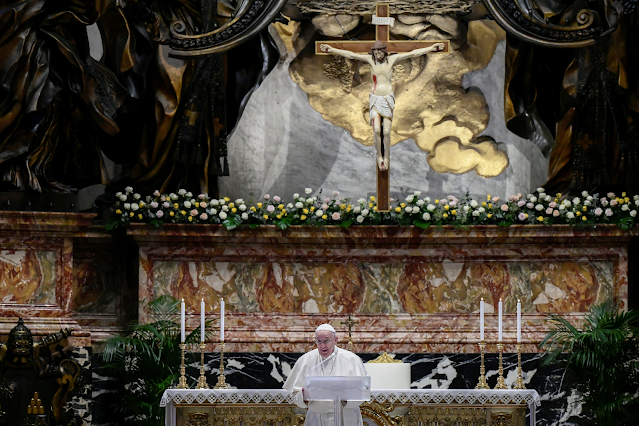
The cardinal outlines a profile of the future Pontiff based on the challenges that the Church will have to face, starting with the reconstruction of its unity: "We will need a good Pope, a deeply religious person, with a governing attitude and charity also in the management of ecclesial institutions"
The point is not who the new Pontiff will be, but how he will be able to interpret the challenges that arise for the Church, whose central element, he recalls, "is Christ, not the Pope. Otherwise, a problem arises". In a long interview with Corriere della Sera, Cardinal Camillo Ruini, 94, brings back to the basics the reflections that are piling up on the eve of the Conclave, warning that excessive personalization of the Pope risks overshadowing them and therefore being misleading and generating a divisive dynamic that distances the faithful and frays the ecclesial ranks. "At the death of Wojtyla, people shouted 'sainthood now', while at the death of Bergoglio they shouted 'thank you Francis'. Now, if the transcendent dimension is overshadowed, a good service is not rendered to the Church", said Ruini, who due to his age is not among the cardinal electors.
What the new Pope should be like according to Ruini
It is in this vision that Ruini's reasoning on what the next Pontiff should bring is rooted. "We will need a good Pope, who is a profound believer, endowed with an aptitude for government matters, capable of dealing with a very delicate and very dangerous international phase. And we will need a charitable Pope. Charitable also in the management of the Church", explained the former president of the CEI, for whom the new Pope "can come from anywhere in the world. Usually Italians have the advantage of being less conditioned by their origins. They are more universalist". "This does not mean that others would not be able to respond better to the needs of the Church. This is the ultimate criterion", he clarified, explaining that it is useless to worry about predictions, since "it is always and only the Conclave that counts".
The need to "return the Church to Catholics, while maintaining openness to all"
"We must return the Church to Catholics, while maintaining openness to all", he added, underlining that "the funeral gave the impression that the main problem of the pontificate has been resolved, that is, the division of the Church, which in some way involved Bergoglio himself. Unfortunately, the division has remained, with the paradox that those in favor of Francis are mostly lay people while those against him are often believers". Pope Francis, he continued, "with a missionary intention had addressed himself above all to those who were distant, in ways that irritated those who for years had devoted themselves to defending Catholic positions. In other words, Francis seemed to favor those who were distant to the detriment of those who were close. It is an evangelical gesture. But as in the parable of the prodigal son the other son protested, so today there are those who protest in the Church". In this scenario, which sees the division between "those who want to maintain traditional values and those who want to open up to today's world" it is necessary to "act with prudence, perhaps to do both things". "Unfortunately - he specified - the population perceived a clear choice by Bergoglio towards openness to novelties. And many rejected him in order to remain faithful to their convictions".
The Cardinal's warning: "We cannot be satisfied with a problematic faith"
For Ruini, the hypothesis of a schism, which has occasionally surfaced in recent years, "is outside the spirit of the times". Furthermore, "the dialectic between conservatives and progressives is healthy, but - is the warning - if it becomes radicalized and pathological, even without schisms it can have devastating effects, paralyzing the life of the Church". There is however a more insidious issue, "not very visible from the outside" and that moves "deep down": the contestation of the "cornerstones" of the "Catholic form of the Church": "Adherence to doctrine" and "ecclesial structures, starting with the papacy and the episcopate". If they are not understood, if they are questioned "the certainty of the Truth is undermined and the joy of faith is taken away". "We cannot be satisfied with a problematic faith", the cardinal clarified, explaining to Francesco Verderami, who signed the interview, that "those theologians who take positions contrary to Catholic orthodoxy" are a symptom of these pitfalls.
Bergoglio's "great merit" on doctrinal questions
Ruini then focused on doctrinal issues, on their centrality. "Certain statements by Pope Francis could give the impression of great openness, such as the famous “who am I to judge”, referring to homosexual people, which seemed to prelude profound doctrinal changes. On other aspects, however, he went in the opposite direction, managing — and this is one of his great merits that no one talks about — to neutralize the ecclesial contestation on the most acute points: from the hypothesis of women priests to the illicitness of abortion, for which he used very strong words, which no one had dared to pronounce before him. Thus, in recent years, sympathy for him has diminished in the most radical ecclesial areas".
Francis and ecclesial institutions: "He wanted to purify, not deconstruct"
Thus the cardinal indicates as "a challenging task that lies before us" also the need to "rebuild the unity of the Church, especially the unity around the Pope, who is the point of reference for the Catholic community". Another "very delicate" issue is that of the "partial deconstruction of our institutions. This also happened because, faced with pre-existing difficulties, especially in the Curia, the Pope tried to find a solution". But, Ruini specified, "in my opinion Bergoglio wanted to purify, not deconstruct. Let us think of the enormous problem of pedophilia, which Benedict XVI also had to deal with".
"Charity must also be expressed in the Church"
In any case, "his (the new Pontiff, ed.) priority should still remain that of “feeding the flame of faith that in many areas of the world threatens to be extinguished”", Ruini clarified, quoting Pope Ratzinger to represent "the fundamental challenge that awaits us": "And it is not a given that the new Pope will be able to overcome it". But to succeed he will certainly have to rely on the "announcement of faith and the testimony of charity: it is because of the charity practiced by the Church that people love and trust it. Francis has worked hard on this. However, charity must also be expressed in ecclesial institutions, avoiding certain useless harshness that is not in accordance with the government of that singular reality that is the Church, with its fundamental law: love, forgiveness, understanding". However, was Ruini’s conclusion, in the end "everything depends on the mercy of the Lord"





.jpeg)

Comments